Widespread confusion and despair gripped the Beduin village of Tuba Zanghariya
on Tuesday, following the torching of a local mosque Sunday night – an act
suspected of being a “price tag” operation by Jewish extremists.
“What I
can’t understand is why us? Why of all places would they come here?” asked
resident Dr. Muhammad al-Haib, in a plaza outside the scorched entryway of the
al-Noor mosque.
RELATED: Police up security at mosques after 'price tag' hit 4 youths from Tuba Zangaria arrested for rioting
In a common sentiment expressed Tuesday, al-Haib said the
people of the village are “completely Israeli” and see themselves as having a
shared fate with their Jewish neighbors in the surrounding towns.
Al-Haib
said the villagers celebrate Independence Day and do not identify with the
“Nakba,” the Palestinian day that mourns the founding of the State of
Israel.
Like others, al-Haib also expressed a sense of bewilderment and
surprise at the suspected arson, rather than a desire for revenge.
“When
this happened, people were very angry and asked: ‘Why us?’ We’re together, we’re
not fighting one another here. We serve together [in the IDF], we live together,
we’re very close. Somebody wrote ‘revenge’ on the wall, but why do you
want revenge on me?”
Al-Haib, who serves as the Education Ministry’s national
director for education in the Beduin sector, described the village as completely
cut off from the greater Arab sector in Israel, with the closest Arab villages
over half an hour away, much farther than Rosh Pina, only a couple kilometers
away.
While the police investigation of the arson is still ongoing, it is
widely suspected to have been a “price tag” operation – the name given to acts
of vandalism or violence carried out by Jewish extremists following state
actions against settlement construction.
In early September, mosques in
the West Bank towns of Yatma and Quasara were vandalized with graffiti reading
“price tag” following the demolition of three homes in the Migron
settlement. No one has been charged in connection with those acts of
vandalism.
Outside the al-Noor mosque on Tuesday, tables with dates and
coffee were set up in front of dozens of plastic chairs, in a scene reminiscent
of a Muslim “mourning tent.” In several of the chairs sat Jews from kibbutzim
and towns of the surrounding area of the Galilee, who came to pay their respects
and show solidarity.
One of those present, Yossi Shani of Kibbutz Amiad,
said he has known villagers from Tuba Zanghariya all of his life – in particular
during his army service when he said he knew villagers who served as combat
scouts.
“We’ve had years of great ties with them and never any problems.
When we heard that this happened, we wanted to show that we are with them,”
Shani said.
Many of the residents of the village, made up almost entirely
of Beduin from the al-Haib and Zanghariya tribes, had relatives who fought in
the “Palhaib,” a unit of the pre-state military organization the Palmach made up
primarily of Beduin from Tuba.
According to the Palmach Information
Center website, and residents of the village, the head of the al-Haib tribe
Sheikh Ismail Abu-Yosef entered a “blood pact” between the 400 members of the
tribe and the Jews of pre-state Israel ahead of the War of
Independence.
According to the website, during the Palmach’s “Operation
Broom” in 1947, in which the military force carried out a series of raids to
clear out Beduin villages between the Sea of Galilee and Lake Hula, Palmach
commander Yigal Alon gave the command not to take action against the al-Haib
tribe. Today, the road leading from the center of town to the mosque bears
Alon’s name.
The town’s long history of service to Israel seems to make it a bizarre
location for a price tag operation. This history of service is possibly
most apparent at the local
cemetery, where a state-built monument stands in honor of 13 soldiers
from the
village who fell in duty.
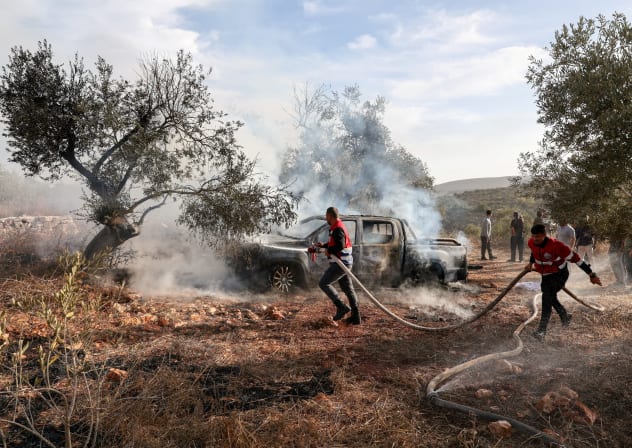
On Tuesday morning, rocks were still
scattered in the roadway on the approach to the village and dozens of piles of
scorched tires lay smoldering in the sun throughout town, the morning after
residents clashed with police and border patrolmen.
There was a high
police presence in the village, including a squad of police in full riot gear
stationed outside the headquarters of the local council, which had been torched
the night before when a group of youngsters from the village went on a tear
vandalizing property and setting buildings alight.
With the situation
still tense in town, a convoy of six police vans and a police water cannon drove
around the village at sunset, looking for local youths suspected of acts of
vandalism the night before.
Carrying an armload of files out of the
scorched council headquarters on Tuesday, an employee who asked for his name not
to be used cast doubt on the likelihood that the fire was a price tag
operation.
“I think it was something between people within the village.
Look at the graffiti; it doesn’t look like Hebrew written by a Jew.”
The
employee also described the town as suffering from high levels of unemployment
and property crime, and that while the majority of the residents are law-abiding
citizens, “there is a small group of young people who cause a lot of
problems.”
The interior of the al-Noor mosque was gutted by the flames,
which also burned dozens of Korans stacked on a table inside the mosque. On a
wall outside the front door, the words “revenge” and “price tag Palmer” were
written. The latter appears to be a reference to Kiryat Arba residents Asher
Palmer and his son Yonatan, who were killed in late September when their car was
hit by stones and spun out of control on Route 60 in the West Bank. the graffiti, which was widely reported to have been "sprayed" or "painted" on the outside wall of the mosque, appeared to be
written in charcoal, and was easy to wipe away with a wet finger.
Fuad Zangaria, the mosque’s imam said the damage done to the
building is very severe, but “the damage is very extensive on our souls, our
feelings, from the damage that was done to our religion. This is the first time
something like this has happened to us before, so the anger is very
powerful.”
When asked about the young people who burned tires and clashed
with police, Zangaria said “the young people are mad not just about this [the
mosque arson] or about the police, but about the entire general situation in the
country in regard to relations between Jews and Arabs.”
In regard to why
his village would be targeted, he said “this is the question that everyone is
asking,” and added that people do not believe that the alleged perpetrators came
from Rosh Pina, or any of the nearby Jewish towns.
Zangaria said
engineers are still assessing the extent of the fire’s damage, but that when the
renovations begin, he believes they will take around two weeks. He said the
building did not have any sort of insurance policy taken out on it, but that
money from residents and outside donors will cover the
renovations.
“Insurance is not our problem; our problem is to find out
who did this, who our enemy is. Our problem is to protect our relations with our
neighbors following this.”
|