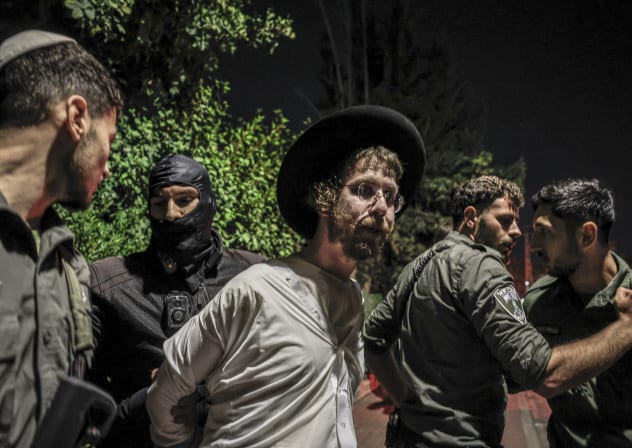
I was the first student to protest Ambassador Michael Oren’s appearance at the
University of California, Irvine in February, 2010. Minutes into the
speech, I stood up and yelled, “Michael Oren, propagating murder is not an
expression of free speech!”
I was moved to this simple act of protest after the
devastation I witnessed in the Gaza Strip in the aftermath of Operation Cast
Lead, which resulted in the deaths of over 1400 Palestinians, including more
than 700 women and children, at the hands of the Israeli military. Months after
the attacks, I visited Gaza to deliver medical aid. There, I met the Sammouni
cousins, three young girls who were orphaned when an Israeli bomb fell on their
home and killed 45 members of their family.
Many families still lived in
the rubble of their destroyed homes, factories, work places, and schools. Those
still lucky enough to have homes lived with clear remnants of the
war. Besides the inability to rebuild due to the Israeli siege of the
Gaza Strip, virtually every home and building was riddled with bullet holes
measuring inches in diameter.Those images compelled me to raise a voice against
the abhorrent devastation and disregard for human life caused by the policies of
Oren’s government.
Despite the fact that I acted in accordance with a
long tradition of protest at American universities, I was arrested. The Orange
County District Attorney eventually filed criminal charges against me and ten of
my peers.The charges were unprecedented. Just a few months before our protest,
thousands of students at UC Irvine undertook an aggressive protest against
tuition increases. Demonstrators entered large, 500-person lecture halls
chanting “walk out!” to urge students to leave their classes and
demonstrate.
At that time, senior UCI administrators and police officers
followed the demonstrators as they moved through every major lecture hall on
campus. Despite these interruptions (and even a shoving match between one
student and a professor), no arrests were made or threatened. No disciplinary
action was taken against the students who disrupted the classes or the campus
organizations that endorsed the protest.
In contrast, our protest, which, totaled just seven minutes over the course of a 90 minute lecture, was met with
the full force of the law. After I spoke up, I began to make my way to
the exit. I was immediately met by police and escorted to a storage room. There,
I was placed in front of a table stacked with dozens of handcuffs, searched and
arrested.
After protests by nine more students and a large walkout where
an eleventh student was arrested, Oren completed his prepared remarks and was
left with nearly 15 minutes to answer questions from the
audience. Instead of fielding questions, however, he left early to attend
a Los Angeles Lakers basketball game and to meet their star player, Kobe
Bryant.
In an editorial earlier this month, this newspaper wrote that we
were eventually charged with a misdemeanor “for planning to trample and then
trampling the freedom of speech of Israeli Ambassador Michael Oren.” In reality
we were charged with disturbance of a public meeting and of conspiracy to do
so. We have appealed our conviction and are hopeful the court will
overturn the decision.
Some people claim that our First Amendment right
to free speech does not include the right to block someone else from exercising
his right to speak. But rights can only be trampled upon and censored by the
government, not by individuals. Furthermore, although our protest was mundane
compared to other acts of protest in the university’s history, the Orange County
District Attorney has managed to delude even The Jerusalem Post into believing
that the charges were fair and justified. This newspaper claimed that both
sides, the Israeli government and American protesters, must be protected from
interruption, as if the parties are on an equal playing field. Rather than
“trample” Oren’s freedom of speech, said the paper, we should have voiced our
opposition during the question & answer session.
But that argument
fails to realize that questions and answers are not an effective form of protest
against states, especially those engaged in war crimes and possible crimes
against humanity. States enhance their power by creating a framework within
which non-state players can challenge state policies. Due to an imbalance of
power, to effect real change ordinary citizens must challenge state power
outside of this framework. We did not wish to politely ask questions but rather
to make a poignant statement. We came to protest Israel’s actions, and a Q &
A session was not the means through which we wanted to act. An effective protest
must voice its opposition in a manner that challenges the policies Oren
represents and the framework through which those policies are propagated.
Protesters who threw tea into the Boston Harbor, who sat-in at segregated lunch
counters, who marched against South African apartheid, and who are now
protesting for their basic human rights across the Arab world all understood
this crucial distinction.
Acts of protest must be judged by their ability
to empower marginalized voices to speak out and demand their basic human rights,
whether in Iran or Irvine. The First Amendment has long recognized the
importance of that value, despite the district attorney's attempt to chip away
at this protection. Only by upholding this right can we protect the free
exchange of ideas and the potential for social change.
Israeli officials
will continue to meet protests in the United States and around the world as long
as they uphold unjust policies like the ones that caused three young girls to be
orphaned. Of all institutions, I would expect a newspaper to support our right
to free speech and to protest injustice loudly.
The writer is a student
at the University of California, Irvine.
|