When the editors of Time crowned Prime Minister Binyamin Netanyahu “King Bibi”
two months ago after he expanded his parliamentary coalition to include 94 of
the Knesset’s 120 members, it evidently did not occur to them that his reign
would last only two months.
The end came when Netanyahu’s new coalition
partner, Shaul Mofaz, chairman of the centrist Kadima Party, pulled out because
the “king” refused to close a satisfactory deal with him that would require
Israel’s haredim as well as the country’s Arab citizenry to be drafted for
military or public service at age 18.
Mofaz immediately won overwhelming
support from his party’s Knesset members – 24 out of 28 voted in favor – and the
coalition government thereby reverted to its previous (and more conventional)
size: 66 MKs.
This development also scuttled the brief opportunity Kadima
had to challenge and possibly change Netanyahu’s policies and tactics not as his
opponent, but as his partner.
Thus ended a short-lived effort to include
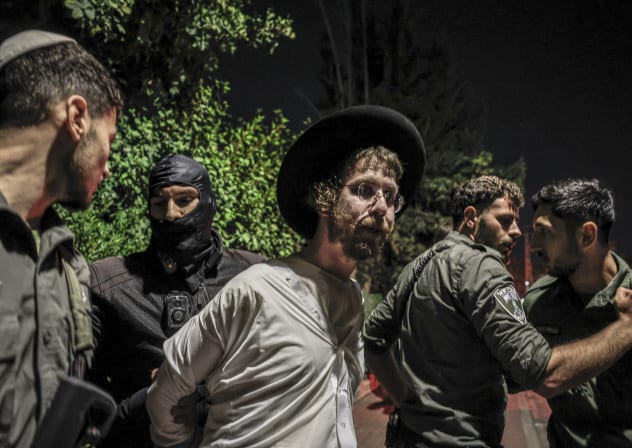
the country’s 60,000 haredi yeshiva students and the estimated 80,000 draft-age
Arab citizens in the national norm.
In other words, Kadima refused to
transform itself into a political ally of the Likud, from which the majority of
its members originally defected five years ago.
This is far from being a
political situation fit for a “king” Actually, by creating an arithmetically
invincible government, Netanyahu undermined Israel’s parliamentary
democracy.
Debates that normally would be conducted by Knesset members
seated on opposite sides of the aisle had to be internalized and conducted
within the respective factions of the Likud and Kadima instead of in
public.
According to political insiders, the friction between the Likud
leadership and its short-lived partner, Kadima, had become so volatile that it
could have compelled Netanyahu to advance the next national election from
September 2013 to January 2013. That certainly would not benefit him, if only
because it not only would have shortened the current estimate of his
government’s longevity, but also risked stiff competition from his diverse
opponents, be they inside Likud’s ranks or outside them.
It is hard to
understand why Netanyahu was willing to admit Kadima into his political fold
just to facilitate formulation of a viable replacement for the “Tal Law” and
thereby achieve a more equitable system of conscription for military or public
service.
This riddle is compounded by the apparent fact that he did not
intend to use Kadima as an ally with which he could free himself from the
pressures brought to bear by the ultra- Orthodox parties upon which he was
dependent. Completely ignored, it seems, was the possibility that a Likud-Kadima
partnership could attain historic dimensions by ending the insufferable and
excessive involvement of various haredi rabbis and their respective courts or
retinues in the conduct of Israel’s government and the shaping of foreign and
domestic policy.
A new coalition without their participation could have
benefitted Israel by bringing about a truly democratic government free of
exclusive and restrictive pressure from domestic religious entities. In short,
this would constitute true separation of church and state modeled on the United
States. If the Israeli majority really prefers democracy and abhors religious
coercion, it should protest the fact that clerics like Shas’s revered mentor and
spiritual leader can play an disproportionate role in the governmental process
simply by activating his most obedient Shas party politician, Interior Minister
Eli Yishai, or by telling the 11-member Shas faction in the Knesset how it
should vote.
The very idea that an elderly rabbi steeped in religious
observances and committed to the requirements of ultra-Orthodox religious
tradition can control a political party committed to him personally on the basis
of religious zeal and loyalty is preposterous.
There is no discussion and
certainly no debate within the inner circle of Shas.
What Rabbi Ovadia
Yosef says goes.
Yishai consults with him regularly and always emerges
with unalterable instructions as to how he and his Knesset colleagues should
vote.
One might wonder if Yishai conferred with Rabbi Yosef about the
idea of expelling up to 60,000 African “infiltrators” or “asylum-seekers,” and
might speculate as to whether the rabbi spelled out his party’s position
unequivocally and without any exceptions or conditions (such as assurances that
the prospective expellees would be able to reenter their native lands or find
alternative countries willing to accept them.
What’s the difference – as
long as they go and take their children with them? It doesn’t matter that some
of the children were born in this country, have been attending Israeli schools
and are fluent in Hebrew (which is virtually their native tongue). This
hard-line and virtually inhuman approach does not seem to befit a Jewish
spiritual leader of whatever faction or persuasion (including Shas), but that’s
the way it is.
After 64 years of independence, during which the influence
of the various ultra-Orthodox parties has increased despite the many oddities of
their involvement (such as the fact that Agudat Yisrael’s (Rabbi) Ya’acov
Litzman serves as deputy minister of health because he and his non-Zionist
political party prefer to forgo full-scale ministerial rank in the Zionist
government), the time has come to reevaluate this peculiar state of affairs.
(Officially, Israel does not have a full-fledged health minister!) There is no
justification for government subsidization of the various religious faiths be
they Jewish, Christian or Muslim. It is incomprehensible that two chief rabbis
(one Ashkenazi and the other Sephardi) as well as senior Christian and Muslim
clergy are eligible for regular salaries, the funding for which is provided by
the country’s secular majority.
If only to assure itself of a secure and
viable future, the government should stop subsidizing yeshivot whose students do
not serve in the IDF. They oppose such service on ideological grounds. Despite
of this, the government not only funds the respective faculties’ and rabbinical
supervisors’ salaries, but also pays for the maintenance of the requisite
buildings and other facilities.
As Foreign Minister Avigdor Liberman
pointed out earlier this month, Israel has a unique opportunity to resolve these
issues. Failure to do so will allow them to fester for decades to come, he said.
Unfortunately, it is doubtful that Liberman’s warning will be taken seriously by
a prime minister whose primary concern seems to be to avoid controversy among
the parties represented in his cabinet and thereby assure the longevity of his
coalition government.
The writer is a veteran foreign correspondent.
|