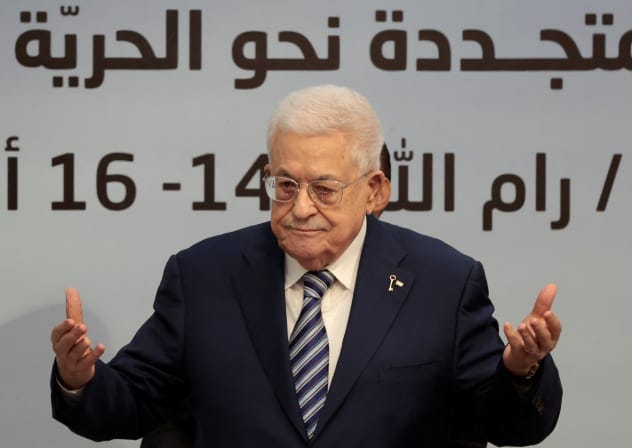
Fatah leaders convened in Ramallah on Tuesday to discuss the latest developments
regarding the peace process and reforms in the faction.
The Fatah
Revolutionary Council, one of the faction’s key decision-making bodies, is
expected to support Palestinian Authority President Mahmoud Abbas’s stance on
the issue of negotiations with Israel.
RELATED:'PM did not show Mubarak map''Basis for direct talks lacking'Abbas has said he won’t agree to
conduct direct talks unless progress is first achieved on security and
borders
during indirect proximity talks.
Abbas is under immense pressure from the
US administration to agree to direct negotiations with Israel as soon as
September, when the four-month deadline for the proximity talks
expires.
Next week, two more significant bodies – the Fatah Central
Committee and the PLO Executive Committee – are scheduled to hold
meetings in
Ramallah to discuss the status of the peace talks and issues related to
internal
reforms in Fatah and the PA.
The two bodies are also expected to back
Abbas’s position regarding direct negotiations.
Dahlan wants progress on security and borders before direct talks
Muhammad Dahlan, a member
of the Revolutionary Council, said Fatah believes the PA should not move
on to
direct negotiations unless Abbas’s conditions are met.
“Fatah wants to
see real progress on the issues of borders and security,” Dahlan said.
“We also
want a complete freeze of settlement construction, including natural
growth,
especially in occupied East Jerusalem.”
Dahlan said Fatah’s position
remained that negotiations should be resumed from the point where they
ended in
December 2008 under then-prime minister Ehud Olmert.
The talks should be
based on the basis of a two-state solution according to the June 4,
1967, lines
and the Arab Peace Initiative, he added.
He warned that unless these
demands were fulfilled, Fatah would not accept Washington’s request to
launch
direct talks.
On the eve of the Revolutionary Council meeting, Hatem
Abdel Kader, a top Fatah figure, launched a scathing attack on the
faction for
failing to reform.
Abdel Kader said that a year after Fatah’s sixth
General Assembly, the first in 20 years, met in Bethlehem, the faction
remains
“paralyzed” and divided.