One soldier, three border policemen and 270 Palestinians were lightly hurt in
clashes in the West Bank and east Jerusalem Tuesday as Palestinians marked the
64th anniversary of the “Nakba,” meaning “catastrophe,” which refers to their
loss to Israel in 1948.
The violence, which occurred mostly in two spots
on the outskirts of Ramallah, near the Kalandiya crossing and in Beitunya by the
Ofer Prison, was not felt inside the city.
Hundreds gathered in Martyr
Yasser Arafat Square for a midday rally. The event mixed the sorrow of
historical memory, the desire for nationalism, and happiness over Monday night’s
end to the Palestinian prisoners’ hunger strike.
Children marched into
the square beating drums and wearing black T-shirts that read “1948.”
Demonstrators carried black flags in mourning for the destruction of their homes
and villages.
Some held Arabic signs with the names of the villages. They
also held posters of Palestinian prisoner Ahmad Sa’adat, the secretary-general
of the Popular Front for the Liberation of Palestine whom Israel jailed for
ordering the 2001 assassination of Tourism Minister Rehavam
Ze’evi.
Family members of jailed prisoners sat in the protest tests set
up in the square. A large blue mock jail cell stood
nearby.
Representatives of the Palestinian Authority, including Prime
Minister Salam Fayyad, led the rally in Ramallah as sirens sounded for 64
seconds to mark the day. Clapping and dancing briefly followed before speakers
took the stage.
“The right of return is sacred and cannot be
compromised,” Fayyad told the crowd. He also stressed the need for a full
Israeli withdrawal to the pre- 1967 lines.
Wasel Abu Yusef, a member of
the PLO Executive Committee, said that the “right of return” remained the
essence of the Palestinian cause. He said that the rights of the refugees did
not go away with the passing of time.
At the end of the rally, black
balloons were released into the air. Though some of them flew up to the sky, the
wind blew many of them under the cloth canopy set up over the
stage.
Music blared from loudspeakers in the square as the rally
dispersed.
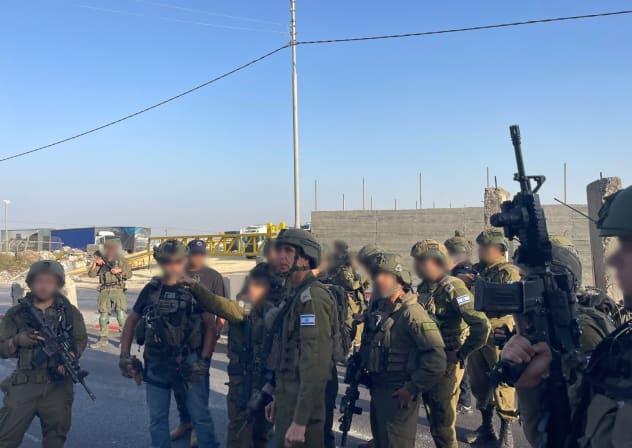
In contrast, on the outskirts of the city, one soldier and
three border policemen were lightly wounded after rocks hit them during
demonstrations at the Kalandiya crossing and near Beitunya. Five Molotov
cocktails were thrown at the policemen near Beitunya, and police bomb squads
destroyed an explosive device.
In Beitunya, near Ofer Prison, clashes
continued into the late afternoon. Demonstrators filled the paved road leading
toward the prison. While many simply milled about, a group of teens and young
adults, many with keffiyehs over their faces or around their necks, engaged the
security forces by throwing rocks and pushing burning tires in their direction.
At times, black smoke billowed into the air.
The IDF and Border Police
responded by shooting rounds of tear gas and rubber bullets.
The tear gas
canisters made white streaks in the air before landing in clouds of smoke that sent protesters
running. But within minutes, they returned. In some cases, demonstrators threw
themselves on the ground, overcome by the gas, as medics treated them and lifted
them in waiting ambulances.
In a field off to the side, some teens threw
rocks at a small group of soldiers, while demonstrators and reporters watched
from a gas station parking lot.
Near Ni’lin, some 30 demonstrators
gathered and tried to break through a nearby IDF checkpoint. The army detained
two demonstrators. Several dozen people also protested near Bethlehem and
Hebron.
Earlier Tuesday morning, Palestinians threw stones at Israelis
praying at Rachel’s Tomb near Bethlehem. Police dispersed the attackers. There
were no injuries in the attack.
At a checkpoint near Hebron, Palestinians
hurled stones at security forces. IDF soldiers and Border Police dispersed the
riots, and no damages or injuries were reported.
In Nablus, events
unfolded peacefully as hundreds of Palestinians marched toward the offices of
the United Nations Relief and Works Agency for Palestinian Refugees (UNRWA),
chanting slogans in favor of the “right of return.” Representatives of the
protesters delivered a letter to the UNRWA heads urging them not to cut their
aid to the refugees and to support their struggle to return to their former
villages.
Nablus governor Jabareen al- Bakri said that the Palestinians
had been waiting for 64 years for the international community to implement UN
resolution 194, which, he claimed, calls for compensating Palestinian refugees
and returning them to their homes.
Thousands of Palestinians in the Gaza
Strip also took to the streets to participate in rallies and marches marking the
day.
East Jerusalem was mostly quiet on Tuesday, with the exception of
clashes in the Isawiya neighborhood, near The Hebrew University of Jerusalem.
Five people, including one youth, were arrested in an early morning
operation.
A number of children, some as young as five, hurled stones at
security forces for hours after the arrests. There were no
casualties.
About 150 people protested peacefully outside the Old City’s
Damascus Gate on Tuesday evening, chanting, “We sacrifice our lives and souls
for Palestine,” and “We are all the prisoners,” referring to the hunger-striking
prisoners who ended their strike on Monday. The mostly young protesters, many
holding cardboard keys, briefly surrounded an Egged bus on its way to The Hebrew
University, but there was no violence.
“We came here to show Israel and
everyone that we will never, ever forget Palestine, the whole Palestine,” said
Shahd, a 22-yearold chemistry student at Al-Quds University. Shahd said that
while she was disappointed by the lack of international protests compared with
last year’s Nakba Day, she understood that many of the Arab countries were
dealing with their own upheavals.
“We are disappointed, but there’s a
revolution,” she said. “All of the focus is on the prisoners… [they made] a
victory for all of us and for all Palestinians around the
world.”
Palestinian sources said at least 270 people were hurt in the
various demonstrations, mostly from tear gas inhalation.
Outside of the
West Bank and Gaza, Nakba Day protests in the Arab world were relatively
muted.
In Lebanon, a smattering of Palestinians and members of the ruling
Future Movement demonstrated outside UN headquarters in Beirut.
Plans for
a rally in Cairo apparently did not materialize. Still, Egyptian presidential
candidate Abdel Moneim Abol Fotouh praised Palestinians incarcerated in Israel
who had waged the weeks-long hunger strike demanding better prison
conditions.
“We congratulate our brothers the Palestinian prisoners in
the jails of the Zionist occupation for their steadfastness in their victory
over the enemy in the battle of the empty gut,” he said. “We support the
continued struggle to meet all their human rights, and... to defend themselves
and wage resistance against the occupation.”
He said Egypt had changed
since the days of president Hosni Mubarak, when it was “a military ally of the
United States and a strategic treasure for the Zionist entity.”
The
state-run Al-Ahram newspaper quoted the candidate as saying Israel had been
founded on “ethnic cleansing and apartheid”: “For 64 years the Zionist entity
has only been a model for blatant discrimination between people on the basis of
religion and race, and on the denial of democracy.”
Abol Fotouh – a
former top Muslim Brotherhood official who, along with ex-foreign minister Amr
Moussa, is one of the most likely candidates to replace Mubarak – said he fully
supported the Palestinian “right of return” to land now in Israel.
“We
support... the right to return to homes and villages from which they were
forcibly displaced – in Acre, Haifa, Jaffa, Lod, Ramle and other parts of
Palestine,” he said.
Melanie Lidman, Oren Kessler, Yaakov Katz, Yaakov Lapin and Jerusalem Post Staff
contributed to this report.