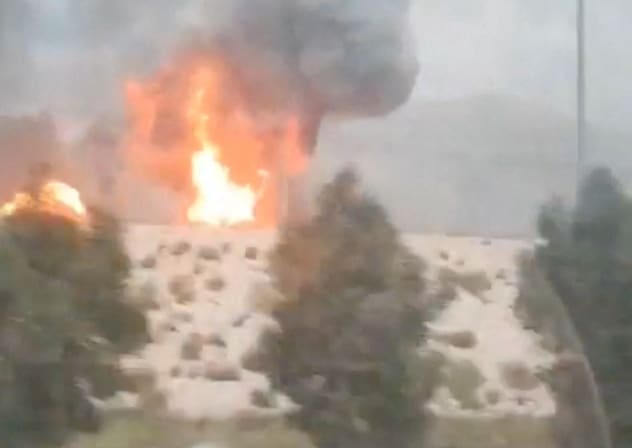
Opposition activists in Syria on Sunday criticized UN observers for failing to
take action to prevent the massacre of at least 109 people in the town of
Houla.
They also slammed the UN mission for not condemning President
Bashar Assad’s forces for the killings on Friday. Syrian authorities have
denied responsibility, blaming “terrorists” for the slaughter.
Late on
Sunday night, at least 30 more people were killed when Syrian army tanks shelled
neighborhoods in Hama that have been serving as a base for rebel attacks against
loyalist forces, opposition activists said.
The reports could not be
independently verified.
In a rare comment on the turmoil, Prime Minister
Binyamin Netanyahu expressed “revulsion over the ongoing massacre being
perpetrated by the forces of Syrian President Bashar Assad against innocent
civilians.
“Iran and Hezbollah are an inseparable part of the Syrian
atrocities and the world needs to act against them,” Netanyahu
said.
Defense Minister Ehud Barak called on Sunday for international
intervention in Syria, saying the massacre in Houla proved why Israel needed a
strong military to protect it.
“The massacre perpetrated by the Assad
regime in Houla and the murder of children, women and elderly over the past year
obligates the world to intervene,” Barak said. “The barbaric crimes that Assad’s
regime commits and the support it enjoys from Iran and Hezbollah, obligate the
world to act to stop it.”
The Revolutionary Council of nearby Homs said,
“The observers’ delegation remained helpless and did not take an initiative to
intervene, except to count the victims the day after the massacre, just as the
UN did in Sarajevo and Srebrenica in Bosnia.”
Images of lifeless young
bodies, lain side by side after the massacre, triggered shock around the world
and underlined the failure of a six-week-old UN ceasefire plan to stop the
violence in Syria.
UN military and civilian observers counted 32 children
under 10 years of age among the dead in Houla.
Gen. Robert Mood, head of
the unarmed UN observers force, called the killings “a very tragical expression”
of the situation in Syria but refrained from apportioning blame.
Maysara
al-Hilawi said he was one of the first activists belonging to the Houla
Coordination Committee who rushed to the area on Friday shortly after members of
a pro-Assad militia, drawn from the Alawite offshoot of Shi’ite Islam, fled the
Sunni area.
“I helped collect over 100 bodies in the last two days,
mostly women and children. The last ones were six members of the al-Kurdi family. A father and his five kids. The mother is missing,” he said
by telephone from the area. He said he had feared a “massacre was about to be
committed,” but UN observers whom he pleaded with to rush to the area had
“arrived too late.”

Opposition activists in Homs said the violence began
when Syrian troops and militiamen, stationed at roadblocks that surround Houla,
fired heavy machine guns at a demonstration, killing five people.
Free
Syrian Army rebels responded by ransacking two army roadblocks, the activists
said.
Houla then came under an intense artillery barrage that killed
around 15 villagers. Residents say members of Assad’s “shabbiha” militia then
entered Houla from nearby villages, hacking men, women and children with knives
and shooting them at close range.
The opposition activists said around
400 families had fled the region in the 48 hours since the massacre.
The
Gulf Cooperation Council of Sunni-led monarchies accused Assad’s soldiers of
using excessive force and urged the international community to “assume its
responsibilities to halt the daily bloodshed in Syria.”
EU foreign policy
chief Catherine Ashton spoke of a “heinous act perpetrated by the Syrian regime
against its own civilian population,” speaking in a statement on Sunday. The
head of the European Parliament said it could amount to a war crime.
US
Secretary of State Hillary Clinton demanded that those who carried out the
killings be held to account.
“The United States will work with the
international community to intensify our pressure on Assad and his cronies,
whose rule by murder and fear must come to an end,” she said.
France said
it would call a meeting of the Friends of Syria, a group of Western and Arab
countries keen to see Assad removed.
Britain said it would summon Syria’s
envoy over the massacre and that it would call for a meeting of the UN Security
Council in coming days.
The United Arab Emirates requested an urgent
meeting of the Arab League, whose head, Nabil Elaraby, urged the UN Security
Council to stop the killing.
But there was no immediate official word
from Russia, which along with China has vetoed Council resolutions calling for
tougher action.
Although the cease-fire plan negotiated by former
secretarygeneral Kofi Annan has failed to stop the violence, the United Nations
is nearing full deployment of a 300-strong unarmed observer force meant to
monitor a truce.
The plan calls for a truce, withdrawal of troops from
cities and dialogue between the government and opposition.
Syria calls
the revolt a “terrorist” conspiracy run from abroad, a veiled reference to Sunni
Gulf powers that want to see weapons provided to the insurgents.
The
United Nations has accused Assad’s forces and insurgents alike of grave human
rights abuses, including summary executions and torture.
The Security
Council met on Sunday to discuss the massacre in Houla, which the United Nations
has blamed on the Syrian government but Damascus and Moscow suggested was due to
a rebel attack.
Russian Deputy UN Ambassador Alexander Pankin told
reporters Moscow was skeptical about suggestions that the government was behind
the massacre, saying it appeared most of the victims were killed with knives or
shot at point-blank range.
British Ambassador Mark Lyall Grant
disagreed.
“It seems quite clear that the massacre in Houla was caused by
heavy bombardment, by government artillery and tanks,” Lyall Grant said ahead of
the meeting.
Diplomats said they hoped to agree on some kind of
condemnation of the massacre, though Russia was clearly at odds with the Western
powers regarding who was to blame.
The emergency council meeting was
called after Russia rejected a French and British proposal for a statement
condemning the massacre, diplomats said on condition of
anonymity.
Moscow, which remains a staunch ally of Assad, told other
members of the 15-nation Council that it wanted a briefing from Mood before
agreeing on a statement, envoys said.