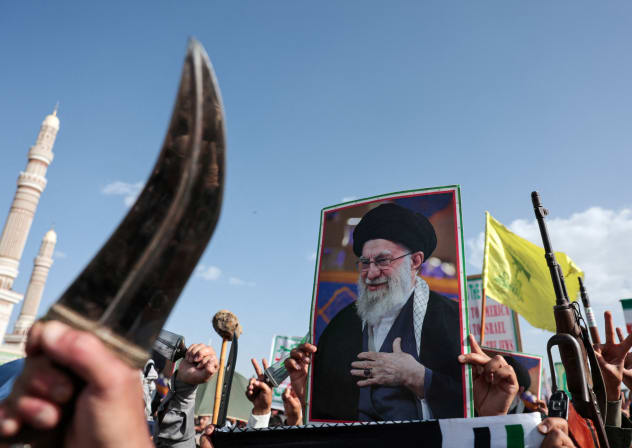
A week into worldwide protests by Muslims furious over a California-made film
demeaning Islam, Lebanon’s Hezbollah is trying to spearhead popular rage at the
US, and Egypt says it will try in criminal court seven Christians believed to be
behind the film.
Hezbollah leader Hassan Nasrallah made a rare appearance
before tens of thousands of his supporters on Monday, warning in a fiery speech
that the US would face increasing rage and diplomatic repercussions across the
Muslim world if it didn’t ban the film, Innocence of Muslims.
Nasrallah
called on governments to block access to websites showing the film. A day
earlier he called for an international resolution prohibiting insults against
religions and their major prophets.
“They slandered the purity of his
birth, slandered his faith and his morals, slandered his Koran,” Nasrallah,
speaking of the prophet Muhammed, told supporters following a march through
southern Beirut’s Shi’ite suburbs.
“The distribution of this entire film
must be banned by the Americans.”
The crowd carried Lebanese flags and
yellow Hezbollah banners and chanted: “America, hear us – don’t insult our
prophet! Enough humiliation!” Nasrallah, many Lebanese media observers noted,
has rarely appeared in public since he led Hezbollah in a month-long war with
Israel in 2006.
“The world should know our anger would not be a passing
outburst, but it would be the start of a serious movement that continues on the
level of the Muslim nation to defend the Prophet of God,” he said. “America,
which uses the pretext of freedom of expression... needs to understand that
putting out the whole film will have very grave consequences around the
world.”
It is not clear whether a full-length film actually exists, since
none has surfaced.
Obama administration officials have called the film
“disgusting” and “reprehensible,” but said they could not legally act to
restrain it due to rights pertaining to freedom of expression.
In Egypt,
the public prosecutor announced Tuesday that a criminal court would try seven
Egyptian Christians living abroad, as well as a controversial US pastor, for
their role in the film and its insults to the prophet.
The Egyptians on
the prosecutor’s list included US-based Morris Sadek, a Copt who said he
promoted the film, and Elia Basseley, also known as Nakoula Basseley Nakoula, a
55-year-old Copt residing in California.
Nakoula, 55, originally told
reporters from AP and The Wall Street Journal that he was an Israeli-American
real estate developer named Sam Becile.
He was interviewed by US
authorities last week for possible probation violations.
Egypt’s
prosecutor said Florida pastor Terry Jones, who angered Muslims in 2010 by
threatening to burn the Koran, would also be tried. He added that the accused,
if convicted, could face the death penalty, and called for the seven Copts and
Jones to be extradited to Egypt.
Sadek, who heads a group called the
National American Coptic Assembly, told Reuters last week that he promoted the
film to highlight discrimination toward Copts in Egypt. Some scenes address that
issue – an anachronism given that the film is largely meant to focus on the life
of Muhammad.
In Afghanistan Tuesday, a female suicide bomber attacked a
minivan carrying foreign workers, killing 12 people. Several hours later, Afghan
militants claimed responsibility for the attack and said it was in retaliation
for the film.
“A woman wearing a suicide vest blew herself up in response
to the anti-Islam video,” said Zubair Sediqqi, a spokesman for the insurgent
group Hezb-e-Islami.
Thousands of protesters clashed with police in Kabul
the previous day, burning cars and hurling rocks at security forces.
It
was the worst outbreak of violence there since February, when US soldiers were
found to have inadvertently burned Korans. The Obama administration apologized
for the incident, but few Afghans believed it was an accident.
There were
also large demonstrations on Monday in Pakistan and Indonesia.
Iranian
Supreme Leader Ayatollah Ali Khamenei on Monday tied Muslim ire over the film to
the “Islamophobic policies of arrogant powers and Zionists,” according to
Iranian media, as civilians across the country staged a second day of protests
against the movie.
Speaking at Iran’s northern port city of Noshahr to a
group of army cadets, Khamenei added that it was incumbent upon Western
governments to prove to the Muslim world that they were against attacks against
Islam.
“Leaders of [the US and European countries] must prove that they
were not accomplices in this big crime in practice by preventing such crazy
measures,” he said.
Iran also took the issue to the UN through a more
official channel, as the country’s foreign minister, Ali Akbar Salehi, wrote a
letter to UN Secretary-General Ban Kimoon asking him to take legal action
against those responsible for the film.
“This sacrilegious act should
ring the alarms for all of us and unite us against such hate crimes,” Salehi
wrote, according to Press TV.
Many Muslims have come out against the
violence that has ensued since news of the denigrating, poorly made film broke
about a week ago. In Paris, Saudi Prince Alwaleed bin Talal said on Tuesday that
only a minority of Muslims were involved in the protests, adding that he hoped
the demonstrations would taper off soon.
“This despicable and disgusting
12-minute movie is really unacceptable, but having said that we shouldn’t honor
[it] with such demonstrations and give it so much attention,” he said after
opening a new Islamic art wing at the Louvre in Paris, Reuters
reported.
“I hope these demonstrations will subside,” he
said. “You have to remember [that] those who go on the street and shout
are the minority. Islam is a lot stronger and
resilient.”
Jerusalem Post staff and Reuters contributed to this report.