Hamas leader Khaled Mashaal ended his first visit to the Gaza Strip on Monday
with a pledge that his Islamist terrorist organization would strive to heal
political rifts with Palestinian rivals who hold sway in the West
Bank.
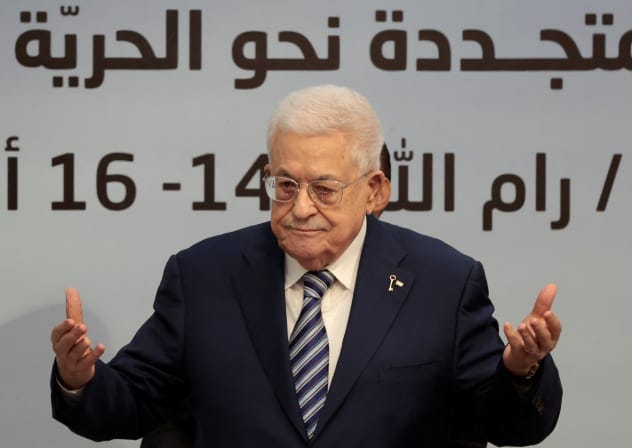
His comments reinforced promises he and Palestinian Authority
President Mahmoud Abbas made to each other during a telephone conversation a
month ago to forge ahead with a stalled unity deal opposed by
Israel.
Also on Monday, Ma’an News Agency reported that the PA that day
granted Hamas permission to hold a 25th anniversary celebration in the West
Bank, in growing signs that Fatah and Hamas were working to end the five-year schism between them.
The festival, to take place on Thursday,
will feature speeches from Hamas leaders. Hamas had earlier approved plans for
Fatah to celebrate its own anniversary in Gaza.
The most recent sign of
reconciliation between the factions follows Fatah’s participation in Hamas’s
25th anniversary celebration in Gaza on Saturday.
Abbas announced Sunday
that he planned to head to Cairo soon to resume reconciliation talks with
Hamas.
“Reconciliation is dear to us and the unity of our people,” Abbas
told the Arab League in Doha, Qatar.
Mashaal agreed, telling an audience
at Gaza’s Islamic University that “responsibility for Palestine is bigger than
one faction alone... Hamas cannot do without Fatah and Fatah cannot do without
Hamas.”
During his four-day stay in Gaza, Mashaal angered Israel with
vows to never recognize the Jewish state and to seek to “free the land of
Palestine inch by inch,” a statement Israel views as vindicating its reluctance
to yield land for peace.
But in brief remarks before crossing back into
Egypt from Gaza, Mashaal focused on internal Palestinian feuds.
“I
entered Gaza carrying a great love for it and I exit with a greater love in my
heart,” the 56-year-old Hamas leader, who lives in exile, said.
“From
Gaza, I have stressed the need for reconciliation, and I do so again. Gaza and
the West Bank are two dear parts of the greater Palestinian homeland, and they
need each other.”
Hamas has ruled the Gaza Strip and its 1.7 million
residents since 2007, when it won a brief civil war with Fatah, which still
controls the West Bank. Israel pulled troops and settlers out of Gaza in
2005.
The two main Palestinian factions have tried, often with little
enthusiasm, to patch up their differences. Aside from their quarrel over Gaza,
the groups are also divided over Abbas’s peacemaking efforts with Israel, which
Hamas opposes. But the talks with Israel have been frozen for two years, making
it easier to sidestep that issue in order to reconcile.
Both parties also
now hope to boost ties on the heels of an eight-day round of violence with
Israel last month that ended with a truce Hamas saw as a victory, and the PA’s
successful initiative at the United Nations General Assembly to receive the
status of an observer non-member state.
Mashaal became the head of Hamas
in 2004 after Israel assassinated the group’s co-founders Sheikh Ahmed Yassin
and Abdel-Aziz al-Rantissi. He himself survived a 1997 assassination attempt in
Jordan.
Some Hamas leaders have suggested that they would back a
long-term truce with Israel along with the creation of a Palestinian state in
land Israel captured in 1967 in the Six Day War.
Mashaal, though, took a
hardline approach during his Gaza visit.
“Today is Gaza. Tomorrow will be
Ramallah and after that Jerusalem, then Haifa and Jaffa,” he told a rally on
Saturday.
“We do not accept the twostate solution,” or Palestinian
statehood alongside Israel, Mashaal said on Sunday at the Gaza Islamic
University.
Any push for Palestinian reconciliation would likely further
anger Israel, already incensed at Mashaal’s combative statements in
Gaza.
Prime Minister Binyamin Netanyahu said on Sunday that Mashaal’s
statements in Gaza and Abbas’s lack of condemnation showed that the Palestinians
“have no intention of compromising with us. They want to destroy our country.”