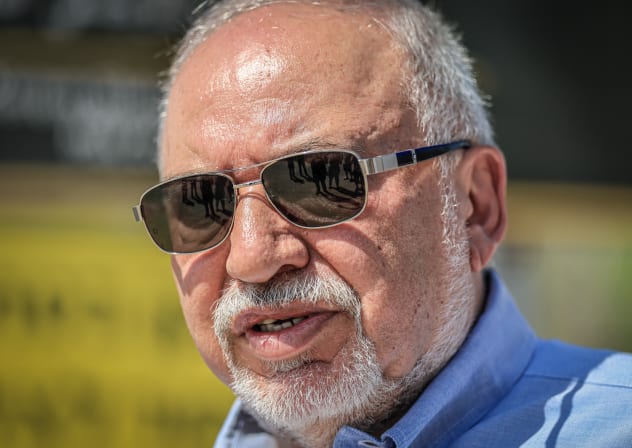
“If you want peace, be prepared for war,” Nobel Prize laureate Yisrael Aumann
told participants in the third Israeli Presidential Conference in
Jerusalem.
Aumann, an expert in game theory, said that although he hated
the Romans for having destroyed the Temple in Jerusalem, he admired them for
their understanding of game theory.
He also drew the conclusion that
United States President Barack Obama theoretically understands peace, based on a
single sentence from Obama’s address when he received the Nobel Peace Prize.
Quoting Obama more than once in the context of a workshop that he gave at the
conference, Aumann stressed the significance in the meaning of the sentence:
“The belief that peace is desirable is rarely enough to achieve
it.”
Generally perceived as a hawk, Aumann asserted that he too wants
peace, but a real peace. Shouting peace, making concessions and gestures,
expelling thousands from their homes as happened with the people of Gush Katif
will bring war, not peace, he declared, stating that there was a great body of
historical proof to support his claim.
One of the most obvious, he said,
was when British prime minister Neville Chamberlain returned from Germany to
England after negotiating the Munich Agreement and announced that he had
succeeded in bringing “peace for our time.”

“Chamberlain did not bring
peace for our time; he brought war,” said Aumann, noting that German aggression
did not abate after the signing of the agreement and that the invasion of Poland
took place eleven months later.
The Munich Agreement was an act of
appeasement to Hitler.
Aumann was convinced that had Hitler known that
the allied forces would rise against him, he might have hesitated about
launching a war.
In more recent history and closer to home, Aumann quoted
Hezbollah leader Hassan Nasrallah, who publicly admitted that Hezbollah would
not have abducted two Israeli soldiers (Ehud Goldwasser and Eldad Regev) had it
thought that this would lead to war and a war of such magnitude.
The
expulsion of Jews from Gush Katif sent the wrong signals to the Arabs, said
Aumann, namely “that we are not here to stay. We have to convince them that we
are here to stay.”
But such a campaign must not be based on harsh
measures unless they are absolutely warranted, he stipulated.
“We must
expel nobody – not Jews [and] not Arabs from their homes. We should not adopt
collective measures like denying electricity, because it hits the people and not
the leaders.”
Aumann thought it to be far more effective to create
incentives as a disincentive to the present goals of the Palestinians, by making
life more livable for them.
“We have to improve the quality of life, and
enable movement and commerce to be as free as possible” while responding to
provocations in an immediate and predictable way, he said.
In Aumann’s
view, one of the most important aspects of the Oslo agreement has been all but
forgotten.
“We have to insist on the Oslo provision calling for education
for peace and tolerance. It’s the most important provision in the Oslo Accords –
and the least remembered. We have to work to create incentives for peace so that
they will change their goals. The most intelligent kids swallow all the hate and
then they become the leaders.”
Drawing a distinction between response to
provocations and outright warfare, Aumann said: “There are no positive
consequences of war.”
He did not see any prospect of peace in the near
future. While Palestinian leader Mahmoud Abbas is promoted as a moderate, said
Aumann, “the moment he makes a peace agreement with us, he’ll be out of
power.”
Referring once again to the sentence from Obama’s Nobel Prize
address, Aumann said: “Our problem is that we want peace now.”
Too many
mistakes have been made in the course of the peace process, and “we’re not going
to fix things now,” he said. “It will take a long time. We have to start a big
campaign for the way children are taught in the territories.
We have to
get used to the fact that nothing will happen now. We’ve made too many
mistakes.”
An out-of-the-box thinker with a pronounced though slightly
cockeyed sense of humor and a gift for delivering shockers, Aumann suddenly
declared: “Helen Thomas did us a great favor.”
The most senior and most
veteran White House correspondent was forced to retire after having been
recorded as saying that Jews in Israel should return to Poland, Germany, America
and anywhere else.
“Thomas was saying what a lot of people are actually
thinking,” said Aumann. “We have to find strategies for belonging here.”