What kind of Israel do we want?
02/23/2012 05:21
The conversation has switched from external threats to internal divides, Hartman Institute’s Becker tells Conference of Presidents.
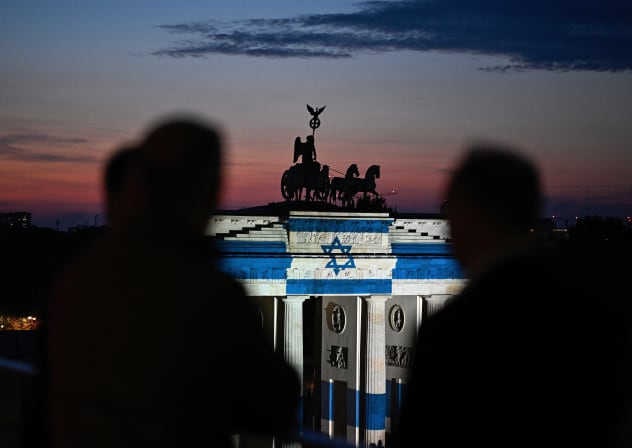
Israeli flags Photo: Marc Israel Sellem
“Israel was created to concentrate Jewish anxiety in one place,” Dr. Tal Becker
told the Conference of Presidents of Major American Jewish Organizations
convening in Jerusalem on Wednesday. “Some of us are afraid that crisis is the
greatest thing that unites us.”
Becker is a Fellow at Jerusalem’s Shalom
Hartman Institute and an International Associate at the Washington Institute for
Near East Policy.
On a more serious note, he said that in Israel, as
distinct from the Diaspora, “the conversation has moved away from how to protect
the state from external enemies to the kind of society we want.”
The
focus in the Jewish world has always been on threats to Israel’s existence, he
said, and while Israel acknowledges that this crisis is real, the general
feeling, especially with regard to peace, is that there’s not much that anyone
can do about it. So now, Israelis are asking themselves more and more what kind
of a society they want, Becker said.
“We like to talk about crisis
because of our history. We are a people who have gone through a lot of trauma
and the miracle of the creation of the State of Israel after the Holocaust. The
guiding idea of Zionism was that the Jewish people needed a refuge – a safe
haven.”
But now there is a need for a different kind of Zionism, Becker
said.
“Our greatest moment is behind us. Tomorrow has come, and the first
question we need to ask ourselves is not how to respond to the challenge, but
with what values.”
Under the old Zionist flag, criticism of Israel was
seen as a form of treason, but under the new flag – at least in Becker’s
perception – “when you are focused on the kind of country you want, criticism
becomes a vital part of the question.”
One of the reasons he believes in
permitting criticism is because “there is nothing that makes a voice louder than
trying to silence it. Outside of Israel, you either support Israel or you don’t.
But in Israel the argument is about the kind of society you want.”
To
illustrate how difficult it is to reach consensus, Becker quote the oft repeated
statement that Israel is a democratic, Jewish state.
Personally, he has
no problem with that, and can even present a convincing argument as to the lack
of internal conflict in the definition. But he said that the general feeling is
that to that extent that Israel is democratic, it isn’t Jewish, and to the
extent that it is Jewish, it isn’t democratic.
In Becker’s opinion,
there’s too much tribalism in Israel and not enough sharing of common
space.
MK Einat Wilf, who chairs the Independence faction, said that she
has been thinking a lot lately about whether there can be solidarity between
Zionists and non- Zionist in Israel – namely mainstream Israeli society with
Arabs and ultra-Orthodox Jews.
To have a generous welfare state, she
said, “You need a high level of trust among the citizens themselves and the
citizens and the government.
That level of trust must be developed in the
formative stages of society.”
With hindsight, Wilf came to the conclusion
that when Israel was formulating its policy of social justice, it didn’t ask the
right questions. “The social justice mechanism was created by Zionists for
Zionists to serve the solidarity of Zionists who were engaged in the insane
effort to establish a homeland for the Jewish people in this region,” she
said.
Two groups were excluded from the Zionist enterprise, Wilf said.
One was the Arabs who regarded Zionism as a threat, and the other was the
ultra-Orthodox who viewed Zionism as heresy.
However, the solidarity
mechanism was extended to the Arabs and ultra-Orthodox on the basis that welfare
would breed solidarity rather than that solidarity would breed
welfare.
This was not a successful means of creating trust, said Wilf.
“The Arabs and the ultra-Orthodox still have an ambivalent attitude to the state
and say that it’s all right to take but not to give.”
Wilf suggested that
the time had come to bid each other farewell and to allow the Arabs and the
ultra-Orthodox to lead their own lives without interference but also without the
support of the state.
“That means we won’t have a socialist or a
capitalist system, but a Zionist system.”
More significantly, it means
that Arabs and ultra-Orthodox who don’t serve in the army or in community
services will not receive free education, National Insurance or child
allotments. Members of those communities who do serve will receive the same
benefits as mainstream Israel.
“It may not be the most politically
correct thing to do, but it will be the right and most sustainable thing to do
if we are to go forward,” Wilf said.