'Elections should decide Steinitz, Yishai fates'
10/10/2012 19:03
High Court hints that the public should decide ministers' fate over Carmel fire handling in upcoming elections.
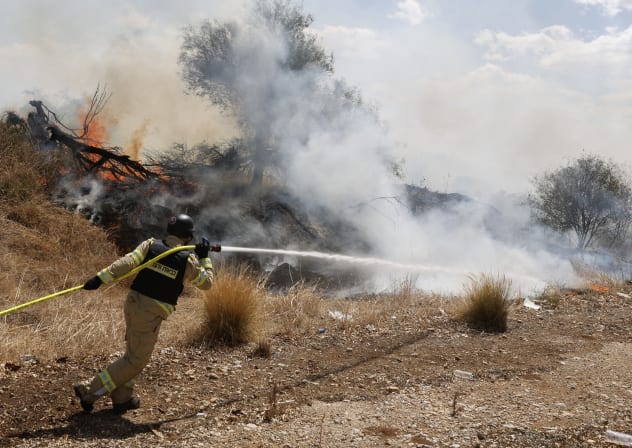
Firefighter during Carmel fire Photo: REUTERS
The public should decide the fate of Interior Minister Eli Yishai and Finance
Minister Yuval Steinitz for their roles in the Carmel fire disaster, the High
Court of Justice hinted on Wednesday to petitioners seeking a court order to
force Prime Minister Binyamin Netanyahu to fire them.
No decision was
given and it was not clear if and when the court would render one, particularly
with upcoming elections essentially resetting all ministerial
appointments.
The justices repeatedly noted that former state comptroller
Micha Lindenstrauss had said the question of Yishai’s and Steinitz’s
responsibility for the fire and its aftermath was a public issue.
“Does
the court need to do more than what the comptroller called for?” it asked the
petitioners. It also emphasized that Lindenstrauss had consciously assigned
“special responsibility” to the two ministers, but not “personal
responsibility,” which he had assigned to others.
The petitioners – Ze’ev
Even Chen, a former senior police figure whose daughter was among the 44 people
killed in the December 2010 disaster, as well as the Movement for the Quality of
Law and others – believed they had a strong case due to the emphatic criticism
Lindenstrauss had directed at Yishai and Steinitz.
Attorneys for the
petitioners tried an emotional appeal in response to the justices’ hands-off,
legalistic approach, asserting that the state comptroller’s report had been
completely ignored by the government.
They also said that if the High
Court did not act there would be no more accountability by public servants and
future comptroller reports would be ignored as well.
Failing to order the
ministers to be fired, they said, would be “clipping the wings” of the state
comptroller and might even discourage him from being as tough as necessary in
future conclusions out of fear of being ignored.
The state shot back that
it was completely unconstitutional for courts to get involved in ministerial
appointments and dismissals.
It also argued that the prime minister had
grappled with the report but had decided that the most important response was to
learn lessons and implement reforms, not focus on blaming and firing public
servants who were involved.
The court also said it did not dispute the
state comptroller’s conclusions that Yishai and Steinitz had made major errors
in their job performance.
However, it indicated that it could get
involved only with ethical and criminal issues, and could not judge how bad a
minister’s job performance needed to be in order for the minister to be fired,
even if the errors led to major tragedies.