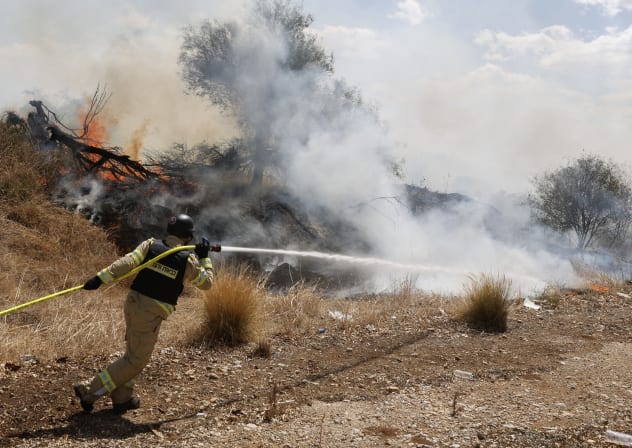
The hundreds of rockets that have hit the South have damaged many agricultural
resources, and in other cases, farmers have been unable to get to
work.
Not only have many farms been damaged, but others continue to be at
risk from the ongoing attacks, according to the Institute for Resolving Conflict
in Agriculture at the Israel Loss Adjusters Association.
Meanwhile,
farmers are avoiding going to work in many locations and are losing many days of
labor as well as their products in the process, the organization said. In many
cases, owners of damaged private property are not entitled to government
compensation.
The institute has therefore announced that it will provide
free counseling to southern farmers in need of financial help.
“The
Institute for Resolving Conflict in Agriculture sees fit to assist in all ways
possible victims of the security situation in the South, to reduce the damage
and to promote the issue of compensation,” said Doron Havkin, vice chairman of
the Israel Loss Adjusters Association.

The Agriculture Ministry said it
aims to ensure that a steady supply of vegetables continues to come from the
South, what it calls “the country’s vegetable storehouse.”
The
Agriculture Ministry is working with the Defense Ministry and the Industry,
Trade and Labor Ministry to draft a list of farms where the IDF Home Front
Command will allow workers to come and pick produce. All approvals, the
Agriculture Ministry stressed, will be subject to the Home Front Command’s
discretion.
“The Agriculture Ministry sees great importance in the
continued existence of agricultural activity in the area surrounding Gaza,
especially during these days, and this among other things is for the sake of
enabling a supply of fresh produce to the country’s residents,” Agriculture
Minister Orit Noked said. “Activities will continue to be carried out with
precision while maintaining the safety and well-being of farmers in the
region.”
Simultaneously, the Agriculture Ministry has joined together
with the Home Front Command and the Defense Ministry for an immediate pooling of
resources, to position 100 additional bomb shelters in agricultural areas near
the Gaza Strip and thereby enable work with cattle, in greenhouses and at open
agricultural sites.
In coordination with the various agricultural
production councils, the Negev district office of the Agricultural Ministry is
working to remove security barriers on an emergency basis, to allow for the
continued activities of farmers in the area and to ensure national food
security, the ministry said.