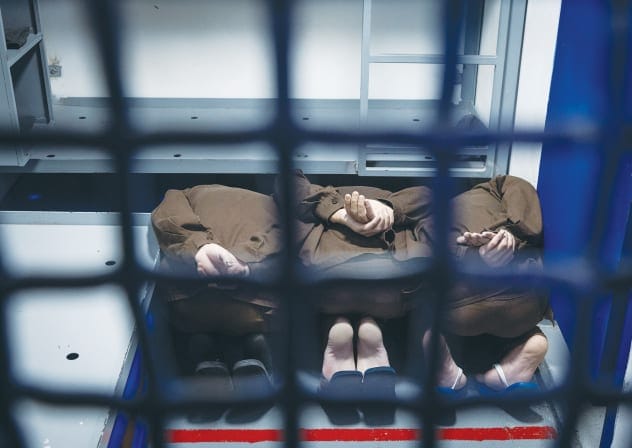
Two words immediately come to mind in connection with the Ben Zygier-Alon-Allen
affair: Tragedy and negligence.
Click here for full JPost coverage of this story
Why tragedy? Because at the end of the
day, we’re talking about a young, idealistic Australian Zionist Jew who left a
comfortable life in a quiet Melbourne suburb and made aliya at the age of 19,
joined the IDF, and then later the Mossad.
What happened to Ben Zygier
along the way? How did he go from being an enthusiastic idealist who passed
through all the Mossad’s rigorous filters to ending his life by hanging in Block
15 in Ayalon Prison?
According to media sources, Zygier spent a considerable
amount of time in exotic places like Iran, Syria and Lebanon.
The Mossad
and the Justice Ministry offered Zygier a plea bargain while he was in jail: a
two-digit sentence, i.e. more than 10 years in prison.
They used
these words in an effort to force him to confess and sign the plea
bargain.
People who’ve met Zygier describe him as an enthusiastic
Zionist, maybe too enthusiastic. Could it be that he boasted about the wrong
details to the wrong people?
Following the suicide, the Zygier family hired a
civil lawyer to settle compensation details with the Mossad.
If, as the
Australians are insinuating, Zygier did in fact betray the Mossad and the State
of Israel, then the Mossad needs to do a thorough self-check: How is this
happening again?
Since the Mossad was established, very few people have betrayed
the incredible trust given to them. Zygier, who was 34 at the time of his death,
had a family: a wife and two daughters. As different a situation from former
nuclear technician Mordechai Vanunu’s as possible.
Revenge, ideology,
money or spirituality are the usual motives when intelligence agents betray
their country.
Each one of these motives is worse than the other. The
Mossad must clarify how Zygier made it through the filters to the belly of the
organization.
Was there negligence in the admissions process and the
testing? How is it that no red lights went off when they should have – a long
time before Zygier became “Prisoner X” in a prison cell that was built for Rabin
assassin Yigal Amir?
The second form of negligence in the Zygier affair involves
the Prisons Service.
On Wednesday night, the court allowed the media to
make public that the president of the Rishon Lezion Magistrate’s Court, Judge
Daphna Blatman Kedrai, investigated the circumstances surrounding the death and
apparently determined that it was in fact a suicide.
However, she
transferred the file to the State Attorney’s Office so that it could be
determined if there had been any negligence in the handling of the
case.
Neither Zygier’s parents in Australia nor his wife in Israel
registered any complaint.
No one sued anybody.
Perhaps shame
overcame any desire to sue the Israeli authorities for allowing Zygier to hang
himself.
The Prisons Service proudly boasted this week that there has
been a significant decrease in prisoner suicides between 2010 (12 suicides,
including Zygier’s) and 2012 (only three suicides). Following the Zygier
suicide, the Prisons Service installed a sensor in Block 15 that works on the
same principle as baby monitors, with which all new parents are familiar: An
alarm sounds if the prisoner in the cell stops breathing. As always, we are
wiser after the catastrophe.
When we hear someone talk about “Prisoner
X,” we straight away think of The Man in the Iron Mask by Alexander Dumas. A
prisoner without a name, without a face, who will decay in prison. Except that
in Israel’s extensive history, there has already been a series of Prisoner Xs,
or at least affairs that began as Prisoner X until the X turned into real names
and pictures.
IDF Military Intelligence’s Mordechai Kedar, who murdered a
collaborator, was Prisoner X for seven years, as were KGB spies Marcus Klingberg
and Shabtai Kalmanovich. And when Nahum Manbar was arrested, he was also at
first called Prisoner X: a prisoner no one had heard about, seen or
known.
Except that Israel is not the France of The Three Musketeers. All
investigative and detention procedures were carried out with the full knowledge
of the courts. Judges oversaw Zygier’s arrest and incarceration; the court’s
legal adviser signed everything, then-Mossad director Meir Dagan, during whose
tenure the affair blew up, and of course the prime minister and defense
minister.
Zygier’s family was informed immediately upon his arrest, and
he received proper representation from lawyers Roi Belcher and Boaz
Ben-Zur.
There used to be a “prisoner X facility” that was used by IDF
Intelligence Unit 504. It used to be called Facility 1391. Military Intelligence
and the Shin Bet used it to hold unnamed detainees. This is where the commando
unit brought Sheikh Abdel Kareim Obeid and Mustafa Dirani in an attempt to
retrieve information about the fate of missing IAF navigator Ron Arad. In 2006,
after human rights organizations petitioned the High Court of Justice, the
facility was shut down.
Even the greatest democracy on earth has Prisoner
Xs: In the war on terror that the Americans have been waging since the attack on
the Twin Towers, there are terrorists, mainly from al-Qaida, who were arrested
in Afghanistan, Pakistan and Iraq. They are taken on airplanes in the middle of
the night, and flown to what the CIA calls “black sites” – outside US territory
and legal jurisdiction – which are detention and interrogation centers, where
torture is sometimes used. No one knows where they are or what exactly takes
place there.
Opponents will say that in a democracy there shouldn’t be
Prisoner Xs, that there is no such thing as suspending the law in the name of
the law. Supporters will say that we don’t have a choice and the bleeding hearts
can go to hell.
The Mossad, the Shin Bet, the IDF and Military
Intelligence still believe that keeping the identity of Prisoner Xs’ secret is
an effective tool for a democracy to use to protect itself against people who
are doing everything they can to destroy it.
Ben Zygier, may his memory
be for a blessing, will probably not be the last Prisoner X in
Israel.
Translated by Hannah Hochman.