A Dose of Nuance; From Limmud to Lapid
02/23/2013 12:22
Jewish learning for everyone, not just haredim, part of Lapid's 'wind of change'.
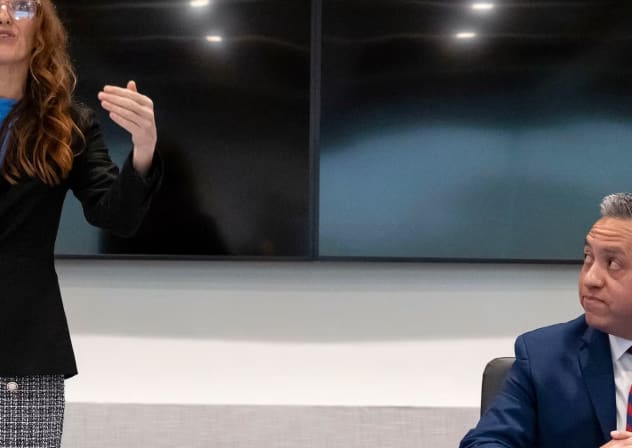
YESH ATID MK Ruth Calderon gives her inaugural speech in the Knesset Photo: Marc Israel Sellem/The Jerusalem Post
If Limmud is so fascinating, why do I usually find myself leaving it with such
mixed emotions? What is it about this multi-denominational, volunteer-led,
creative out-of- the-box experience that renders me so conflicted, whether I
attend it in Nottingham or New York, Los Angeles or (later this year) Australia?
The answer actually has nothing to do with Limmud, and everything to do with the
country to which I return when I depart it.
Limmud is one of those places
where the silos come tumbling down, where the whole point is to encounter Jews
who are very much unlike us, and with that encounter, to accept and even embrace
the discomfort that such encounters often evoke. Limmud forces us to acknowledge
that people whose Jewish lives look very different from ours are not necessarily
less passionate or committed, not less open or more fundamentalist, but rather
that their experiences, intellectual dispositions, spiritual needs and search
for meaning sometimes just took them to places that are different from where we
ended up.
At Limmud, one almost cannot but recognize that the danger lies
not with those whose teaching and learning we might disagree with, but with
those who do not attend, who have no interest, who don’t want to be part of the
Jewish conversation. The religious and the secular, the passionate Zionists and
the Israel-questioners, the Reform and the Orthodox, the deeply respectful and
the unabashedly irreverent at Limmud all have much more in common with each
other than they do with those who just don’t care at all. It is always, for me,
a powerful dose of optimism in a Jewish world that desperately needs it, a
reminder of what we could be if only we weren’t what we are.
SO WHY does
Limmud usually leave me so conflicted? Because I’m invariably headed back to
Israel, where the silos stand tall, where more often than not, we manage not to
meet people who construct meaningful Jewish lives differently than we do, where
policy is made top-down and not bottom-up, where authority is derived from
politics and not from knowledge, creativity and the passion of one’s
convictions.
Yet this year, somehow, as Limmud NY wound down, I had a
vague but irrepressible hope that the departure might feel different. Not
because Limmud has changed, but because, though we have a long way to go, the
Israeli sands are shifting.
The signs are everywhere. MK Moshe Feiglin,
not exactly known as a voice of political or religious moderation, has informed
us that he has decided it’s not impermissible to shake hands with a woman. And
he did so in the Knesset, after his inaugural Knesset speech.
Could a
newly pluralistic Knesset be working its magic? Then there was the performance
of 17-year-old Ofir Ben-Shitrit, a religious young woman who appeared on the
reality show The Voice, with a voice so beautiful and a soul so pure that no one
who heard her was unaffected. The secular judges were no less moved when she
sang an Andalusian religious song than when she sang a modern Israeli love song.
And the reactions? The crowd loved her, but her school suspended her for singing
in front of men.
What that did, of course, was make Ben-Shitrit an even
greater sensation.
Power, the school officials learned the hard way,
comes in many forms. And it’s not always top-down.
And bigger than even
Feiglin and Ben-Shitrit is the impact that Yair Lapid’s party, Yesh Atid, is
having on Israeli discourse, even before a government has been formed. Lapid,
the secular Jew not disconnected from Jewish life, who’s found meaning in a
Reform shul, has a haredi rabbi (Dov Lipman) as part of his team in the
Knesset.
The very same Lapid gave a lecture to haredi students at Kiryat
Ono College, telling them, “You won.” Because they are so numerous, such an
economic power, so significant in Israeli politics, Lapid told them, they no
longer have the luxury of thinking of themselves as marginalized. But with the
end of marginalization, he challenged them, should come the end of
fear.
“I understand that you don’t want your children to play with my
children on the playground,” he said, “and I try hard not to be insulted by
that. But can we not find a way to at least be able to live next door to each
other?” And should he and his children defend the state, when they and their
children don’t, he wanted to know.
Watch the YouTube video and look at
the audience. They were listening.
They were uncomfortable, but not
angry. They were challenged.
At long last, Israel is having a
conversation.
It may be slow, but the silos are cracking.
AND THEN
there was the inaugural Knesset speech by Ruth Calderon, also from Lapid’s
party, who had the audacity to teach a Talmudic text. It’s her right, of course.
She’s got a PhD in Talmud from the Hebrew University. But she’s not part of the
religious camp.
Yet, she says instructively, it’s her book, too. It’s her
tradition. It’s her music. It’s her voice. And she’s not about to relinquish it
to anyone else.
So with class and with grace, this non-religious woman
taught a Talmudic text to the Knesset, which includes many men who have studied
Talmud for years but had never heard a woman teach a single line of it. That
YouTube video, as of this writing, has 150,000 views. Watch it. See the men
listening, and some of them squirming uncomfortably in their seats. Witness a
new conversation emerging.
And don’t miss Calderon’s line about equal
sharing of the burden applying not only to military service, but to the study of
Torah as well. Her point, even if unspoken? If Israel is going to survive, it
needs a strong military. The haredim can’t leave the defense of the state to
secular Jews just because they don’t feel like serving. But if Israel is going
to be a Jewish state, then it can’t be only the religious who know something
about Judaism, whose conversations are framed by encounters with the Jewish
canon. If the draft needs to be universal, so does the study of Jewish
tradition. So she opened a Talmud and began to teach.
Unlike in the case
of Ben-Shitrit’s school, no one can suspend Calderon.
But that didn’t
stop certain elements from trying. The haredi publication Kikar Hashabbat
(Shabbat Square), which published its editorial about Calderon under a URL
containing the words “the generation of the smartphone” (whatever that was
supposed to mean), understood the threat.
“They do not want to erase the
Torah of Israel,” the article stated. “They do not want us to be a nation like
all the other nations.... They want Talmud for everyone, and therein lies the
danger.” Suddenly the enemy is the one who doesn’t hate the Jewish tradition,
but loves it.
They’re right to be worried. As are the principals of
Ben-Shitrit’s school, and all those others who prefer life in silos. For with
any luck, all of this is no mere blip on the screen. With any luck, the winds of
change are finally beginning to blow.
The writer is senior vice president and
Koret distinguished fellow at Shalem College, Israel’s first liberal arts
college, in Jerusalem. His newest book, The Promise of Israel: Why Its Seemingly
Greatest Weakness is Actually Its Greatest Strength, was recently named by
Jewish Ideas Daily as one of the best Jewish books of 2012.