No sooner had Hillary Clinton announced the imminent resumption of direct
Israeli-Palestinian peace negotiations without preconditions, than the
Palestinian leadership cold shouldered the US secretary of state. An emergency
meeting of the PLO executive committee (which controls the Palestinian
Authority), chaired by PA President Mahmoud Abbas, agreed to return to the
negotiating table but threatened to pull out of the talks if Israel didn’t
extend the freeze on all settlement activities. “Should the Israeli government
issue new tenders on September 26, we will not be able to continue with talks,”
chief PA negotiator Saeb Erekat told reporters.
But the story doesn’t end
here. While the Englishlanguage announcement of the PLO’s decision sets “the
emergence of an independent, democratic and viable Palestinian state living side
by side in peace and security with Israel” as the outcome of the negotiations,
the Arabic-language version makes no mention of the two-state solution. Instead
it notes the Palestinian readiness to resume the final-status talks, adding a
few new preconditions, notably the rejection of Israel’s annexation of east
Jerusalem.
And just there, no doubt, lies the heart of the
problem.
For while the PLO leadership, since the launch of the Oslo
“peace” process in 1993, has been singing the praises of the two-state solution
whenever addressing Israeli or Western audiences, it has consistently denigrated
the idea to its own constituents, depicting the process as a transient
arrangement required by the needs of the moment that would inexorably lead to
the long-cherished goal of Israel’s demise.
In this respect there has
been no fundamental distinction between Yasser Arafat and Abbas (and, for that
matter, between Hamas and the PLO). For all their admittedly sharp differences
in personality and political style, the two are warp and woof of the same
dogmatic PLO fabric: Neither of them accepts Israel’s right to exist; both are
committed to its eventual destruction.
IN ONE way, indeed, Abbas is more
extreme than many of his peers. While they revert to standard talk of Israel’s
illegitimacy, he devoted years of his life to giving ideological firepower to
the anti-Israel and anti-Jewish indictment. In a doctoral dissertation written
at a Soviet university, an expanded version of which was subsequently published
in book form, Abbas endeavored to prove the existence of a close ideological and
political association between Zionism and Nazism. Among other things, he argued
that fewer than a million Jews had been killed in the Holocaust, and that the
Zionist movement was a partner to their slaughter.
In the wake of the
failed Camp David summit of July 2000 and the launch of Arafat’s war of terror
two months later, Abbas went to great lengths to explain why the “right of
return” – the standard Arab euphemism for Israel’s destruction through
demographic subversion – was a nonnegotiable prerequisite for any settlement.
Two years later, he described the Oslo process as “the biggest mistake Israel
has ever made,” enabling the PLO to get worldwide acceptance and respectability
while clinging to its own aims.
Shortly after Arafat’s death in November
2004, Abbas publicly swore to “follow in the path of the late leader Yasser
Arafat and... work toward fulfilling his dream... We promise you that our hearts
will not rest until the right of return for our people is achieved and the
tragedy of the refugees is ended.”
Abbas made good his pledge. In a
televised speech on May 15, 2005, he described the establishment of Israel as an
unprecedented historic injustice and vowed never to accept
it.
Two-and-a-half years later, at a US-sponsored peace conference in
Annapolis, he rejected prime minister Ehud Olmert’s proposal of a Palestinian
state in 97 percent of the West Bank and the entire Gaza Strip, and
categorically dismissed the request to recognize Israel as a Jewish state
alongside the would-be Palestinian state, insisting instead on full
implementation of the “right of return.”
He was equally recalcitrant when
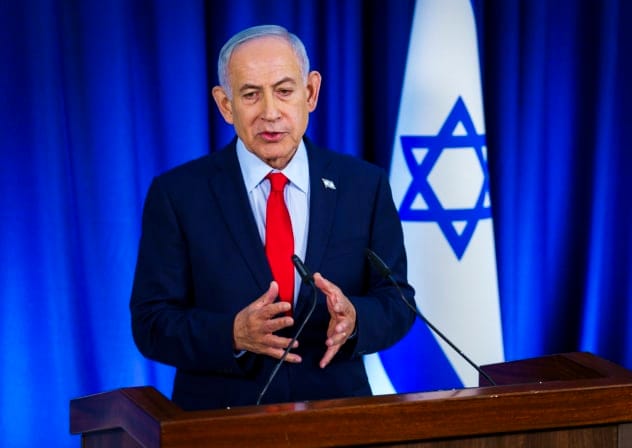
the demand was raised (in April 2009) by newly-elected Prime Minister Binyamin
Netanyahu. “A Jewish state, what is that supposed to mean?” Abbas asked in a
speech in Ramallah. “You can call yourselves as you like, but I don’t accept it
and I say so publicly.”
When in June 2009 Netanyahu broke with
longstanding Likud precept by publicly accepting a twostate solution and
agreeing to the establishment of a Palestinian state, provided the PA leadership
responded in kind and recognized Israel’s Jewish nature, Erekat warned that the
prime minister “will have to wait 1,000 years before he finds one Palestinian
who will go along with him.”
Fatah, the PLO’s largest constituent
organization and Abbas’s alma mater, went a step further. At its sixth general
congress, convened in Bethlehem last August, the delegates reaffirmed their
long-standing commitment to “armed struggle” as “a strategy, not a tactic...
This struggle will not stop until the Zionist entity is eliminated and Palestine
is liberated.”
And so it goes. Precisely 10 years after Arafat was
dragged kicking and screaming to the American-convened peace summit in Camp
David, only to reject Ehud Barak’s virtual cession of the West Bank and Gaza
Strip to the nascent Palestinian state and to launch an unprecedented war of
terror, his erstwhile successor is being dragged to the negotiating table, which
he would rather continue to shun after a year-and- a-half absence.
Not
because of the unconstitutionality of any agreement he might sign (owing to the
expiry of his presidency in January 2009), or his inability to deliver anything
that is not to Hamas’s liking, but because, like Arafat and the rest of the PLO
leadership, as far as Israel’s existence is concerned, Abbas would not take a
yes for an answer.
The writer is professor of Middle East and
Mediterranean studies at King’s College London, editor of Middle East Quarterly
and author, most recently, of Palestine Betrayed.