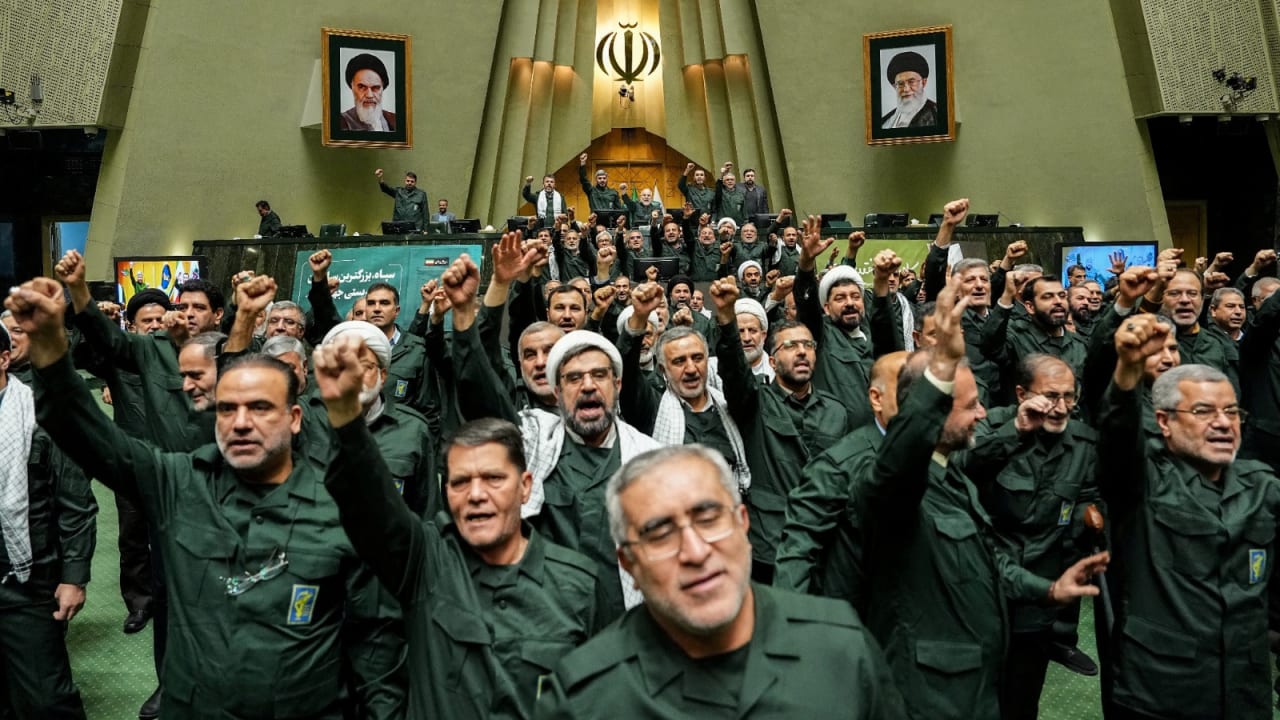
A decisive majority of senior commanders in Iran’s Islamic Revolutionary Guard Corps (IRGC) would back a military leader, not a cleric, to replace Supreme Leader Ali Khamenei, according to a behavioral artificial-intelligence simulation created by Israeli start-up AskIt.
The findings come amid growing international scrutiny over Iran’s internal stability and regional posture.
Khamenei, who has led the Islamic Republic since 1989, is 86. Under Iran’s constitution, the next supreme leader is formally selected by the Assembly of Experts. In practice, however, the decision reflects complex power balances among clerical institutions, the IRGC, and political elites.
Speculation over succession has intensified during periods of heightened regional tension, including last year’s 12 Day War.
Analysts caution that discussions of a leadership transition do not necessarily indicate that Iran is preparing for a broader war. Rather, they reflect structural uncertainty inside a system built around a single dominant authority figure.
According to AskIt’s findings, 85 out of 122 modeled commanders, or nearly 70%, favor appointing a senior general as successor. Another 36 support the idea of Khamenei’s son assuming leadership, while only one profile indicated support for a cleric.

The simulation was based on synthetic behavioral profiles of 122 real figures within the IRGC. Each profile incorporated publicly available biographical and career data, including personal history, military trajectory, age, family background, and psychological traits.
The system then applied psychological and socio-physical modeling to project how each commander would reason through strategic dilemmas.
Rather than measuring public positioning, the platform seeks to identify underlying cognitive patterns.
Dr. Neal Tsur, AskIt’s chief technology officer and project lead, said the goal was to simulate how decision-makers would respond in scenarios where direct polling is not possible.
The analysis found that those favoring military leadership consistently prioritized national security considerations over ideological or clerical continuity.
This orientation mirrors internal developments during the 12 Day War, when the IRGC consolidated governing authority, as well as during the January protests, Tsur said. The broader pattern reflects a shared strategic mindset rather than isolated individual preferences, he said.
AskIt’s AI models simulate decision-making patterns
AskIt’s methodology diverges from conventional surveys and standard AI prompting. Instead of asking what an Iranian general might think in abstract terms, the system constructs individualized behavioral models based on cumulative life experiences and then runs scenario-based simulations. The company says this approach enables forecasting even in contexts lacking reliable historical precedent.
AskIt was founded in 2025 by CEO Lotan Magal and Tsur. It positions its platform as applicable beyond geopolitical analysis.
Magal previously held intelligence-related government roles and later specialized in behavioral economics under Prof. Dan Ariely before leading the polling firm Direct Pulse.
Tsur, a former officer in Unit 8200 with a doctorate in sociophysics (social physics), has worked on predictive modeling for Israeli defense bodies and the Prime Minister’s Office.
Magal said organizations typically devote extensive time and resources to surveys, focus groups, and testing frameworks that often produce biased responses. AskIt, however, creates a “synthetic audience” environment that allows real-time testing of reactions to new ideas, aiming to reveal authentic decision-making patterns rather than socially filtered answers, she said.