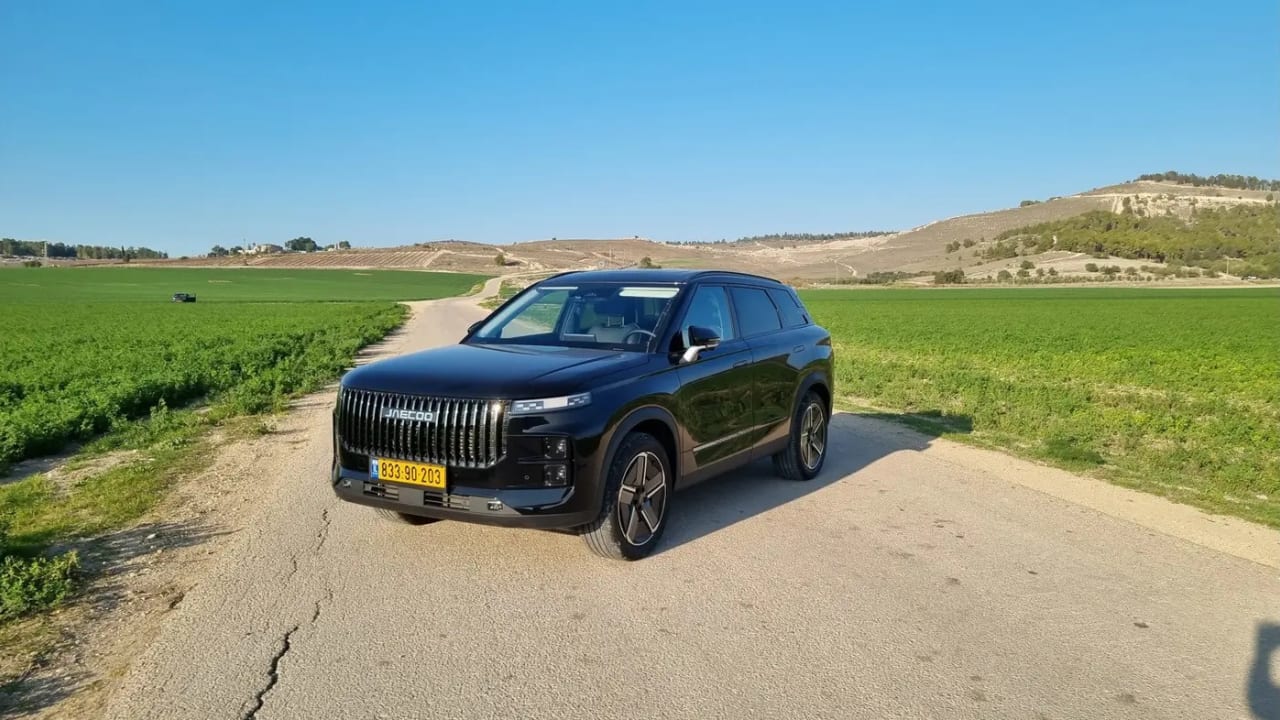
In recent weeks, we have seen quite a few price cuts on existing models, a result of the falling dollar and euro exchange rates and the strengthening shekel, as well as an effort by importers to restart sales after realizing that customers were not rushing to pay the high prices they demanded. But this week’s move by Colmobil, the importer of JAECOO and Omoda, was unusual: Only three months after Omoda’s launch, it announced a NIS 5,000 reduction on the entry-level Omoda 7, across all three trim levels.
The Omoda 7 is a twin model to the JAECOO 7 and the Cherry Tiggo 7, three crossovers from the Chinese Cherry Group, sold in Israel primarily as plug-in hybrids. While JAECOO has put nearly 3,000 units on the roads since the start of 2026 and remains the best-selling model in Israel as it was throughout 2025, Tiggo 7 delivered 1,199 units, and Omoda only 299, far behind. Together, the three account for 9% of the new car market so far.
While JAECOO and Omoda now start at NIS 180,000, Tiggo 7 also has a version at NIS 170,000, the Comfort trim. But this is a fairly “bare-bones” car by Chinese standards: Seats without electric adjustment, no panoramic roof, side mirrors that do not fold electrically, no electric trunk opening, no wireless phone charging, and more. A classic leasing model.
Thus, the main competition is between the NIS 180,000–190,000 models. The Tiggo 7 receives most of the features it lost, including front electric seats, panoramic roof, wireless charging, electric mirrors, and more. On the other hand, the JAECOO 7 Elegance at NIS 180,000 is similar in features to the base Tiggo 7, whose premium trim mostly reaches NIS 190,000.
The Omoda 7 at NIS 180,000 is better equipped than JAECOO at the same price: Electric driver and passenger seats, panoramic roof, but no wireless charging. Omoda also has a larger multimedia screen, 15.6 inches, compared to 14.8 inches in JAECOO and 12.3 inches in Cherry, with all three suffering from the same ergonomics issue of operating most car functions through the screen.

Omoda is also larger: 4.66 meters in length with a 2.72-meter wheelbase, compared to 4.55 meters for Cherry and 4.50 meters for JAECOO, which share a 4.67-meter wheelbase. Its trunk offers 540 liters of space, compared to 480 in Cherry and only 340 liters in JAECOO.
All three share the same powertrain: A plug-in hybrid based on a 1,500 cc turbo gasoline engine and an 18.3 kWh battery. Cherry and JAECOO declare 347 hp, Omoda 342 hp. Acceleration from 0–100 km/h is nearly identical: 8.4 seconds for Omoda and Cherry, 8.5 for JAECOO, with a top speed of 180 km/h for all three and an almost identical electric range: 90 km for JAECOO, 91 for Cherry, and 92 for Omoda. Official fuel consumption figures are unrealistic for JAECOO (142.9 km/L) and somewhat closer to reality for Cherry (43.7 km/L) and Omoda (41.4 km/L).
Warranty is identical for all: 6 years or 150,000 km for the vehicle, 8 years or 150,000 km for the expensive battery.
Will the price cut revive Omoda sales, or does the struggle indicate that Israelis have difficulty accepting additional Chinese brands? The Cherry Group has a fourth twin brand, LEPAS, positioned slightly above Cherry, just as Omoda is positioned slightly above JAECOO. According to market estimates, LEPAS is expected to land in Freesbe, which already imports Cherry (Freesbe has not provided a comment).