
Art does not exist in a vacuum; the context in which an artist creates, along with the viewer’s perspective, shapes how a work is perceived.
While some art enthusiasts seek out entirely new sensations, many of us, as viewers, subconsciously look for points of reference in our own past experiences and memories of works we have encountered before.
We also search for other connections – intellectual or emotional – that might link the art we are viewing to something familiar or personal. A similar process occurs among the creators, who often engage in dialogue.
For this month’s column, I chose artists who are openly in dialogue with other artists, either whom they met in person or whose works inspire them, or in a dialogue also with ethnic cultures and nature.
Outwardly, the three exhibitions shown in Tel Aviv and Holon, selected from among the many I have seen in recent months, seem worlds apart; yet, to my mind, the theme of artistic dialogue connects them in a certain way.

Three very different artists agreed to answer my three questions:
What inspires you?
What do you call art?
What, in your opinion, makes your artwork different from other artists?
Nadav Weissman
Born in Haifa in 1969, Nadav Weissman is a multidisciplinary artist based in Tel Aviv.
From a young age, he knew that he wanted to express himself through art, and he began his art education already in high school.
He holds a BA in Art, with studies in Philosophy and Literature (1999), from the University of Haifa, and an MA from the Interdisciplinary Program at the Faculty of the Arts (2018), Tel Aviv University.
He is a recipient of numerous awards, including the Art Encouragement Prize from the Culture Ministry, the Oscar Hendler Award, and grants from Mifal Hapayis and the Rabinovich Foundation.
Weissman has exhibited his work in both solo and group exhibitions in Israel at the country’s most prominent museums and galleries, as well as in the US, Europe, and Asia.
He participated in the Busan Biennale in South Korea (2006) and the Asian Art Biennale at the National Taiwan Museum of Fine Arts in Taichung (2007).
Weissman also lectures in art and design at the Faculty of Architecture and Town Planning at the Technion-Israel Institute of Technology.
As an artist, he focuses on installations that combine sculpture, relief, drawing, video, and animation. Weissman creates multilayered, material-based sculptures that explore the relationships between space, material, line, stain, image, and movement.
In recent years, he has engaged in an ongoing dialogue with Moshe Kupferman’s works (1926–2003), one of the key and most influential figures in Israeli art during the second half of the 20th century, and a co-founder of the Ghetto Fighters’ Kibbutz.
Weismann told me that he first met Kupferman at the opening of his own debut solo exhibition in 2001. The encounter left a profound impression on him, one that has stayed with him ever since.
When I saw Weissman’s installation, “A Rupture in Time,” last year at the Petah Tikva Museum, I was drawn to its form, which to me was clean but gave space to imagination.
Yet his relation to Kupferman’s painting cycle The Rift in Time (Di Kriye, 1999) gave it another light: the inherent duality of form and consciousness. Weissman continues this dialogue in his latest show, Nadav Weissman // Moshe Kupferman – Duo Exhibition, at Tel Aviv’s Chelouche Gallery for Contemporary Art.
“Because I make topographical reliefs, with a kind of architectural section through which you can see the layers of depth within the relief, I became very interested in the hidden and revealed depth between the layers,” Weismann noted.
“I think this was what drew me to creating this dialogue with Kupferman. His paintings are made up of layers built one on top of another, creating both concealment and depth at the same time.”
Inspiration: My diverse sources of inspiration change, shift, and accumulate over the years.
I am obviously inspired by the visual language of architecture, structure, and topography, but I am also inspired by psychology and the structure of the mind; by archaeology and the layers that are revealed beneath the ground; and by the human body and the gap between its external appearance and the physical processes taking place beneath the skin – in the cells, the blood, and the internal organs.
I am also inspired by allegorical literature.
I am drawn to this gap between what is visible from the outside and what is happening inside, within things, through layers and in hidden areas. Archaeology, the body and the mind, architecture, and literature share this. I see myself as an allegorical artist; it’s not about the formal or a direct, graphic description of reality.
Meaning of art: I accept Duchamp’s epistemological idea that when someone calls something art and presents it as such, then it is art. But that, in itself, says nothing about the qualities of the work, and those are what really interest me.
For me, they are deeply connected to its visual, material, conceptual, structural, formal, and organizational language, and to the way all these elements relate to the “subject,” or to what is expressed within the work.
I see these elements as part of the “subject” itself, just as much as the desire to express something that exists outside the work.
Weissman’s art: I assume I have quite a lot in common with other artists. All of us want to make work that is uniquely our own, but it is not something I consciously strive for or spend much time trying to define.
But I do think certain visual characteristics are distinctive to it: a particular material, compositional, symbolic, and conceptual presence, and even a certain atmosphere and spirit that run through the work and make it fairly easy to recognize.
www.nadavweissman.com/
Ido Michaeli
Born in Petah Tikva in 1980, Ido Michaeli is an interdisciplinary artist whose work fuses art, design, and craft. He holds a B.Des (2005) and an MFA (2010) from the Bezalel Academy of Art and Design in Jerusalem.
He won the Kolliner Award for a Young Israeli Artist from the Israel Museum (2017), the Artport scholarship (2013-2014), and the Outset Contemporary Art Fund, London, United Kingdom (2023).
He exhibited in many group and solo shows in Israel and around the world, and his works are in private and public collections, including the Israel Museum Collection, the Herzliya Museum of Contemporary Art Collection, and the Serge Tirosh Collection.
Since moving to the US in 2012, he has lived and worked between New York and Connecticut and gained recognition in the American art scene. He told me, however, that recently, “Being an Israeli artist in the US became more challenging…”
Michaeli, born to a Kurdish Jewish family in Israel, pays tribute to his family heritage through his art. He also aims to connect European art with a more traditional Middle Eastern visual language.
He often collaborates with others worldwide. “For more than a decade, I have worked closely with traditional Afghan weavers, developing artworks through an ongoing exchange of ideas, knowledge, and craftsmanship,” the artist shared with the Magazine.
Surprisingly, this led him to the latest project, his exhibition Sunflowers of the Middle East at the Noga Gallery in Tel Aviv, in which Michaeli engages in direct dialogue with Vincent Van Gogh, presenting a series of oil paintings paying homage to Van Gogh’s iconic Sunflowers, but also in a “conversation” with the tradition of Oriental nomadic carpets.
When I asked him why Van Gogh on carpets, he replied: “I saw his sunflowers looking at Afghan carpets!” Upon entering the gallery, visitors encounter something highly familiar, yet presented in an unexpected form, an unconventional medium.
Inspiration: I enjoy visiting exhibitions at galleries and museums in New York, such as the Metropolitan Museum of Art, the Jewish Museum, the Museum of Arts and Design, as well as art fairs like the Armory Show.
I also draw inspiration from my family heritage. I was born in Israel to a family that immigrated from Kurdistan. I’m very interested in the material culture of that region, including carpets and textiles.
As a way of telling the story of my family’s heritage, I’m interested in superimposing Middle Eastern aesthetics onto things associated with high cultural capital: like Central Park, Israel’s largest bank, or a Van Gogh painting.
Meaning of art: Something that brings people together and finds ways to foster understanding. Art is a universal language that reveals a network of mutual influences.
For example, in a Persian miniature, you can find elements of Chinese painting from the other end of the Silk Road. This reveals how human creativity crosses national borders.
Art can also express emotions and ideas that are difficult to put into words. This is exactly why it makes us think beyond the conventional categories of a polarized world. A single work can contain opposing ideas.
In this sense, art is a rare bird, and this is exactly what allows it to challenge the way we see the world. It has the potential to create unexpected conversations and unexpected connections with new people.
Andy Warhol once said that a good work of art can be ironic and iconic at the same time. It can challenge existing conventions while still seriously proposing an alternative. Warhol challenged the boundary between popular and high culture; it opened the way for new participants in the conversation.
Michaeli’s art: I have lived in the US for over a decade, but my family was part of the Middle East for many generations. Many Jews who immigrated from Arab countries to Israel experienced a kind of rupture from the region they had previously been part of.
Israel is part of the Middle East, but feels isolated. Located at the western edge of the Asian continent, between the Mediterranean Sea on one side and the deep valley of the Syrian-African Rift on the other.
Perhaps this is what characterizes the connections my work creates: connections between Eastern and Western cultures.
This encounter raises ethical questions about cultural value: What is considered high culture and what low culture, good or bad taste? There are flirtations between different ideals of beauty.
My projects are conceptually driven, but ultimately, those ideas are tested through formal decisions of color, shape, and mark.
Through my art, I draw attention to often-overlooked traditions and create spaces for conversation between cultures, communities, and countries.
www.idomichaeli.com/
Shelly Boneh
Born in Hod Hasharon in 1996, Shelly Boneh is currently based in Tel Aviv.
She is an award-winning industrial designer, entrepreneur, and researcher who holds a B.Des with honors from the Department of Industrial Design at Bezalel Academy of Arts and Design (2022), and a Master of Science in Industrial Design, with honors, from the Faculty of Architecture and Town Planning at the Technion – Israel Institute of Technology (2025).
This artist invites viewers into a very different dialogue: with nature and science. Her work operates at the intersection of design, material research, ecology, and technology.
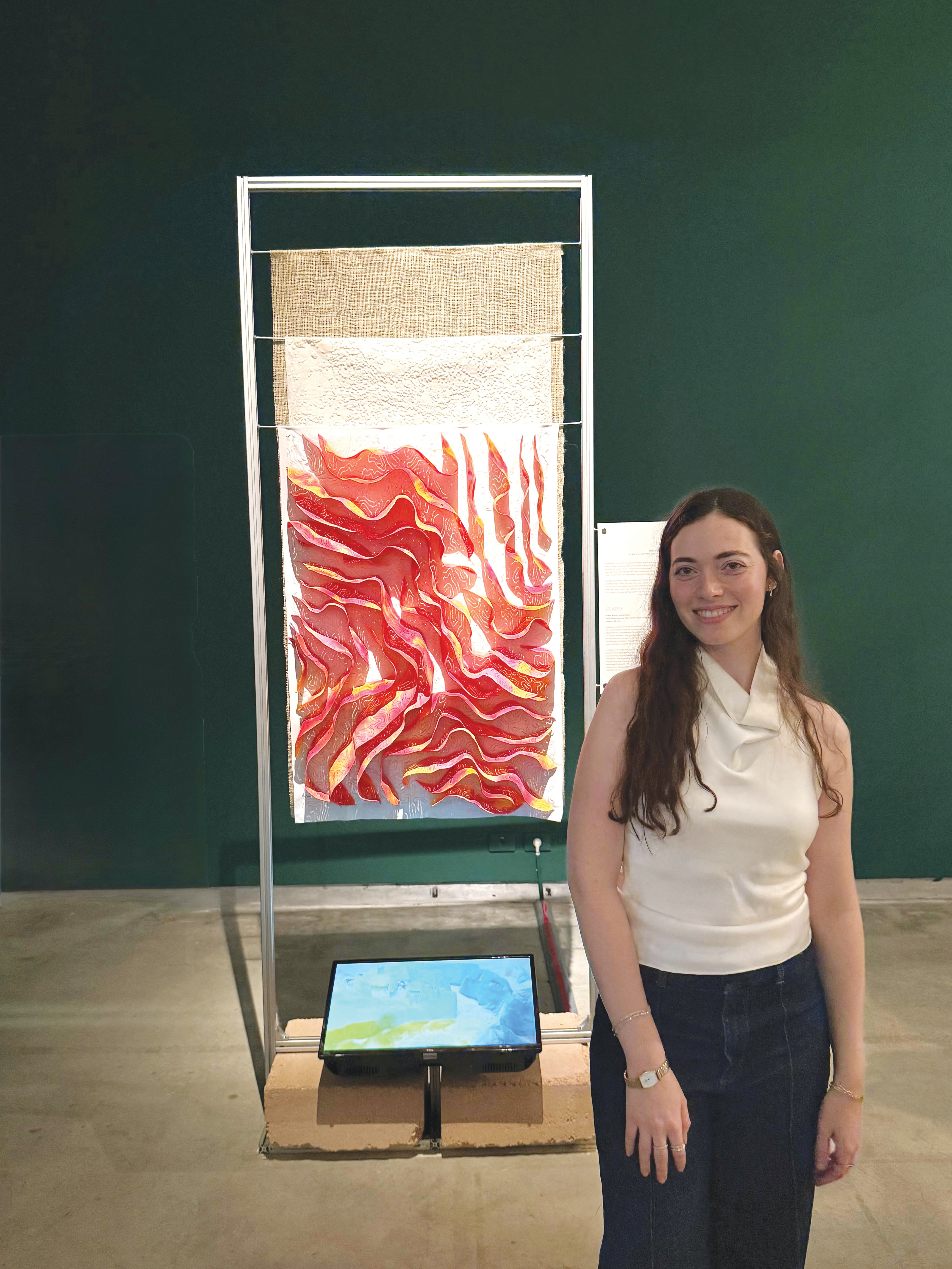
Boneh’s design practice is grounded in hands-on experimentation, design thinking, and the integration of advanced fabrication technologies with material and craft-based processes. She specializes in translating research into tangible, scalable design systems that integrate aesthetics, functionality, and ecological responsibility.
Alongside her research, Boneh leads multidisciplinary design projects across environmental, medical, textile, agricultural, and industrial fields. She specializes in translating research into design systems that integrate aesthetics, functionality, and ecological responsibility. Her work has been exhibited internationally.
In her work SEATEX, presented in the exhibition The Circle at the Design Museum Holon, which encourages visitors to greater ecological awareness, Boneh explores the use of a combination of various organic materials and natural fibers from different sources.
“I use natural pigments. The colors are selected according to the specific marine environment in which the sheet is deployed, to support ecological restoration,” she told the Magazine.
She explained further: “SEATEX presents an innovative method (Registered Design, Patent Pending) for seagrass planting and restoration, marine ecosystem restoration, and the creation of habitats for marine life.”
Her work’s colors, the orange-red waves, despite referring to the sea, have the energy of fire. At first glance, it is simply pretty and energetic. Speaking to the artist, I learned how much research she did in order to achieve that effect.
Her other work in dialogue with fashion is on view in the just-opened group exhibition City on Troubled Waters at the Tel Aviv City Museum.
Inspiration: I find inspiration in almost everything I see and hear. I draw inspiration both from the world around me and within. My mind is constantly working overtime, filled with thoughts and ideas.
I am very curious, drawn to many different fields, and love to explore. Lots of my inspirations come from nature: its colors, materials, forms, textures, and movement, but also from the way natural systems function, adapt, and change.
Working with materials hands-on is a source of inspiration in itself. I like to take a material, technology, or method of making, explore it through my hands, and discover new possibilities, and question how they can be used differently.
I draw inspiration from new technologies, but also from handcrafts passed down through generations. The encounter between the two fascinates me and is central to my work.
Meaning of art: To me, art is everything. The world we live in is itself a form of art, and art is all around us. It can be something created by people and expressed through a thought, an idea, the body, movement, poetry, handcraft, or a physical object, even a functional one.
But I also see art in existence itself, in us, in nature, and in everything that surrounds us.
Boneh’s art: In my own work, I do not like to define art by discipline. For nearly 12 years, I studied art and design, from visual art to industrial design and research. I enjoy moving freely between these worlds, which, for me, have long since become one.
For me, creativity often lies exactly there: in creating connections that did not exist before. Boundaries between disciplines are fluid, and the freedom to move between them allows me to arrive at ideas that might never have emerged from a single field alone.
My projects can look very different from one another, yet for me they share a clear common thread: curiosity, the search for new connections, and the desire to look at familiar things from a different point of view.
www.instagram.com/shelly_boneh_/ ■