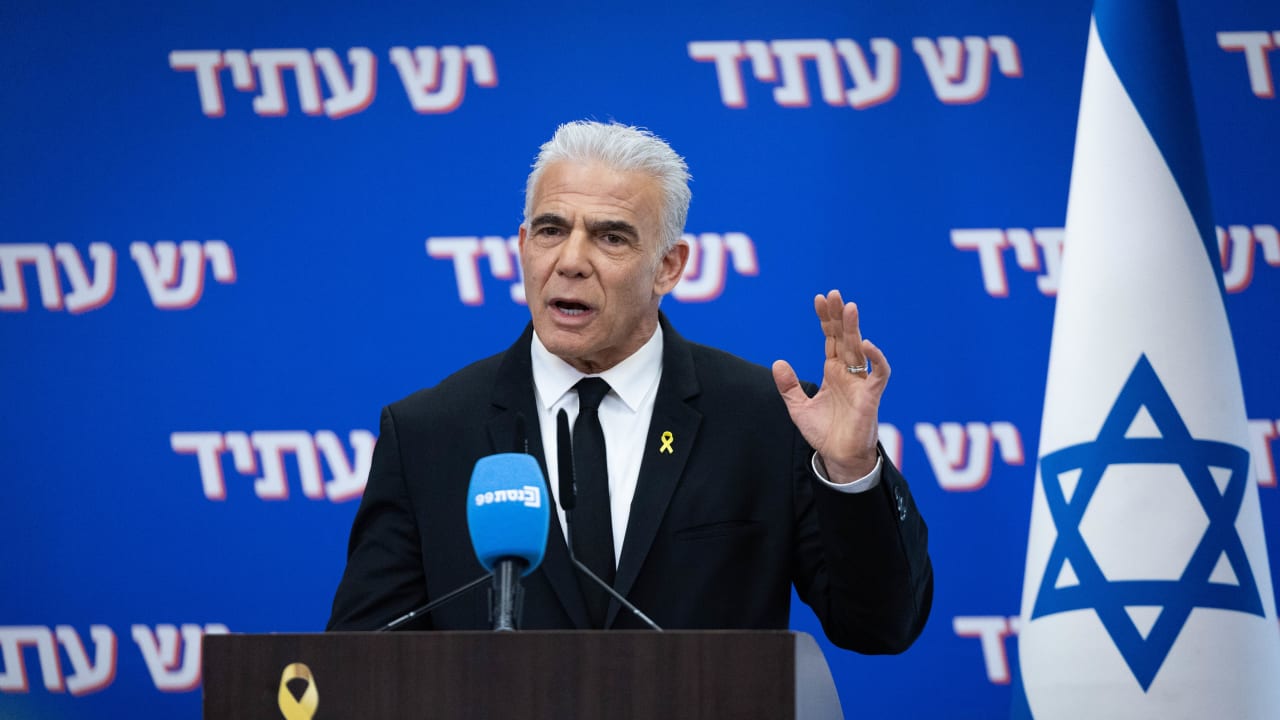
Opposition leader Yair Lapid on Tuesday accused the Prime Minister’s Office on Wednesday evening of misleading the public and straining ties with Washington, after a newly revealed emblem linked to postwar governance in Gaza prominently featured a symbol associated with the Palestinian Authority.
Notably, the logo for the National Committee for the Administration of Gaza (NCAG) is nearly identical to the emblem previously used by the Palestinian Authority and the PLO: it features an eagle with a shield, the colors of the Palestinian flag on its chest, and a banner in its talons. In previous iterations, the banner read "Palestine" in Arabic, but the NCAG version reads "NCAG" instead.
“If the Palestinian Authority enters Gaza, then the logo is also that of the Palestinian Authority,” Lapid said. “The Prime Minister’s Office needs to be much more careful before accusing the American administration of lying.”

Lapid’s remarks came in response to a growing controversy over a new emblem meant to represent the international body slated to manage the Gaza Strip once the current war ends. The logo, unveiled earlier this week, sparked political alarm in Jerusalem for appearing to contradict Israel’s longstanding policy of rejecting any PA role in post-Hamas Gaza.
Is the Palestinian Authority involved in Gaza's future?
At the center of this is the larger question of who is shaping Gaza's diplomatic and administrative future and who is being left behind.
Prime Minister Benjamin Netanyahu has repeatedly pledged that the Palestinian Authority would play no part in governing Gaza after the war, whether in an administrative, civilian or symbolic capacity. But the emblem, perceived as bearing PA insignia, has raised doubts about whether Israel still controls the process.
In a statement, the Prime Minister’s Office insisted that the logo shown to Israeli officials differed from the one later released. It reiterated that Israel would not allow the PA to operate in Gaza or to appear in any official capacity. However, the carefully worded response avoided addressing the broader concern: that decisions about Gaza’s future may be unfolding outside of Israeli influence.
The administrative mechanism now taking shape is not an Israeli initiative. It is the product of a U.S.-led process, coordinated with regional and international partners. Though framed as a pragmatic effort to quickly stabilize the Strip, the plan places the Palestinian Authority, despite its governance challenges, at the center, given its existing institutions and workforce.
Notably, Yisrael Beytenu chairman Avigdor Liberman issued a statement Tuesday night slamming the decision.
"We were promised 'total victory', but what we got was total disgrace. This weak leadership must be removed, the sooner, the better!"
On the coalition side, the move is also unpopular. Leadership in the Religious Zionist party has warned that if the Palestinian Authority is granted actual authority, it would constitute a political red line. For now, the party is not threatening to collapse the coalition or disrupt budget votes. But senior figures say a tipping point would be reached if the PA assumes meaningful control on the ground.
Privately, coalition sources see the Prime Minister’s Office statement as a dual signal: a message to Washington and a political reassurance to the domestic right. Yet few believe the controversy ends with the logo. The real test, they say, lies in future appointments, administrative structures, and decisions that will determine who governs Gaza.