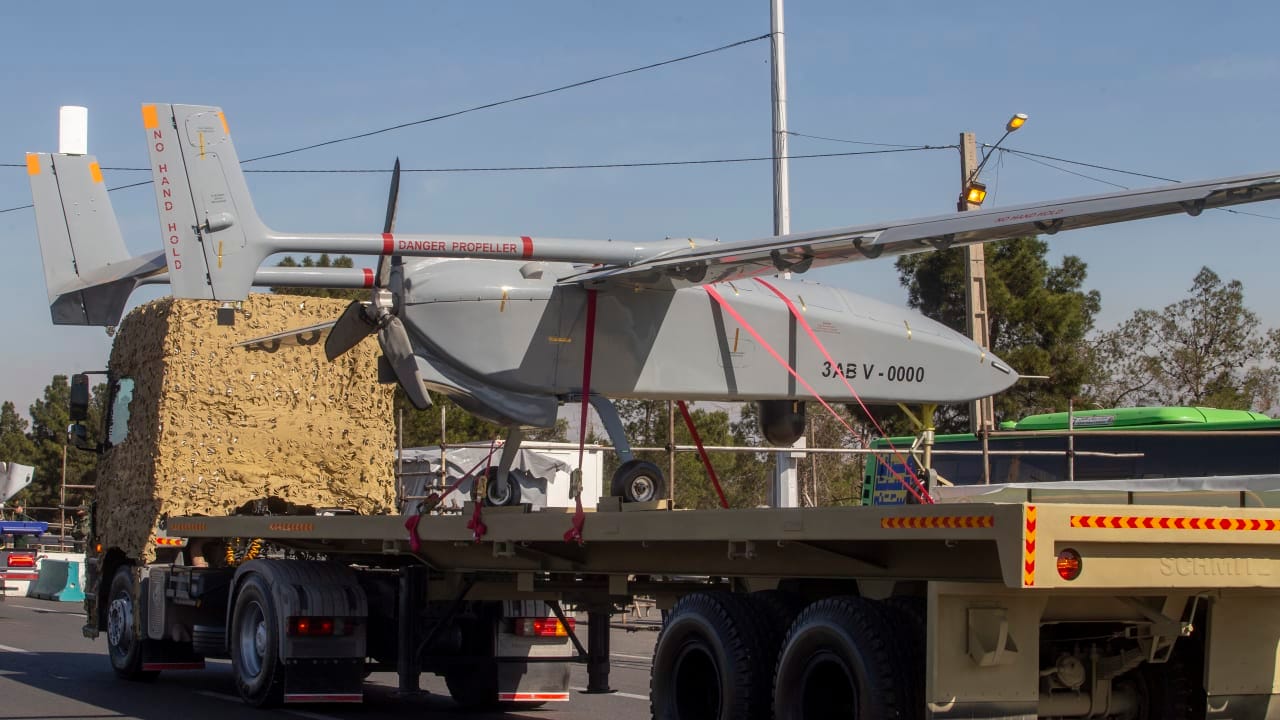
The Iranian Shahed-139 drone launch toward the USS Abraham Lincoln aircraft carrier in the Arabian Sea on Tuesday was part of Tehran’s message to US President Donald Trump, an expert told The Jerusalem Post on Wednesday.
The Islamic regime is “trying to make good on its threat that, if there is another war, it will be a region-wide war,” Behnam Ben Taleblu, the Iran Program Senior Director and Senior Fellow at the Foundation for Defense of Democracies think tank in Washington, told the Post.
Recounting how Iranian officials, most recently among them Ayatollah Ali Khamenei, have threatened regional stability as a consequence of an attack, Taleblu said that Tehran was showing the “Persian Gulf stands to become a theater of conflict.”
“In the cycles of violence that we have seen in the region post-October 7, the Persian Gulf and Strait of Hormuz have not featured as prominently then as they did during max pressure 1.0 particularly 2019, to 2020 when the Islamic Republic was contesting American oil sanctions by threatening ships, taking tankers hostage, putting mines on ships, as well as striking oil facilities,” he said.

“Max Pressure 1.0” refers to the sanctions and diplomatic isolation policy imposed on Iran by the first Trump administration in 2018 after the US withdrew from the 2015 nuclear deal.
Houthi tactics
The Gulf and Strait of Hormuz have been quiet these past few years of conflict, especially compared to the maritime disruptions caused by the Houthis in the Red Sea, Gulf of Aden, and the Bab el-Mandeb Strait.
“Those asymmetric harassment tactics that the Houthis employed post-October 7 were actually created and perfected by the Islamic Republic for the Persian Gulf and Strait of Hormuz,” he explained. “The regime used to often harass oil tankers and other vessels in the region with small boats, and then it shifted to doing so with drones…”
Taleblu said that the regime is “poking, prodding and testing Trump’s resolve,” and that was part of the reason the US needed to respond with “pure military professionalism.”

“The USS Abraham Lincoln aircraft carrier and the F-35 jet that destroyed that drone passed their tests with flying colors,” he asserted.
The oversaturation threat
While the drone that approached the carrier was one of the regime’s longer-range drones, other experts have warned that Iran may attempt a swarm strategy to overwhelm US and Israeli military defenses. Cameron Chell, CEO of Canadian drone company Draganfly, told Fox News Digital last week that there was a credible threat to high-value US naval vessels by Iran’s use of low-cost one-way drones.
“If hundreds are launched in a short period of time, some are almost certain to get through,” he said.
Responding to Chell’s concern, Taleblu said that most of Tehran’s drones are low and slow flying drones.
“The regime’s suicide drones are popularly called one way attack drones, or kamikaze drones, function as a poor man’s cruise missile, and could feature in a layered attack with other cruise missiles or fired before ballistic missiles, basically in an attempt to overwhelm defenses,” he admitted, though noted that Tehran failed in its attempt to use this strategy in the June 12-day war with Israel.
While Israel’s layered air and missile defense systems protected the country, he warned that assets closer to Iran’s territory are more vulnerable, and the chance of a swarm attack succeeding does increase. The US tackled such a threat when it came to the Shia militias in Iraq, he continued, but has yet to face the volume of drones that Tehran could send.
“While the Islamic Republic is weak, it is still lethal, and it is still in charge of a spectrum of unmanned aerial threats, which on the low end include mortars, then rockets, then drones, then cruise missiles and ballistic missiles, and together, the unmanned aerial threat spectrum becomes the regime’s biggest weapon of both punishment and deterrence,” he concluded.
Jacob Laznik contributed to this report.