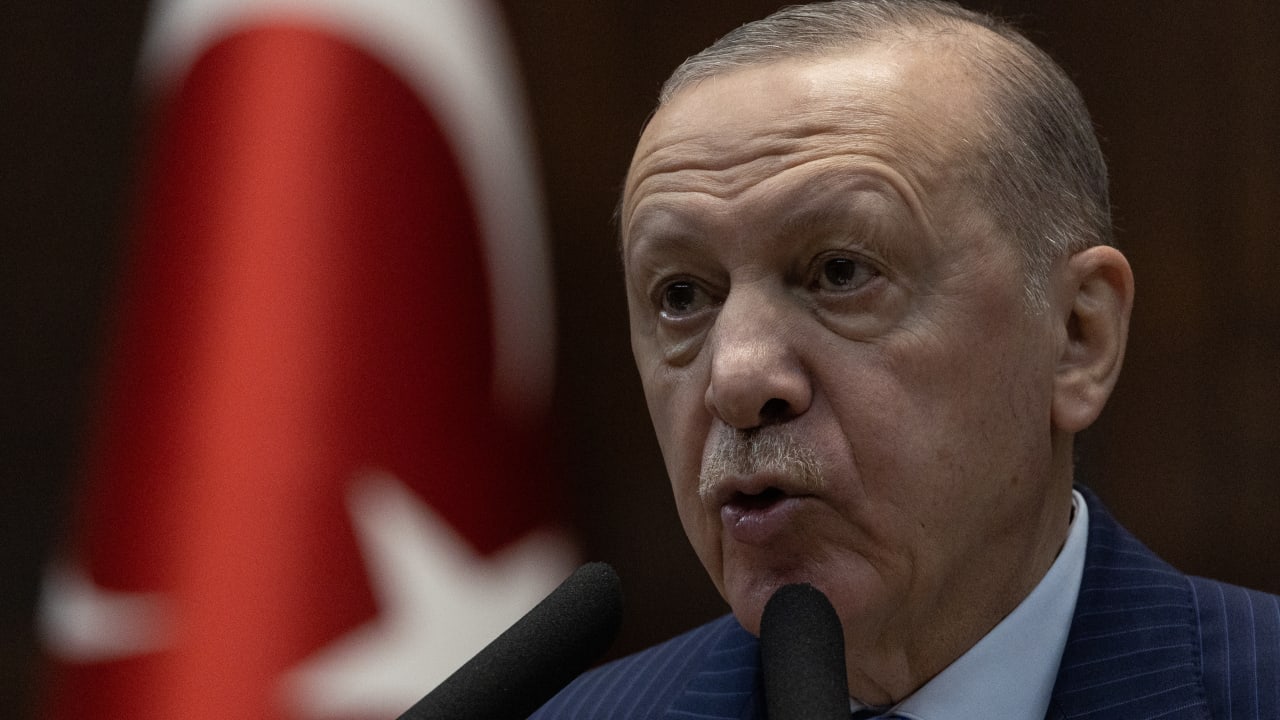
President Tayyip Erdogan said Turkey is working hard to prevent US-Iran tensions from tipping the Middle East into a new conflict, as the two adversaries signal that disagreement over Tehran’s missile arsenal threatens to torpedo a deal.
Speaking to reporters on a return flight from a visit to Egypt, Erdogan added that talks at the level of the US and Iranian leadership would be helpful after lower-level nuclear negotiations due in Oman on Friday, according to a transcript of his comments shared by his office on Thursday.
Turkey was doing its best to prevent an escalation, said Erdogan, who has spent years cultivating a close relationship with US President Donald Trump while expanding Ankara's diplomatic influence across the Middle East and beyond.
Iran and the US remain at odds over Washington's insistence that negotiations include Tehran's missile arsenal and Iran's vow to discuss only its nuclear program, in a standoff that has led to mutual threats of airstrikes.
The differences over the talks' scope and venue have raised doubts about whether the meeting would take place, leaving open the possibility that Trump could carry out a threat to strike Iran.

Trump says Ali Khamenei should be worried
Asked on Wednesday whether Iran's Supreme Leader Ayatollah Ali Khamenei should be worried, Trump told NBC News: "I would say he should be very worried. Yeah, he should be." He added that "they're negotiating with us," but did not elaborate.
After Trump spoke, US and Iranian officials said the two sides had agreed to move the talks to Muscat, after initially agreeing to hold them in Istanbul.
But there was no indication they had found common ground on the agenda.
German Chancellor Friedrich Merz said on Thursday that concerns about a further escalation of the conflict with Iran characterized his talks during a trip to the Gulf region.
He urged Iran to end what he called aggression and enter into talks, saying Germany would do everything it could to de-escalate the situation and work towards regional stability.
"In all my conversations yesterday and today, great concern has been expressed about a further escalation in the conflict with Iran," he said during a press conference in Doha.
Gulf Arab states fear that Iran will carry out its threat to target US bases on their territory if the United States attacks the Islamic Republic.
China, meanwhile, said it supported Iran's legitimate right to the peaceful use of nuclear energy and opposed the "threat of force and sanction pressure."
China would continue to promote the proper resolution of the Iranian nuclear issue, Liu Bin, China's assistant foreign minister, told Iran's deputy foreign minister in Beijing, the Chinese ministry said.
Tensions are high across the region as the US builds up forces there, and regional players seek to avoid a military confrontation that many fear could escalate into a wider war.
Trump warned of 'bad things' if no Iran deal agreed
Iran says the talks must be confined to its long-running nuclear dispute with Western powers, rejecting a US demand to also discuss Tehran's missiles, and warning that pushing issues beyond the nuclear program could jeopardize the talks.
But US Secretary of State Marco Rubio said on Wednesday that talks would have to include the range of Iran’s ballistic missiles, its support for armed proxy groups around the Middle East, and its treatment of its own people, besides nuclear issues. Iranian sources say the US is demanding that Tehran limit the range of Iran's missiles to 500 km (310 miles).
Tehran's regional sway has been weakened by Israel's attacks on its proxies - from Hamas in Gaza to Hezbollah in Lebanon, the Houthis in Yemen, and militias in Iraq - and by the ousting of Iran's close ally, former Syrian President Bashar al-Assad.
While the talks were originally set for Turkey, Iran wanted the meeting to take place in Oman, as a continuation of previous talks held in the Gulf Arab country, which had focused strictly on Tehran's nuclear program, a regional official said.
Iran says its nuclear activities are meant for peaceful, not military purposes, while the US and Israel have accused it of past efforts to develop nuclear weapons.
The diplomatic efforts follow Trump's threats of military action against Iran during its bloody crackdown on protesters last month and the deployment of more naval power to the Gulf.
The US has sent thousands of troops to the Middle East, along with an aircraft carrier, other warships, fighter jets, spy planes, and air refueling tankers.
Trump has warned that "bad things" would probably happen if a deal could not be reached, ratcheting up pressure on the Islamic Republic.