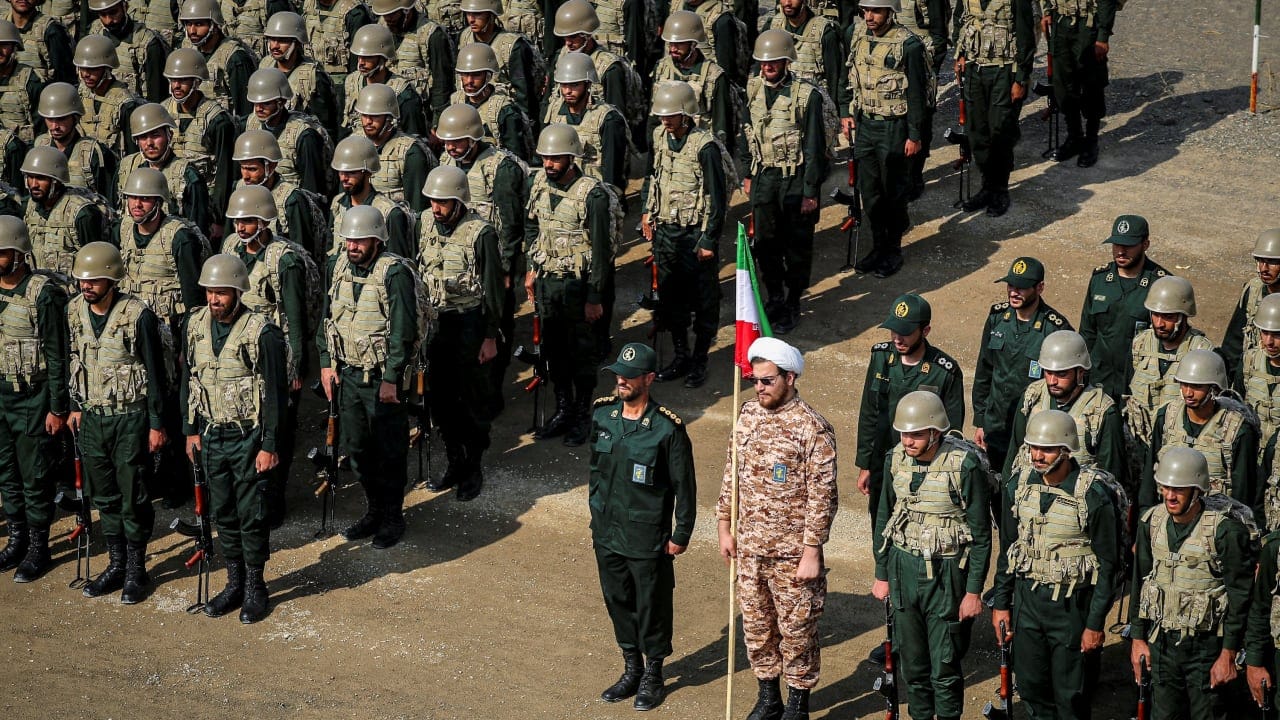
The Islamic Revolutionary Guard Corps (IRGC) has tightened its grip on wartime decision‑making despite the loss of top commanders, senior sources say, driving a hardline strategy that is propelling Tehran's drone‑and‑missile campaign across the region.
Anticipating the decapitation of their leadership, the Guards had already delegated far down the ranks before Saturday's US-Israeli attack, a resilience-building strategy that could also risk miscalculation or a wider war with mid-ranking officers empowered to attack neighboring states. On Wednesday, Iran fired on Turkey, a NATO nation.
Inside Iran, the Guards' central role at all levels of the system and draconian approach to security may also make it harder for protests to erupt, undermining any US or Israeli hopes that their attack will spur an uprising and regime change.
The choice of the next supreme leader, after Ayatollah Ali Khamenei's death on Saturday, could further cement their role, said Kasra Aarabi, head of research on the Guards at United Against Nuclear Iran, a US-based policy organization.
Khamenei's son Mojtaba, widely seen as a likely candidate, has very close ties with the Guards, exercising significant control over them and enjoying extensive support, including from more radical junior ranks.
"If the conflict suddenly stops and the regime survives, we can be certain the Guards will have an even more important role," said Aarabi.

IRGC decentralization strategy
Reuters spoke to six Iranian and regional sources with close knowledge of the Guards for this article, all of whom confirmed they had taken a far greater role in the hierarchy since the war began on Saturday and were now involved in every major decision.
A security official close to the Guards said the Guards' new head, Ahmad Vahidi, was present in every high-ranking meeting and that the Guards' overriding objective was always the survival of Iran's Islamic revolutionary system and its goals.
Deputy defense minister and Guardsman Reza Talaeinik spelled out the elite force's efforts to build resilience in a television interview on Tuesday, saying each figure in the command structure had named successors who span three ranks, ready to replace them.
"The role of each unit and section has been organized in such a way that if any commander is killed, a successor immediately takes their place," he said.
Israeli strikes last year killed the Guards' overall head and the heads of their intelligence, aerospace, and economic units. On Saturday, an airstrike killed the latest Guards' head, Mohammad Pakpour.
Decentralization has been part of the Guards' doctrine in case of attack for nearly 20 years and was developed after watching the collapse of Iraqi forces during the US-led invasion in 2003, Aarabi said.
"The whole idea was to decentralize so that if one particular province came under attack, it could defend itself and sustain the regime's authority and rule," he said.
Fighting external, internal threats to IRGC
Crucially, the plan was designed to ensure that the Guards could continue to act as both the main spearhead of Iran's military response to external attacks and as the enforcers of internal security inside the Islamic Republic, he added.
The approach appears to be holding for now, though sustained attacks that continue to pick off both senior and more junior Guards commanders could eventually test the Guards' ability to maintain strategic coherence.
To be sure, the Guards are not an entirely homogeneous unit, with their own factional rivalries, personal disputes, and differences over the group's role. But one of the sources said they are more "united than ever when Iran is under attack."
There may also be signs, five days into the Israeli and US strikes, of the command structure starting to degrade, said Aarabi, pointing to what he called increasingly wild attacks on civilian targets in Gulf monarchies.
How far that may also reflect a deliberate strategy to show the attack on Iran was a mistake with global implications is not certain.
Foreign Minister Abbas Araqchi said Iran's response to the attack had already been planned.
"These units are operating based on general instructions given to them in advance, rather than direct, real-time command from the current political leadership," he told Al Jazeera.
While the Guards are now involved in almost every strategic decision taken in Iran - even beyond the central role they held before the war - they can also count on a surviving political leadership in which the three top men are former Guards members.
Political, economic empire in Iran
The IRGC was founded soon after Iran's 1979 revolution to defend the new republic against both internal and external foes and to serve as a counterweight to the regular armed forces.
Answering directly to the supreme leader, it has emerged as a state-within-a-state, combining military power, an intelligence network, and economic might all focused on maintaining the survival of Iran's Islamic system of power.
That role was put to the test when Iraq invaded months after the revolution, unleashing an eight-year war of attrition that was a formative experience for many of the current generation of Iranian leaders.
Senior Iranian figures who served with the Guards in the war include the three non-clerics occupying the most critical positions in Iran since Khamenei's death.
President Masoud Pezeshkian was a battlefield surgeon; Parliament Speaker Mohammad Baqer Qalibaf fought on the front lines before heading the Guards' air force unit; while Ali Larijani, Khamenei's top adviser, was a staff officer behind the lines.
From the early 2000s onward, as the wartime generation began moving into more leadership positions and Iran's long confrontation with the West accelerated, the role of the Guards within the Iranian state also began to increase.
The Guards were put in charge of Iran's nuclear program, a project Tehran has always maintained is for purely peaceful purposes, but which Western countries believe is a cover for building an atomic bomb.
As sanctions imposed over the nuclear project bit, the Guards took on a role in the economy, with their construction arm, Khatam al-Anbia, winning major contracts, including in the all-important energy sector.
The Guards increasingly also served as the conduit to Shi'ite proxies across the Middle East, while their volunteer paramilitary, the Basij, was used to crush internal unrest.