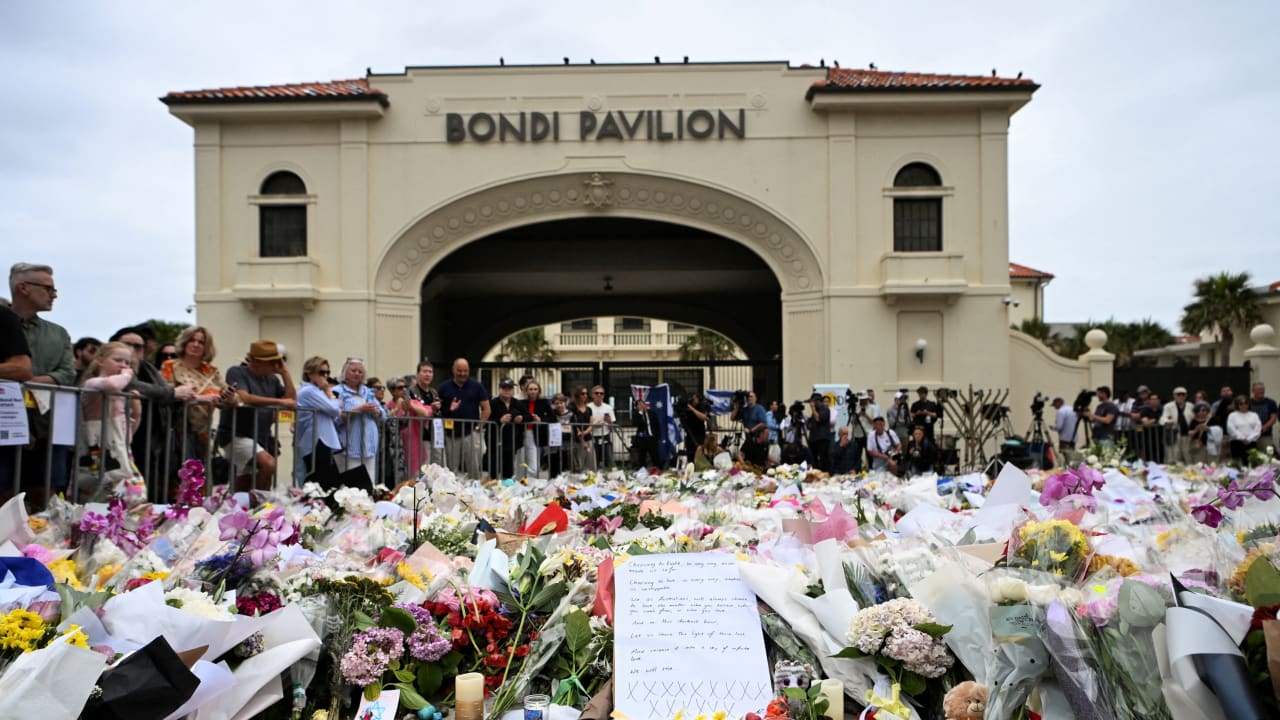
I left Australia with sand still in my shoes and the sound of the Pacific in my ears. Bondi does that to you. It disarms you. It convinces you that this is a place beyond the darkness of the world, a sun-drenched strip of land where life is lived loudly, joyfully, and without apology.
And then, on Hanukkah, that illusion was shattered.
Bondi Beach, synonymous with freedom, openness, and carefree multiculturalism, became the scene of a horrific massacre. A place of light was plunged into darkness. A festival that celebrates the triumph of a small flame over overwhelming night was scarred by a hatred that felt disturbingly familiar.
Just after I returned home, a ceremony was held to mark the end of the shloshim (30-day mourning period) for the victims. I was no longer in Australia, but one person who was in my group stayed on and attended.
He later sent me his notes and a video recording of the event. I read them once. Then again. Then slowly, line by line, letting each detail sink in. I watched and rewatched the video. By the end, I was in tears.
The memorial took place outdoors, beside the Bondi Pavilion, at 7:30 on a Sunday evening. The weather was unforgiving – heavy rain and cold. The kind of night that offers every excuse to stay indoors. And yet, attendance was estimated to be in the thousands. Jews and non-Jews. Young and old. Locals and visitors. They stood shoulder to shoulder in the rain, refusing to allow memory, solidarity, or moral clarity to be washed away.
The opening speaker was the governor of New South Wales. She spoke of one Australian people with one heart. Unity was the theme of the evening – not the hollow unity of platitudes, but the kind demanded when values are tested and lines must be drawn.
Tehillim (Psalms) were recited in Hebrew and English. Music followed – guitar, flute, violin, and voices – weaving grief and hope together in a way that words alone cannot.
The ceremony was organized and led by Rabbi Yossi, who carried the impossible responsibility of holding a shattered community together without allowing its grief to collapse into despair.
The survivors speak
One of the speakers was a woman named Jesse. She had attended Hanukkah on the Beach with her young daughter. When the shooting began, she ran, found shelter, and lay on top of her child, using her own body as protection.
Minutes passed. The noise grew closer. At one point Jesse whispered to her daughter and heard no reply. Panic surged. She feared she had suffocated her own child in her attempt to save her.
Eventually, a small voice answered.
They lay motionless as the shooting drew nearer, certain that death was approaching. Jesse told her daughter to open her heart and say all the good things she could think of – gratitude as a final prayer, love as resistance. They were eventually rescued, physically unharmed though forever changed.
Her husband spoke next. He spoke about unity and about the Shema prayer: its insistence on oneness, not only of God but of human responsibility. Then, guitar in hand, he led thousands of people in singing Shema Yisrael. Jews and non-Jews. In the rain. On Bondi Beach.
The rabbi then read the names of the victims, one by one. He lingered over each name, telling their stories – who they were, how they lived, how they contributed. Names ceased to be statistics and became lives once again.
Two stories struck with particular force. One was of a Holocaust survivor, taken in and welcomed by Australia after surviving the unspeakable horrors of Europe, only to find death decades later through the same senseless hatred. Eighty years had passed. The geography had changed; the ideology had not.
Another moment was almost unbearable in its symbolism.
Memorializing the victims
Each evening after the attack, people gathered at the memorial and the names of the victims were read aloud. On the second evening, as one name was spoken, a plane passed overhead. It was pointed out that the body of that victim was on the plane, on its way to Melbourne for burial. As the rabbi said, he was still with the people of Bondi, looking down upon them, present now only in spirit.
The final name read was that of Matilda. She was ten years old.
The rabbi spoke of her joy, her love of life, her infectious energy. Thousands stood in silence. There were barely any dry eyes among them.
Matilda’s father then tried to speak. He was overcome with emotion. Grief has a physical weight. Still, he insisted on thanking the first responders, not only for trying to save his daughter, but for their efforts to save so many others, both those who survived and those who did not.
The rabbi explained the meaning of the kaddish prayer. Not a prayer of death, but of life – a declaration of faith and sanctity in a broken world. All who could stand stood, and a communal kaddish rose into the cold, rain-soaked night.
It was followed by the singing of “Waltzing Matilda,” with new words written in memory of a child who should have had a lifetime ahead of her.
Australian and Jewish. Particular and universal. Grief transformed into song.
The shifts in society
The final speaker was another Holocaust survivor. He began by explaining that in the camps, crying was forbidden. Tears were considered weakness and could cost a life. He had never cried publicly since.
Until that night. Until Matilda’s father spoke. Until “Waltzing Matilda” was sung.
He spoke of the welcome he had received from Australia after the Shoah, of a country that prided itself on decency, multiculturalism, and fairness.
Then his tone shifted. He said everything changed after October 7. Antisemitism moved from the margins to the mainstream.
Even Sydney University, where he once studied happily, had become a place of hostility. He said that if he walked there today wearing a kippah (skullcap), at best he would be insulted and at worst assaulted.
His final words brought the longest applause of the evening.
“Give us back our Australia.”
It was not nostalgia speaking, but moral urgency – a demand from people who know precisely where unchecked hatred leads and who refuse to surrender their country’s soul.
Australia’s Jews, joined by countless non-Jews, are not asking for special treatment. They are demanding the return of something that belongs to everyone: courage, decency, and the refusal to excuse evil in the language of ideology.
The world should take note. Because what happened at Bondi was not only an attack on Jews, or Australians, or a beachside celebration. It was an assault on the idea that free societies can remain free if they abandon the values that sustain them.
On a cold, rain-drenched night, thousands of Australians stood and declared: not here. Not like this. Not on our watch.
They have demanded their country back. The rest of the world must now decide whether it has the courage to do the same.
The writer is a rabbi and physician. He writes and teaches on Jewish ethics, leadership, and resilience. His work appears on rabbidrjonathanlieberman.substack.com and youtube.com/@rabbidrjonathanlieberman.