Israel has spent decades cultivating a fearsome reputation for reaching its enemies wherever they are.
After attacks, phrases like “anyone who raises a hand against us, his hand will be cut off,” or “whoever harms us, Israel’s long arm will harm them sevenfold” regularly roll off the tongues of the prime minister, defense minister, and IDF chief-of-staff.
That policy is not just bluster: from Adolf Eichmann to the murderers of Israel’s Olympic athletes in Munich to the assassination of Iranian nuclear scientists, Israel has proven that it will track down and kill those who spill Israeli and Jewish blood.
What is Israel's responsibility for the security of Jews abroad?
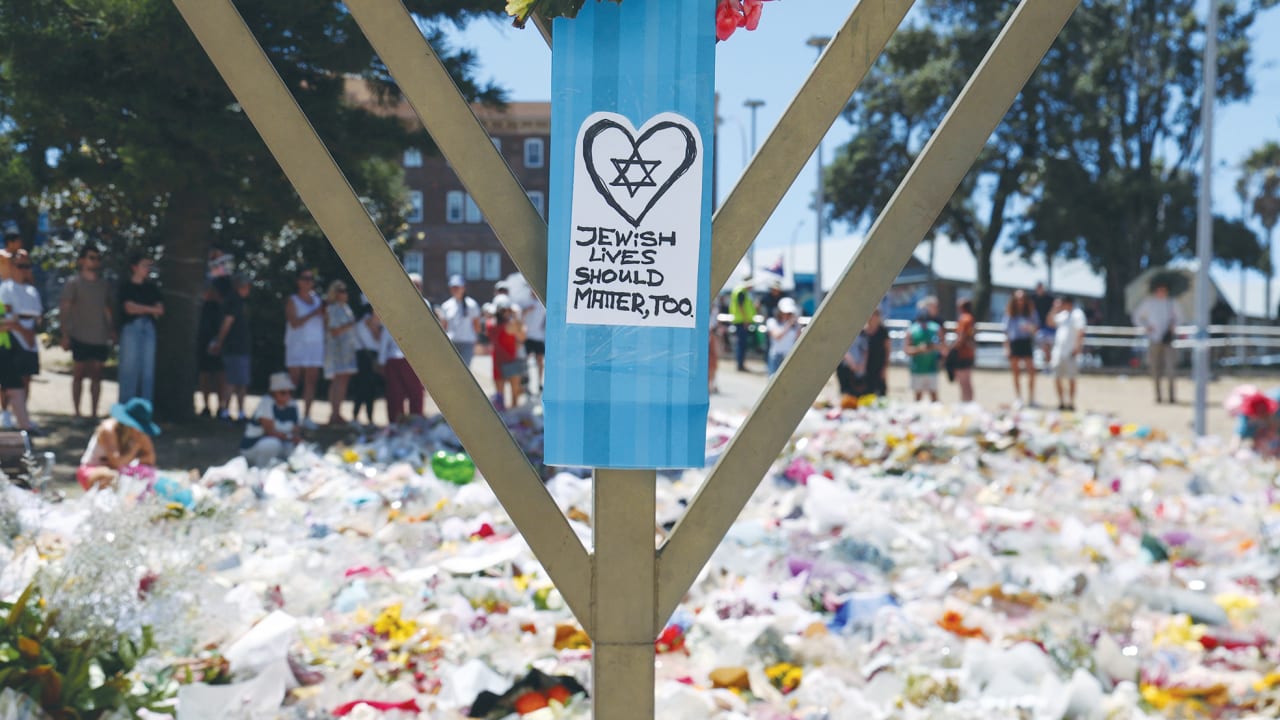
But what happened Sunday on Bondi Beach in Sydney, where 15 people were killed by jihadist terrorists hunting Jews at a Hanukkah party, forces Israel to face a difficult question: In an age of “globalizing the intifada,” what is Israel’s responsibility for the security of Jews abroad, what are the limits of its reach, and how must its security doctrine evolve when Jews are murdered not just in Tel Aviv and Jerusalem, but at gatherings in Boulder, Manchester, and Sydney?
In the popular imagination, the Mossad is almost omnipotent. If there is a foreign hand behind a terrorist attack on Jews, many assume Israel can – and will – eventually find the murderers wherever they are and eliminate them, whether in Tehran, Beirut, or Dubai.

But Bondi highlights a serious dilemma: counterterrorism beyond Israel’s borders looks very different when the arena is an English-speaking democratic ally - even an ally that has turned much more critical of Israel over the past three years.
Australia is not a weak state where foreign services can operate with ease; rather, it is acutely sensitive to questions of sovereignty and the rule of law.
It is also a core member of what is known as the Five Eyes intelligence alliance - a close-knit intelligence-sharing partnership of English-speaking countries formed after World War II, made up of the US, UK, Australia, New Zealand, and Canada.
Any perception that Israel is conducting unilateral operations on Australian soil would trigger a maelstrom in Canberra that would reverberate in Washington.
That does not mean Israel is powerless. It does mean that the familiar image of it acting alone, decisively, and invisibly does not apply in the same way.
Bondi, therefore, exposes something rarely acknowledged: there are limits to what Israel can do when terror strikes Jews in the territory of a democratic ally.
Israel cannot flood Australia with operatives. It cannot tap local citizens’ communications at will. It cannot take out culprits in the way it has occasionally done in places with little real capacity to object.
At most, it can move in the shadows at the invitation of Australian services or in tightly controlled joint frameworks.
For Jews raised on the stories of Israel hunting down Eichmann and those responsible for the Munich massacre and the attacks in Buenos Aires, that is jarring.
But it does not mean helplessness.
Israel cannot deal with the globalized intifada on its own
It means that Jerusalem cannot deal with this globalized intifada alone, and that the most durable way forward lies in working with local authorities - in Australia and in other countries where Jews may be targeted - as indispensable partners in preventing the next attack.
That shifts the emphasis from spectacular unilateral action to painstaking, shared work: Israeli and Australian intelligence officers comparing the travel histories of flagged suspects, following financial trails, and examining encrypted communications.
They will look for signs of foreign training, ideological guidance, or operational direction - whether in Iran, Lebanon, Southeast Asia, or elsewhere.
If any such link is established, the next question will be political: will Australia be willing to say so publicly, and will its allies be willing to act on this information? Here, Israel’s influence is indirect. It cannot dictate what the Australian government chooses to make public.
What it can do, however, is make the case that naming Iran, Hezbollah, or any other sponsor is not a favor to Israel but a defense of Australian democracy, which has an interest in knowing when foreign actors turn local citizens or residents into foot soldiers in a global campaign of violence.
All too often, attacks like those at Bondi Beach are followed by this refrain: Jews are targeted abroad because of Israeli policy. This is a singularly corrosive claim.
Why? Because no one hints that Russians in Australia may be legitimate targets because of Vladimir Putin’s actions in Ukraine. No one suggests Afghans in Germany are fair game because of the Taliban, or that Chinese Americans should be attacked because of Beijing’s human rights abuses. To say so, to even hint at this, would be to be branded a racist.
Except when it comes to the Jews. If Israel would only “behave itself,” this argument goes, often introduced into polite conversation by an interviewer asking a seemingly innocent question, Jews in Sydney would not be targeted.
This is a way of rationalizing violence against people who do not vote in Israeli elections nor serve in the IDF, and who are attacked precisely because they are Jewish, not because they are Israeli.
There was nothing Israeli about the Hanukkah party Sunday on Bondi Beach - it was a Jewish affair, not an Israeli one. What this type of argument does is excuse and normalize terror against Jews. It signals to extremists that spilling Jewish blood can be justified.
Bondi Beach also exposes the inadequacy of Israel’s traditional security lens. Understandably, Israel’s security doctrine is anchored in territory: defend the borders, pre-empt regional enemies, and fight terror emanating from Judea, Samaria, Gaza, and neighboring states.
Diaspora security was usually ancillary - the realm of quiet coordination with local communities and governments, punctuated by rare, spectacular operations when circumstances allowed.
That framework no longer fits reality. From October 7 to Bondi, via shootings in Europe, North America, and now Australia, Jews are being targeted as Jews, regardless of citizenship or geography.
The “frontline” is no longer limited to the Gaza fence or the northern border; while different in nature and scale, it can now surface unexpectedly wherever Jews gather openly. A doctrine built almost exclusively around defending Israeli territory is therefore not enough.
It needs to be expanded into something more ambitious and unsettling: a doctrine of global Jewish security.
Such a doctrine would begin by re-asserting Israel’s special responsibility not only to its own citizens but to Jews everywhere, while also recognizing the sovereignty and primacy of host states. That balance is delicate, but not impossible. Practically, it could mean several concrete shifts:
• A dedicated unit or bureau - beyond the existing Diaspora Affairs Ministry framework - whose explicit mandate is global Jewish security, with authority to coordinate intelligence, diplomacy, and outreach to communities abroad.
• Formalizing security dialogues with key democracies, spelling out minimum standards for protecting Jewish institutions and events, and developing clear protocols for sharing information about threats and coordinating responses to plots with foreign sponsorship.
Such thinking inevitably raises a very sensitive question: to what degree, if any, should Israel take into account the safety of diaspora communities when determining its own policies?
There is no simple answer. Israel’s primary responsibility remains the security of its own citizens. But Bondi underscores a reality that cannot be ignored: Israel operates in a world where its enemies deliberately erase distinctions between Israelis and Jews, and where the consequences of that erasure are borne by people with no direct influence over Israeli decision-making.
Any move toward a global Jewish security doctrine must navigate two dangers. One is overreach: the perception that Israel is inserting itself too aggressively into the domestic affairs of other countries, trying to dictate how they police protests, regulate speech, or deploy security resources. That would risk political backlash and feed precisely the conspiratorial narratives that fuel antisemitism.
The other danger is timidity: saying that the security of diaspora communities is solely the responsibility of their own governments and that Israel cannot do more than issue statements and share the occasional intelligence tip. Bondi makes clear how untenable that posture is.
When fifteen people are murdered at a Hanukkah celebration, it is no longer credible for the nation-state of the Jewish people to say: “We sympathize, but this is not our arena.”
A serious doctrine needs to be built on more intensive dialogue with diaspora communities themselves. They, not Jerusalem, live with the daily consequences of rising antisemitism. They understand local political cultures, legal constraints, and the fine line between necessary protection and provoking resentment. After Bondi, Israel needs to listen more attentively to those voices.
That conversation will be varied. Some diaspora Jews will want Israel to be far more assertive, pressuring their governments and publicly calling out failures. Others will fear that too visible an Israeli role will make them look less like citizens and more like foreigners under the protection of a foreign state.
Every country has moments that force previously abstract debates into the open. For Israel, October 7 was such a moment in terms of border defense and Gaza policy.
Bondi is a quieter but no less significant shock in the realm of global Jewish security. It strips away comforting illusions: that oceans and distance are protection from the Mideast conflict, that antisemitic rhetoric can be treated as harmless speech rather than as a warning sign of violence, and that Israel can remain primarily a state focused on defending its borders in a world where its enemies see Jews everywhere as legitimate targets.
Israel cannot be the global police force for Jews; it cannot be everywhere or do everything. But it also cannot be just another state expressing condolences from afar when attacks like these take place. In the age of a globalized intifada, Israel now needs to rethink how it approaches the security of Jews abroad.