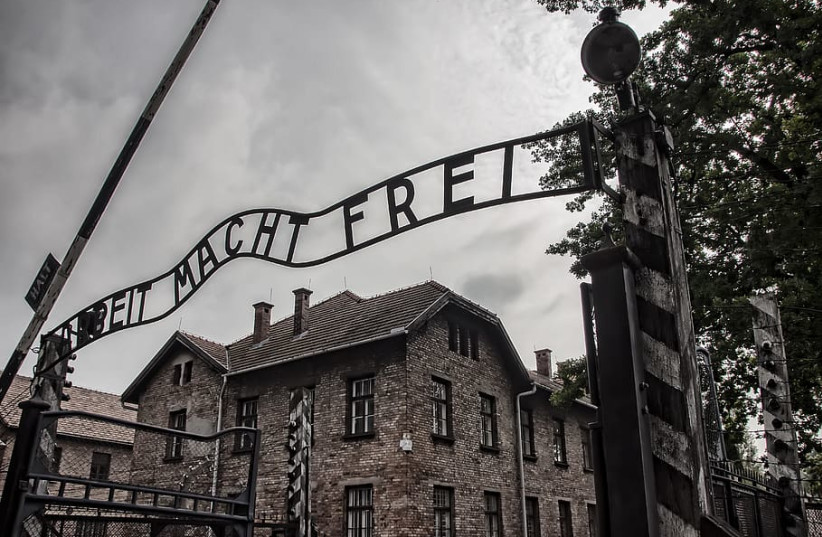
January 27 marks 81 years since the liberation of Auschwitz. Around the world, commemorations will once again be held to remember – with accuracy and moral clarity – what occurred during those horrific years. That includes what took place in Birkenau, sometimes referred to as Auschwitz II, the part of the camp where approximately 1.1 million Jews were brutally murdered.
And yet, even as the world gathers to honor Holocaust memory, a profound violation of that memory persists inside Birkenau itself: a functioning Catholic church stands in a building that once served as the SS commandant’s headquarters.
I have great regard for all religions – for their sanctuaries and symbols, and for the clergy who lead them. But a church does not belong in the largest Jewish cemetery in the world.
This is not the first time Holocaust memory has been compromised at Auschwitz. Adjacent to Birkenau is Auschwitz I. In the 1980s, Carmelite nuns took over a building that had been used for the storage of Zyklon B, the gas used to murder Jews. The Jewish community protested forcefully, and in 1993 Pope John Paul II ordered the convent closed.
As serious as that violation was, it remains less severe than what is unfolding in Birkenau. During the Auschwitz I convent controversy, a priest from the Birkenau church itself – who asked not to be identified – remarked: “It’s a mystery to us – why there is a problem (at the convent) and not here.” (Religion News Service, John Thavis, Sept. 22, 1989, “No Protests Over Birkenau Church”).
The priest was absolutely right. At Auschwitz I, Jews were murdered alongside large numbers of Polish political prisoners. Birkenau, however, was overwhelmingly a Jewish killing site: roughly 95% of those murdered there were Jews. And while the Carmelite convent stood on the perimeter of Auschwitz I, the church in Birkenau stands within the camp itself – in the very space from which the Nazis oversaw their machinery of terror.
Given everything unfolding in Israel and around the world, one might ask: Why should this issue be a priority?
Because Holocaust memory is receding, it has been argued that antisemitism has surged in force precisely because the Shoah, after 80 years, is being forgotten.
For decades after World War II, antisemites held back, at least somewhat. In the shadow of the Holocaust, attacking Jews was not socially acceptable. But as the Shoah moves further into the rearview mirror, antisemites are emerging from the shadows.
Protecting the memory of the Holocaust
That is why our challenge today is not only to remember the Holocaust, but to defend its memory from distortion.
One of the most powerful ways to do that is to ensure that the camps themselves testify to what truly occurred. This is why millions have visited Auschwitz-Birkenau over the decades: because the physical reality of the place speaks with an authority no textbook can match.
But what happens when there are no survivors left? When will even the second and third generations be gone?
What will visitors conclude a hundred years from now – a blink in history – when they arrive at Birkenau and see a church with large crosses at its entrance and crosses on its roof, visible from across the camp, looming over the grounds?
The conclusion is obvious. The world will begin to assume that the Holocaust was a Christian – primarily a Catholic – genocide, or that the Church was centrally involved in protecting Jews. That would be a tragic falsification. Historical evidence shows that the Vatican was, by and large, silent as six million Jews were murdered. Historians have also documented that Church-linked networks assisted Nazi war criminals such as Klaus Barbie in escaping to South America after the war.
This is not the time to remain silent as the past is rewritten. It is the time to confront distortion head-on – to insist on clarity about what happened, so that it never happens again.
In that spirit, it would be both noble and necessary for Yad Vashem and the United States Holocaust Memorial Museum to raise their voices as moral and Jewish consciences, and to demand that the Birkenau church be removed from the camp site and relocated elsewhere, to the town of Brzezinka (Birkenau), far from the grounds of Auschwitz-Birkenau.
In that same spirit, participants in the March of the Living must raise their voices as well. Each time they visit Birkenau, they should stand before the church and protest peacefully but unmistakably, refusing to allow this distortion to go unchallenged.
Historians such as Arthur Morse, in While Six Million Died, and Rafael Medoff, in The Deafening Silence, have documented how the Jewish community was, on the whole, tragically constrained – and too often silent – during the Holocaust, as many failed to heed the biblical commandment “Do not stand idly by the blood of your neighbor.”
Today, as Holocaust memory is being manipulated and blurred, we cannot make the same mistake.
On the 50th and 75th anniversaries of Auschwitz’s liberation, when we stood in protest before the Birkenau church, we were asked: Why are you here? Why stand in Auschwitz so many decades later? Our answer was simple: We are here to speak for those who cannot speak for themselves.
On January 27 – the 81st anniversary of liberation – that must be our clarion call.
The writer is the founding rabbi of the Hebrew Institute of Riverdale – the Bayit in New York.