Sharply reduced air traffic to and from Tehran, Iran’s capital, indicates that the US military buildup in the past weeks is severely punishing the Iranian economy way beyond the economic sanctions that were re-imposed by the Trump administration.
After the Iranian security forces brutally suppressed the demonstrations by January 15, more than two-thirds of the scheduled flights have been cancelled in the ten days that transpired since then.
The recent wave of protest at the end of the previous year was related to economic grievances, which could mean that further economic downturn will increase the chance of renewed protests.
Tehran is serviced by two of the country’s major airports: the Mehrabad International Airport, which, despite its name, is almost exclusively devoted to domestic flights, and the newer Imam Khomeini International Airport, which is Iran’s major gateway to the outside world.
To fully understand the gravity of the situation reflected by air travel, it is important to gauge the longer-term effects of economic sanctions. When the 2011 nuclear agreement with Iran was concluded, Iran’s economy grew, as reflected by the sharp rise in air traffic to Imam Khomeini Airport. In 2017, the airport reported an average of 300 flights per day, a peak never achieved again.

US pulling out of the nuclear agreement damages the Iranian economy
The re-imposition of sanctions in the first Trump administration in 2018 after the scuttling of the nuclear agreement had, as foreseen, a damaging effect on the Iranian economy, once again reflected by air travel to and from Tehran’s international airport.
Daily flights declined from a height of 300 daily flights in 2017 to 128 daily flights in 2019 – nearly a 60% drop. It has remained at that level since, reflecting the stagnation of the Iranian economy.
But the recent wave of unprecedented protests aggravated the situation even more. While all 94 scheduled flights took place on the first day of massive protest on December 28, by January 8, the day the regime closed down internet access, 44 of the 126 scheduled flights were cancelled.
On the following day, at the height of the crackdown, cancelled flights exceeded scheduled flights by a ratio of nearly two to one (98 cancellations against 146 scheduled flights).
Though air traffic slightly picked up, less than half of the scheduled flights have ended in actual landings or departures (for an average of 56 flights) since the end of the crackdown. Looking at this data from the perspective of 2017, this means that Imam Khomeini Airport is operating at less than 20% capacity.
The effects of the protests and the subsequent buildup have been even harsher on domestic travel in Mehrabad airport, which sees, on average, one-fourth more flight movement than in Imam Khomeini airport.
To begin with, scheduled flights had dropped by nearly 40% already at the onset of the wave of protests at the end of December, with a further drop to an average of over 45% in the subsequent 30 days. Thus, on January 2 of the new year, 36 of the 194 scheduled flights actually took place.
Seven days later, at the height of the crackdown, only 24 of 172 scheduled flights either arrived or landed. And in contrast to Imam Khomeini Airport, a further decline took place at Mehrabad after the crackdown.
On January 25 (long after the crackdown), only 18 of 194 flights took place. Such a disparity in air movement between the two airports might not only be due to economic reasons. The authorities, fearing political contagion from one location to another, could be monitoring and preventing prospective travelers from boarding flights, leading to flight cancellations.
Once again, only the wider picture regarding Mehrabad Airport puts into perspective the chilling economic effects of the re-imposed sanctions on Iran, the wave of protests, and the subsequent US military buildup. In 2017, the airport averaged 390 flights. That declined to 184 scheduled flights in the thirty days since the last wave of protest, of which only 30 daily flights actually took place.
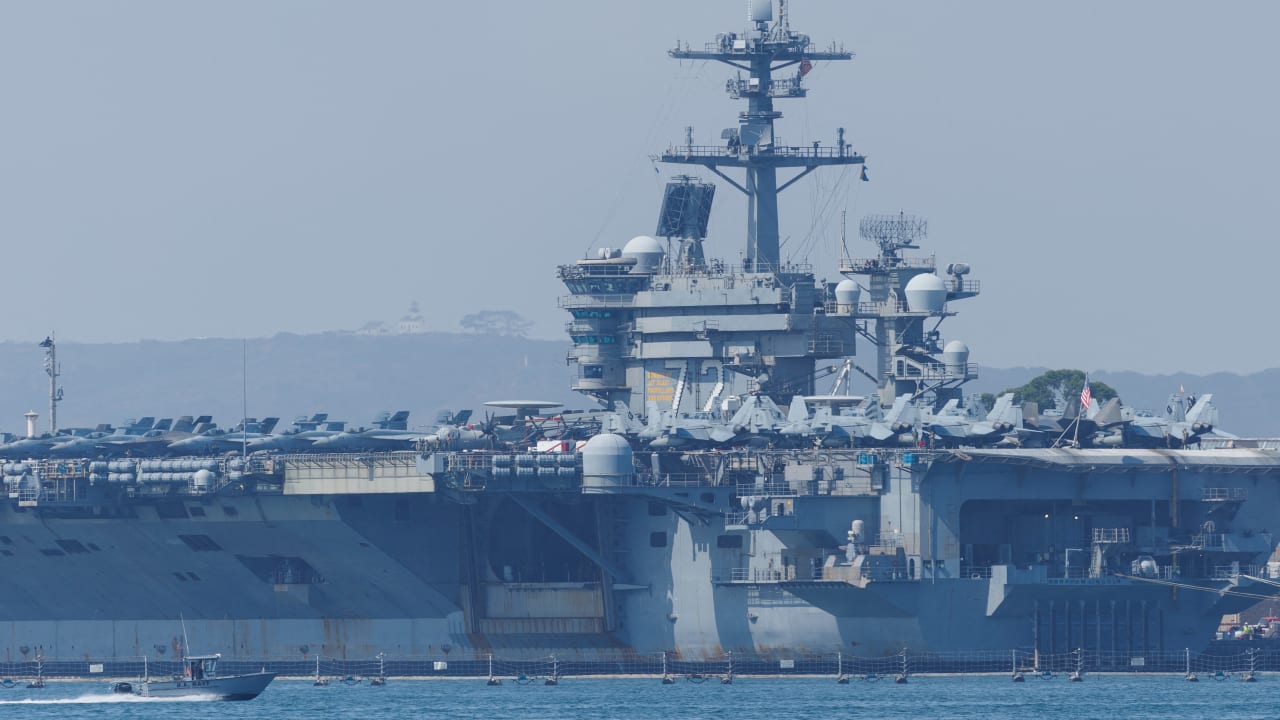
Nuclear-powered aircraft carrier strike group USS Abraham Lincoln is moving towards the Persian Gulf. The aircraft carrier USS George HW Bush, which is reported to have departed Norfolk towards the Middle East, will take several weeks to reach the region.
Economic pressures alone rarely bring down a brutal regime, especially one that enjoys the favor of two leading powers, China and Russia, the former a major and illicit market for Iranian oil, and the latter a major procurer of Iranian arms.
Nevertheless, an economic downturn, coupled with a potential military blow, as the buildup suggests, could engender a wave of protest greater than the present wave, which the regime suppressed. Such a wave might not threaten the regime directly, but it could create rifts within Iran’s ruling elite and misgivings about engaging in massive killings amongst the regime’s security personnel.
The writer is a senior researcher at the JISS.