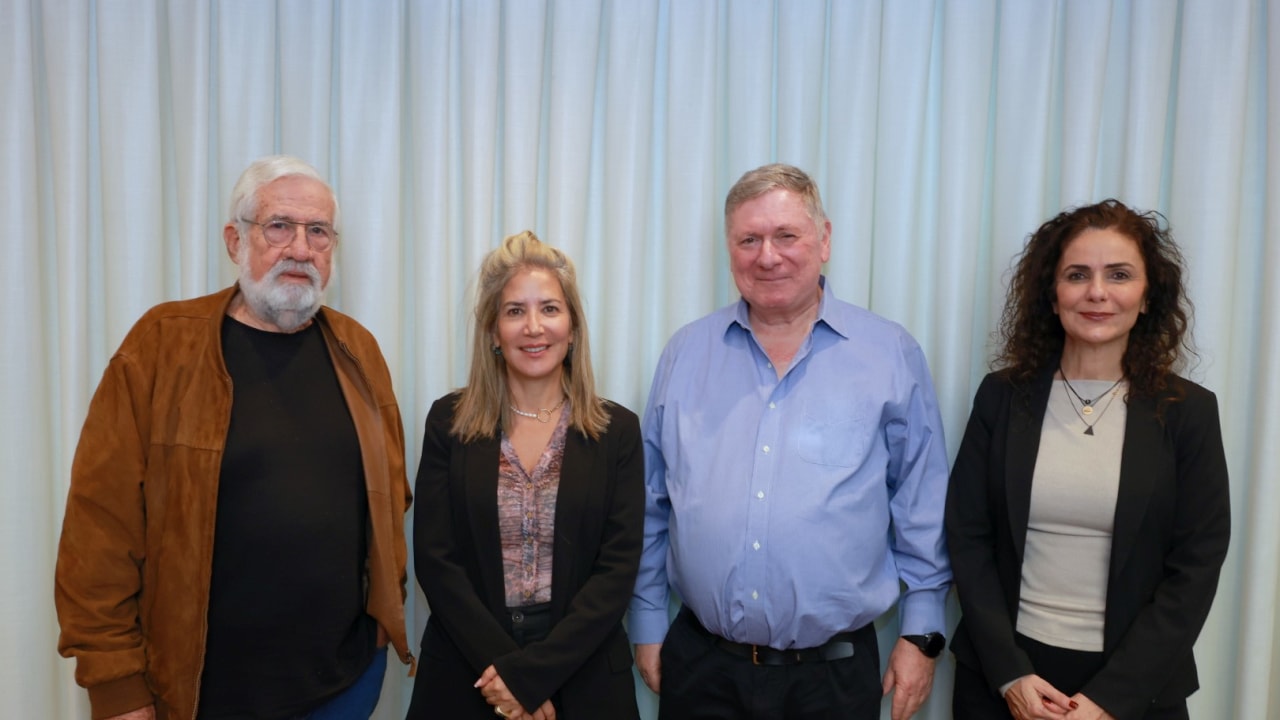
Not all Australian Jews are happy about the visit next week of President Isaac Herzog. Some, including prominent figures in community organizations, are fearful that it will cause more controversy between pro-Israel and pro-Palestinian factions – especially as Herzog will be accompanied by World Zionist Organization Chairman Yaakov Hagoel and Jewish Agency Chairman Doron Almog. To some people in both camps, this appears to be an exercise in Zionist propaganda.
While the Australian Jewish community has an excellent record of supporting Israeli causes from the Negev to the Golan Heights, some Australian Jews anticipate that the trio will stir up harsh emotions among pro-Palestinians at a time when Australia in general is trying to get back to a live and let live environment. That doesn’t mean an absence of protest demonstrations, but such demonstrations should be free of violence and vulgarities. Participants in such demonstrations should also separate their support for a Palestinian state from the atrocities perpetrated by Hamas, and should make this a matter of policy.
It was difficult to reconcile the man who made such a sensitive speech in the most beautiful English with the person who consistently makes antagonistic remarks. Knesset Speaker Amir Ohana, though not a government minister (albeit a former minister), was the official Israeli representative at the reception hosted by Japanese Ambassador Arai Yusuke in honor of the 66th birthday of Emperor Naruhito.
The theme of the evening was peace and harmony – which may have been the reason that the ambassador had Ohana seated alongside former prime minister and defense and foreign minister Ehud Barak. The two men are politically poles apart, but respected the occasion and the fact that they were in the residence of the ambassador, and in a civilized manner, shook hands. After that, beyond sitting alongside each other and looking straight ahead, they had nothing to do with each other, though the expression on Barak’s face indicated that he was amused by the situation.
The ambassador, in his own address, joyfully noted that all the hostages have been returned, adding in Hebrew “Sof sof bau habaita” (At long last they have come home). He also expressed the hope that the people of Gaza will find stability and that peace will come to all of the Middle East.
With reference to the visit to Japan in August by Ohana, the ambassador noted that the first visit to Japan by a Knesset speaker had been in 1999, and that this had contributed greatly to closer relations between Japan and Israel.
In August 2025, Ohana led a delegation to Japan to strengthen bilateral relations, to promote greater awareness of the plight of the hostages, to gain more support for their release, and to combat terrorism in all its forms. The delegation had included close relatives of hostages
Cooperation between Japan and Israel is booming, said Arai, underscoring that this boom is not just limited to high-level figures, but also applies to people at all levels and professions.
Ohana, in his speech, paid tribute to former Japanese prime minister Shinzo Abe, whom he had met only two weeks before he was assassinated. Drawing on similarities between Japan and Israel, Ohana said that both were ancient countries with young democracies that were moving from antiquity toward the future, and advancing the lives of their citizens.
Mentioning the parents of Guy Asulin, who were members of his delegation, he said that Asulin, who was killed at the Supernova festival on October 7, 2023, had always dreamt of visiting Japan. The knowledge that his parents were doing it in his stead made the visit especially meaningful.
As is the case with almost every Israeli or Jewish speaker at a Japanese event, Ohana spoke of Chiune Sugihara, the Japanese vice consul in Lithuania who went against the orders of his foreign ministry and issued thousands of documents to Jews fleeing from the Nazis. He was ostracized for some years afterwards, but is now regarded as a national hero, and pamphlets lauding his humanity and his heroism are now distributed at official Japanese events.
The reception featured Japanese cuisine, a wide-ranging promotion of Japanese tourism, which conveniently coincided with the conclusion of the International Tourism Fair held in Tel Aviv a few days earlier, and an exhibition by Japanese and Israeli exponents of Aikido, one of the self-defensive Japanese martial arts, which is nonviolent and focuses on peace and harmony. Because it is not competitive, it is devoid of conflict.
Weapon of war
The Association of Rape Crisis Centers in Israel deals not only with women who have been sexually assaulted and abused, but also with men – especially those in captivity who, because of their circumstances, are unable to defend themselves. The association issued a statement following an interview given to the BBC by former hostage Sasha Troufanov, who was beaten and abducted on October 7, 2023, and was sexually harassed during 498 days in captivity. According to the statement by the association, this again brings the painful truth of sexual abuse as a weapon of war to the fore.
This untenable situation has been screaming from previous reports of interviews with other former hostages, and confirms testimony given by Romi Gonen, Keith Segal, Guy Gilboa Dalal, and Alon Ohel. What they tell is difficult for all to hear, but it is important in the struggle to outlaw sexual abuse as a weapon of war. The information disseminated creates greater awareness of what happens to the victims physically and mentally. They often suffer depression and despair. When this happens, it is vital that they be treated with compassion and understanding.
US Hebrew Immigrant Aid Society loses funding
US President Donald Trump seems to have an antipathy toward refugees and immigrants – and not only those from Latin American countries who are trying to cross the US border, or those from the Middle East who are regarded as potential terrorists, but also those in Europe. Evidence of this can be assumed from his decision to stop US funding to HIAS, the Hebrew Immigrant Aid Society, founded in the US in 1881, and which for more than a century and a half has aided refugees and immigrants to get to destinations where they could have better and safer lives.
Thousands of Jews were able to survive World War II because of the risks taken by HIAS to get them to safety. During Perestroika, when Soviet Jews were permitted to leave the countries in which they resided, the Austrian authorities, at the request of major Israeli and Jewish organizations, permitted these refugees to use Vienna as a way station. With the current wave of antisemitism, HIAS is sorely needed by people fleeing from places of antisemitic tensions.
Austria has been home to a number of famous Jews. Though born in Budapest, Zionist visionary Theodor Herzl spent a large part of his life in Austria. Probably the most famous of Austrian Jews was Sigmund Freud. Others include philosopher Martin Buber, author Stefan Zweig, Nobel Prize laureate in Medicine Eric Kandel, psychologist Alfred Adler, actress and inventor Hedy Lamarr, and music composer and conductor Gustav Mahler, among others.
Buber chose to live in Jerusalem, as did iconic photographer David Rubinger, filmmaker Micha Shagrir, and journalist Ari Rath, who was an influential editor-in-chief of The Jerusalem Post approximately half a century ago.
Hapoalim art exhibition
It is quite common for banks to decorate their interior walls with works of art, and even to provide grants to artists and art students, but few support art to the extent that Bank Hapoalim has done for over a quarter of a century.
Although the world may revolve around money, successive executive members of Bank Hapoalim have strongly believed in the importance of encouraging national talent with a focus on the visual arts to provide a cultural heritage for Israelis from all walks of life. Toward this end, Bank Hapoalim has hosted an annual art exhibition and sale at its Tel Aviv headquarters, with a percentage of the income from each sale going to the artist who created the work and the rest to one or more of the charities supported by the exhibition and sale, which took up three floors of the building.
All the Who’s Who of Israel always feel that they must attend. All the artwork on display is created by Israeli artists to encourage Israeli art. In addition to that, various charities benefit from the sales. It’s a win-win situation all round. This year’s exhibition will be dedicated to NATAL, which is helping victims of trauma to rehabilitate themselves. The exhibition, with 650 items for sale, will be held on Friday, February 20, from 9 a.m. at Bank Hapoalim’s head office, 63 Yehuda Halevi St., Tel Aviv.
The art exhibition is only one of Bank Hapoalim’s many initiatives aimed at giving back to the community. Its total contributions to a variety of projects over the past two years, distributed by the public committee established by the bank, amount to a total of NIS 100 million to projects in the fields of education, community resilience, and economic resilience.
greerfc@gmail.com