The holidays we celebrate remain constant; what changes is how we experience them as life rolls on.
Children, full of awe and excitement, do not experience the Passover Seder the same way their parents do. Nor do their parents, tired and focused on the children, experience it the way their own parents do, content to sit at their children’s table, watching it all unfold with quiet satisfaction.
What is true of the religious holidays is also true of the civic ones. But here, the difference is not only one of age but also of location and experience.
New immigrants, for instance, will not experience Remembrance Day or Independence Day in Israel the way someone native-born does because they do not share the same memories, connections, or sense of loss.
Nor do those days feel the same in the first few years here as they do after decades. To that I can personally attest.

Remembrance Day for the fallen soldiers was always a solemn affair from the moment I arrived here. I remember coming here as a student long ago and feeling the sadness of the day. But it was a somewhat remote sadness, a distant sadness, even a theoretical sadness.
It was a sadness for people I read about, whose pictures I saw in a newspaper. It wasn’t lived. I didn’t personally know anyone who had fallen in a war, or the parents of anyone who had been killed fighting for the state.
Forty-five years of life here has changed that. Now I know soldiers who fell. Now I know the parents of soldiers who fell. I’ve been to the funerals, known the young men being eulogized; sat in the shiva homes, and felt the raw pain of the parents. Now the sadness is immediate and real, sharpened by the awareness of how close it all is.
Today, unlike in my early years, when I would not have had any qualms about not being in the country on this day, I wouldn’t dream of not being here.
Then there are my kids. During Shabbat two weeks ago, with the entire family gathered to celebrate a family event, the conversation turned to Remembrance Day. But it wasn’t some deep philosophical discourse; it was very brass tacks.
“Where are you going?” The Youngest asked my son Skippy, wondering about his plans for Remembrance Day.
“I’m going to start the day at Segula [the military cemetery in Petah Tikva], then go to Gush Etzion for the siren, and then go up north.” At each place, he will visit the grave of someone he fought with, or visit the parents.
As will each of my sons and my son-in-law. They will spend that day going to the graves of friends, visiting bereaved families, and doing it out of a sense of camaraderie and obligation.
As children who grew up here, Remembrance Day was always a somber occasion. How could it not be? The somberness of the day penetrates everything, with ceremonies at school that inevitably reference students from the school who were killed, either while in the army or in a terrorist attack.
Then they went into the army, and it became even more real – with ceremonies at their bases where flags are lowered to half-mast, and visits to the graves and families of soldiers in their units from years past who fell in earlier wars.
Then they fought in wars, and the visits became to the graves of their own comrades-in-arms, and to the parents of their friends.
That is how these days deepen over time.
So, too, with Independence Day. But here the experience changes not only as a result of age, but also because of geography – where you are located.
Independence Day is most meaningful in Israel
Let’s face it: Israel’s Independence Day is most meaningfully and intensely felt in Israel. As the psalmist wrote: “How can we sing the Lord’s song in a foreign land?” One can, but it’s not the same.
As a kid growing up in Denver, Colorado, I remember community events on Israel Independence Day, or a Walk for Israel to mark the day. It often took place on a Sunday, so people could attend, instead of on the day itself. It was generally a day with some songs and homemade falafel. It was nice, but a pale imitation; a little like eating synthetic meat instead of sinking your teeth into a juicy hamburger.
Then I came to Israel, made aliyah, and felt that now I would get the full experience. But what is that experience? Walking down Jaffa Road in Jerusalem, getting foam squirted in the eye, having one of those plastic hammers bopped on your head, watching others dance to music I didn’t know.
At first, I felt like an outsider looking in, wanting to participate but not quite knowing how. Watching, almost like an anthropologist, other people rejoice. I wanted to do the Israeli thing – a barbecue, a hike – but didn’t quite know where to go or how to do it.
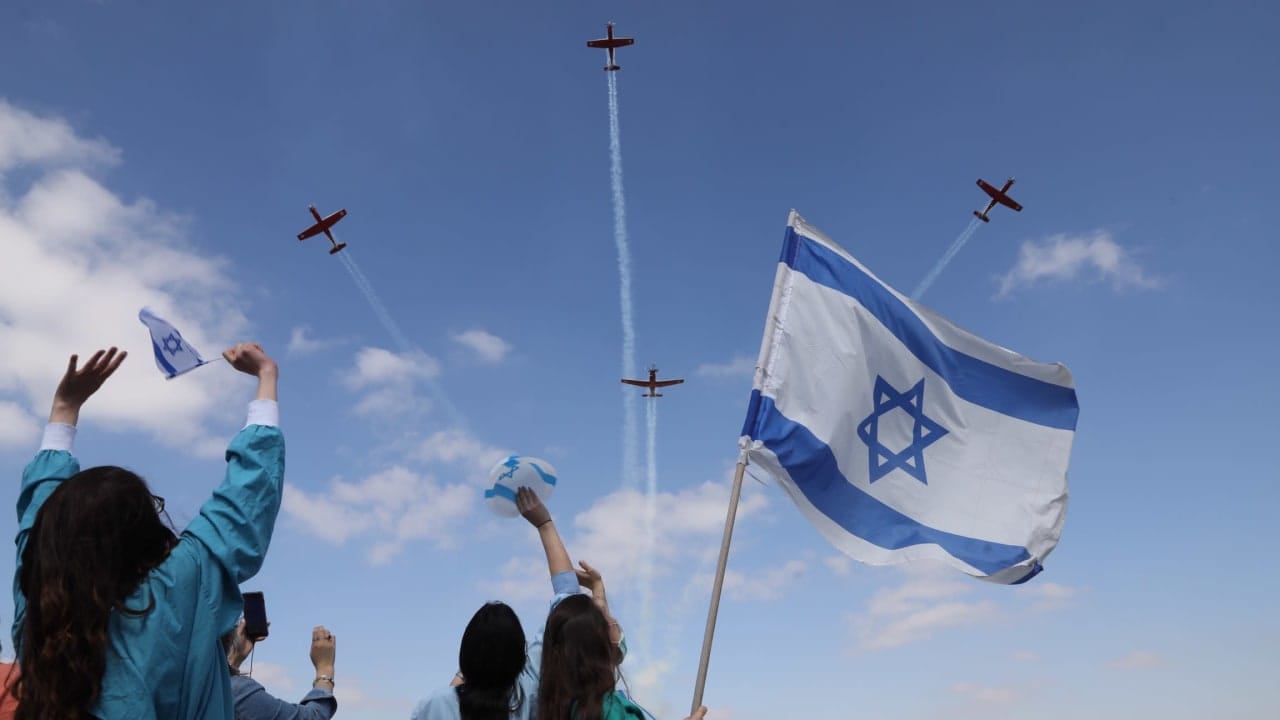
When my kids were born, we began building our own traditions – watching the flyover in the morning, watching the Bible quiz and knowing none of the answers, and joining friends for a barbecue. The key was not to travel too far, so as to avoid spending the day marking Israel’s rebirth stuck in traffic and cursing other Israelis who were doing exactly the same.
Then those traditions began to change as the kids got older, married, and wanted to do things on their own with their friends or their spouses’ families. They wanted to be with their friends, not necessarily with ours. They wanted to create their own holiday traditions for their children, who, when the time comes, will say that it was nice, and then move on to their own.
Forty-five years after my first Independence Day here, I no longer feel the need to prove my belonging by doing things I may not really want to do, but once felt I should, just to feel a sense of belonging. I don’t need to feel part of it anymore. I am part of it.
How do I know? By listening to my children’s conversations – and their Remembrance Day plans.