
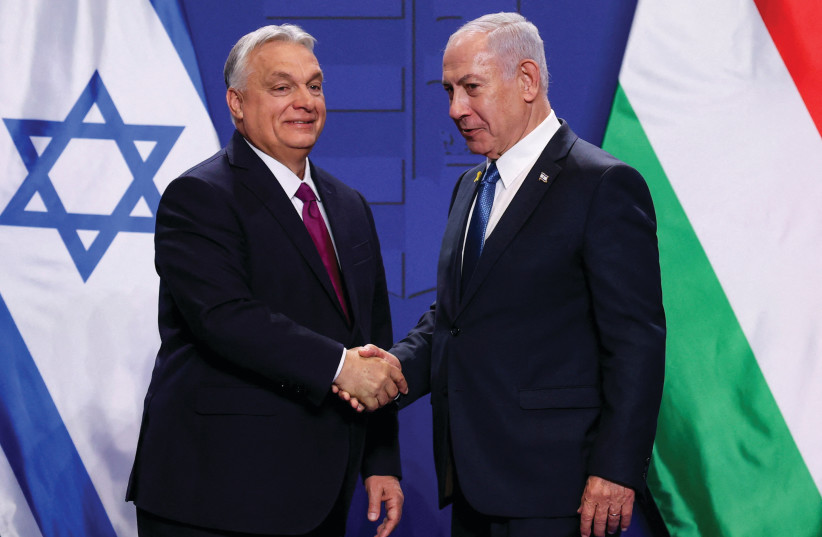
Politicians and journalists aligned with the Israeli opposition often cite the shared “illiberalism” or “dictatorship” of former Hungarian prime minister Viktor Orbán and Israeli Prime Minister Benjamin Netanyahu as the foundation of their political alliance.
While both leaders may be described as nationalists, they operate within fundamentally different social fabrics, and the condition of liberalism and democracy in their respective countries diverges sharply.
Across Europe, policies toward the Jewish state vary considerably from one country and one government to another, shaped by distinct historical experiences and political ideologies. Under Orbán, Hungary occupied a minor yet distinctive place on Israel’s foreign policy map, and its recent political shift carries both local and regional lessons.
After 16 years in power, Orbán’s openly corrupt and autocratic system, a veritable “captured state” from above, was swept aside in a landslide victory for a center-right party in the recent general elections.
The win was driven by a grassroots movement with fifty thousand volunteers, galvanized by a sharp, charismatic, and tireless leader: a lawyer from Orbán’s own ranks who broke with his former party just two years earlier.
Is this victory good for Jews? The question only makes sense in derivative form: is it good for Hungarian Jews, for European or Diaspora Jewry, for Israel, or for Jews of different political persuasions?
Based on what is known about the profile and program of the new ruling party, now holding a two-thirds parliamentary majority, the answer to the first derivative question appears clearly positive.
Most Hungarian Jews are liberal; even without polling, it is evident that only a minority were swayed by Orbán’s pro-Israel stance, while the overwhelming majority opposed his rule and voted against him consistently.
At the same time, many Hungarian Jews supported Orbán’s restrictive migration policies, which the new government is likely to maintain.
Right-wing antisemitism more contained, non-violent under Orban
Likewise, although traditional right-wing antisemitic rhetoric has persisted in public life since the end of communism, it has remained largely contained and non-violent under Orbán’s rule – a pattern unlikely to change. If anything, antisemitism may become further marginalized and isolated.
From an Israeli perspective, the implications of Hungary’s tectonic political shift are more complex. In the wake of World War II, classical right-wing, nationalistic antisemitism in Western Europe receded, while leftist and liberal anti-Zionism gained ground, especially in recent decades.
This transformation, like the broader integration of Western Europe, rested on a postwar liberal, multicultural value system that came to dominate public discourse.
For historical and sociological reasons, however, these values never took firm root in the countries of the former Soviet bloc. This helps explain why the European Union, through its economically driven expansion from a Western core into Eastern and Southern Europe, faces significant internal strains.
Communist internationalism and decades of Russian domination not only stunted the development of sovereign democratic nation-states in these regions but also fostered a lasting suspicion toward supranational political structures and institutions.
In many of these countries, ressentiment, a mix of admiration and envy, blends older forms of antisemitism with pro-Israel attitudes.
In others, where neighboring Russia has long been – and remains – a perceived security threat, and where Western Europe and NATO are not widely seen as fully ready and able to defend all of its member states, Israel is seen in right-leaning circles as a small but powerful nation-state: a model of resilience and readiness to defend its existence.
Within the European Union, countries such as Poland, Romania, the Czech Republic, and Hungary often look for ways to counterbalance Western European influence not only through transatlantic ties but also by strengthening relations with Israel.
Over the past two decades, in its Israel policies, Hungary has stood somewhere between the Czech Republic and Romania – arguably the EU’s most consistently pro-Israel states – and Poland, where support for Israel is often tempered or disrupted by heated disputes over Holocaust memory and historical responsibility.
Hungary under Viktor Orbán had, much like Serbia and Croatia, developed a relatively close and largely transactional relationship with Israel, cultivating ties across multiple domains.
Yet this relationship, and the government’s domestic handling of Jewish issues, has also exhibited clear shadow sides. Israeli surveillance technologies, for instance, exported with official approval, were reportedly used against Hungary’s liberal opposition.
Orbán consistently proclaimed “zero tolerance” for antisemitism and took steps to curb it and to safeguard Jewish religious institutions. At the same time, his government ran a multi-year, conspiratorial campaign against George Soros that carried easily recognizable antisemitic undertones.
Moreover, it established and supported institutions and initiatives promoting revisionist, often extreme right-wing narratives about Hungarian history and the Hungarian Jewish Holocaust.
Characteristically, both in cultivating ties with Israel and in managing its double-edged domestic policies on antisemitism, Orbán’s system relied heavily on the local branch of Chabad, known as EMIH.
This group (a Jewish denomination of its own in Hungary) became a central intermediary in matters relating to Jews and Israel. Its calculated silence on certain manifestations of antisemitism was just one element of its broader public-relations efforts aligned with the government.
Its own public standing, however, among both Jewish and non-Jewish audiences, proved far less successful.
While aspects of its communal work are widely appreciated, its close proximity to political power (the earthly “kingdom”), the material and institutional benefits it received from the Orbán government, and a series of financial controversies have together contributed to growing skepticism about its role.
As Viktor Orbán’s regime has cast a shadow over the local Chabad network, Hungary’s increasingly isolated – and at times disruptive – course within the European Union, particularly its close coordination with Russia, has in turn cast a shadow over Israel’s standing in Europe.
In the broader Israel–EU matrix, relations with Hungary carry only limited weight. It is questionable whether the advantages Israel gained from Hungary’s vetoes of certain anti-Israel EU resolutions in recent years outweighed the costs of such a close association.
The new government, however, has declared its intention to revive coordination within the so-called Visegrád Group, comprising the Czech Republic, Slovakia, Poland, and Hungary, which had functioned from 1991 until 2022, when it was disrupted by the Russian invasion of Ukraine, potentially expanding it to include other EU member states in Eastern and Southern Europe.
The European Union will remain an important partner for Israel, above all economically, but anti-Israel sentiment and policy positions are likely to intensify in Western Europe in the coming years.
At the same time, there is a real possibility that the Visegrád Group, and perhaps additional Eastern and Southern European states, will continue to pursue a coordinated foreign policy more attentive to Israeli security concerns than that of Western Europe, and will seek closer cooperation with Israel in selected areas, mainly security-related.
In the wake of Hungary’s political turnaround, it is worth examining these evolving alignments and possibilities from both the Israeli and Hungarian perspectives.
The writer is a Hungarian Jewish researcher.