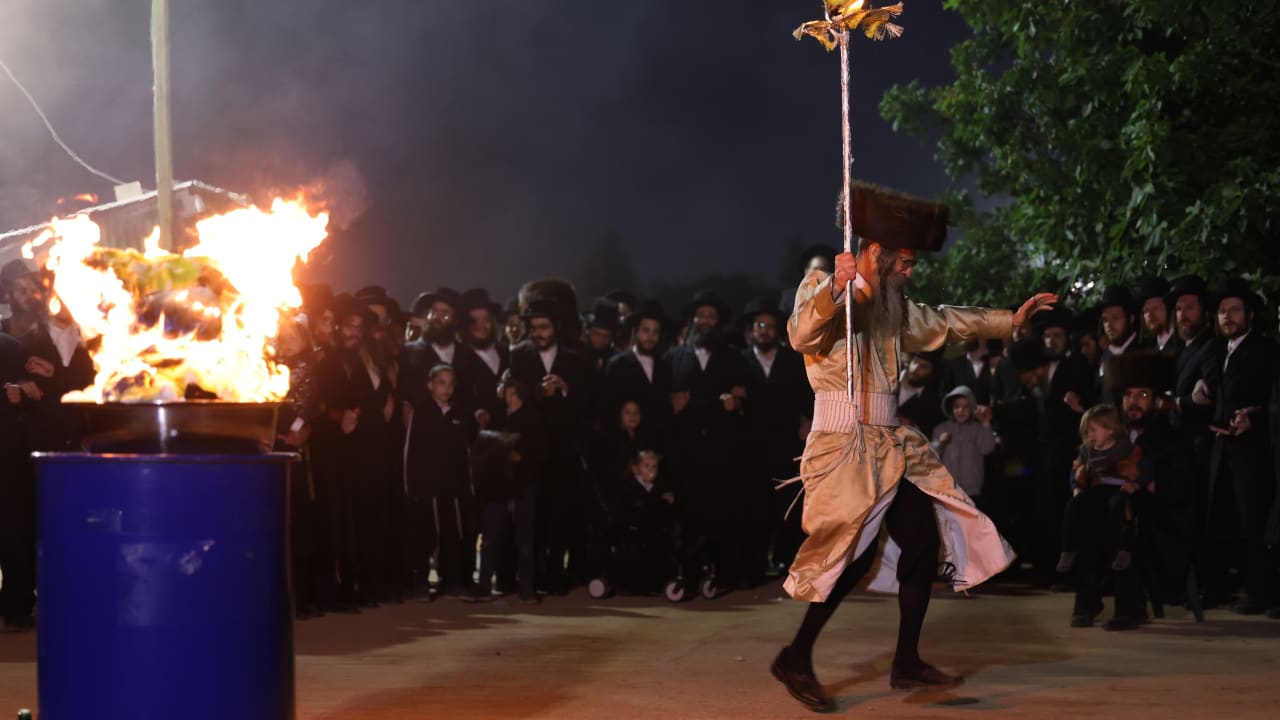
Lag Ba’omer is a day of joy and relief, marking the moment when the students of Rabbi Akiva, who lived in the critical decades just after the destruction of the Temple, stopped dying from a plague. In many Jewish communities, it brings an end to our public mourning for these students, and ushers in a return to happiness, including the beginning of the wedding season.
But perhaps most critical is the cause of the tragedy itself. If we do not reflect on that root failure, we risk carrying it forward with us, even as we move toward Shavuot, a time of spiritual redemption for the Jewish people.
The Talmud refers to 12,000 pairs of Rabbi Akiva’s students who perished of “askara,” commonly understood as diphtheria, because they did not treat one another with respect. The sages saw a deeper meaning in the nature of the disease itself: an affliction of the throat, reflecting the toxic rhetoric of the students’ disrespectful speech. These were not ordinary individuals; they were scholars studying under one of the greatest teachers in our tradition. And yet, their Torah learning and knowledge did not translate into the ability to honor one another.
That breakdown reshaped this period of the Jewish calendar. What should have been a continuous joyous journey from Passover to Shavuot, from redemption to revelation, instead became marked by mourning. It is a stark reminder that disrespect and division do not only harm individuals; they disrupt the moral and spiritual progress of an entire people.
Today in Israel and across the Jewish world, we are seeing these same patterns play out once again. Conversations that should reflect shared purpose and mutual responsibility are instead breaking down into accusation and dismissal. Differences in background – secular, traditional, religious, National-Religious, ultra-Orthodox – too often become lines of division rather than sources of strength. Public discourse, particularly in the political arena, is marked less by principled disagreement and more by personal attack.
Of course, a healthy society depends on debate. Different communities have distinct needs and priorities, and the effort to balance them is a vital part of a functioning democracy. But beneath these differences must remain a deeper commitment: that we are part of a family, a single people, bound not only by shared history but by mutual responsibility.
"Do not speak badly about our fellow Jews"
The words of Maj. (res.) Yossi Hershkovitz, of blessed memory, who fell in battle in Gaza, remain with me. The beloved Jerusalem high school principal and father of an Ohr Torah Stone student once implored: “I have a personal request: do not speak badly about our fellow Jews. Don’t say one bad word. There is no right-wing, no left-wing. No haredi. No ‘other.’ There are simply Jews.”
The same obligation applies beyond our internal discourse, in our relationships and attitudes toward all human beings, created b’tzelem Elokim – in God’s image. When Jews act in ways that degrade or harm those of our community or other faiths, it is not only a moral lapse; it is a betrayal of our deepest values. Recent incidents of Jews attacking other Jews, attacking Palestinians, and desecrating religious icons should trouble us all, regardless of our background or politics. We cannot move meaningfully toward redemption while this remains our reality. We must be a people not only of shared fate but of shared destiny.
Yet there is always room for optimism. Rabbi Akiva himself was able to move on despite the enormous loss of his students. He taught a new generation of Torah scholars, imbuing in them not only Torah knowledge but the capacity to live with one another with respect. Renewal, in Rabbi Akiva’s model, was not automatic. It required intentional change.
We see echoes of that possibility today. When I look at the extraordinary sacrifices and commitment of so many young Israelis from different backgrounds serving hundreds of days together in the army, and supporting families on the home front, I can see their deep sense of shared responsibility, and I am optimistic that our future will be brighter.
But we must reexamine the way we think and talk about others, and those in leadership positions must reinforce this value in word and in practice.
Jewish law and tradition do not stand in tension with this goal; they enable it. Halacha contains both structure and sensitivity, principle and flexibility. Across biblical and rabbinic sources, the call to uphold the dignity of others – Jews and non-Jews alike – is profoundly documented.
No one exists in isolation. In Rabbinic literature the description of Rabbi Akiva’s students as 12,000 pairs – rather than simply 24,000 individuals – highlights that Torah was never meant to be a solitary pursuit.
One cannot fulfill alone what Rabbi Akiva taught as a central principle: “v’ahavta l’re’acha kamocha,’ love your neighbor as yourself. Such a commandment demands connection, encounter, mutual recognition, and respect.
Torah is not only learned in the beit midrash (study hall); it is lived in the space between people. When that space breaks down, even the greatest scholarship cannot sustain the Torah’s ultimate essence.