
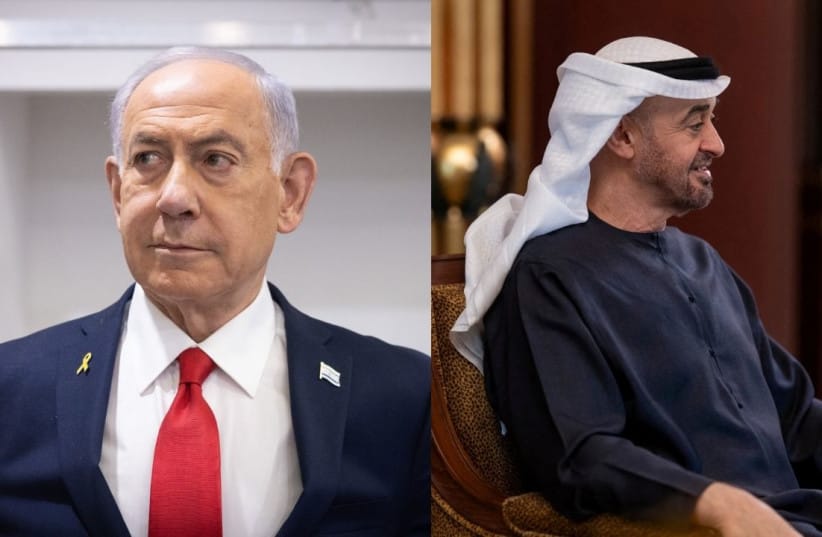
Only a few hours had passed since Prime Minister Benjamin Netanyahu’s office announced his sensational visit to the United Arab Emirates in March 2026, his meeting with President Sheikh Mohammed bin Zayed al-Nahyan – a visit that, according to the statement, had led to a “historic breakthrough” – when the Emirati Foreign Ministry issued a sweeping denial.
Once again, Netanyahu repeated his familiar ritual of publicizing a meeting with a senior Arab figure – a meeting that was supposed to remain secret. Among other examples are the leak regarding his meeting with Sultan Qaboos bin Said of Oman in 2018 and his meeting with Saudi crown prince Mohammed bin Salman in 2020.
Netanyahu has a long history of leaks. During his tenure at Israel’s Foreign Ministry in the United States, he learned that leaking is a central tool for achieving political goals. Since then, he has made greater use of this tool than any other politician in Israel.
When he served as opposition leader in 1995, he leaked what became known as the “Shtauber Document” from the Knesset podium – a highly classified document written in the IDF Planning Directorate by Major General Zvi Shtauber (though in fact authored by his deputy, Brigadier General Shlomo Brom) in preparation for talks between the Israeli and Syrian chiefs of staff.
The aim was clearly to sabotage the negotiations by accusing the Rabin government of planning concessions in the Golan Heights.
Former Knesset member Ran Cohen asked then-attorney general Michael Ben-Yair to strip Netanyahu of his parliamentary immunity for violating criminal law, but the request was denied because Netanyahu enjoyed immunity as a member of parliament.
Israel’s High Court of Justice also rejected Cohen’s petition, ruling that Netanyahu had not acted with premeditated intent but rather in response to a debate with Shimon Peres in the Knesset plenary, and therefore the leak fell within the scope of his parliamentary duties.
This ruling, alongside the dismissal of many other petitions concerning leaks, effectively gave a “green light” to leakers in the Knesset, who could rely on immunity protections.
Netanyahu confirms Israel destroyed Syrian nuclear project
Two decades later, once again in opposition, Netanyahu became the first to confirm that Israel had destroyed the Syrian nuclear project in September 2007, despite the prime minister Ehud Olmert government’s efforts to conceal the matter in order not to humiliate Syrian President Bashar al-Assad and provoke retaliation.
Another famous leak involved the IDF presentation shown during a cabinet meeting in the course of Operation Protective Edge in August 2014. It is widely accepted among those involved that the leak originated in Netanyahu’s office and was intended to legitimize the decision not to enter and occupy Gaza, on the grounds that this had been the military’s recommendation.
Leaks serve several purposes: enhancing a politician’s ego, undermining a political rival, garnering legitimacy for a particular policy, or floating an idea as a “trial balloon.” For example, the leak from Netanyahu’s office to the German newspaper Bild in 2024 was intended to influence Israeli public opinion regarding a hostage deal with Hamas.
The specific leak regarding Netanyahu’s visit to the Emirates was motivated by ego and political considerations tied to the approaching election campaign. It is also possible that the earlier leak, one month before, claiming that Israel had sent an Iron Dome battery with operational teams to the Emirates, reported by The Wall Street Journal, likewise originated from Israeli sources.
An interesting question is why the Emirates would seek to conceal a meeting with the leader of a state with which it already maintains diplomatic relations.
The answer lies in the fact that the Emirates shares common interests with Israel against Iran, yet the aggressive policies of Netanyahu’s government – particularly in the West Bank – have eroded his legitimacy in the Arab world.
Nevertheless, it is difficult to understand why Arab leaders repeatedly fall into the trap of holding secret meetings with Netanyahu, given his poor track record on confidentiality.
This leak is particularly serious for three reasons. First, it harms an ally that, throughout the war, continued cooperating with Israel and largely refrained from condemning it – unlike most Arab states, some of which even recalled their ambassadors.
Second, the tensions between Saudi Arabia and the Emirates, exposed during the war, left the Emirates vulnerable to criticism over its ties with Israel and claims that its policies align – or are even coordinated – with Israel, particularly regarding conflicts in Somaliland, Sudan, and Libya.
The leak, therefore, provides “tailwind” to accusations made by Saudi Arabia and others against the Emirates. One can easily imagine the Saudi crown prince relishing the embarrassment of his Emirati rival. Finally, and most importantly, the leak damages trust between the parties – the cornerstone of any bilateral relationship, especially between leaders.
Israeli leaders across generations have a long history of leaks. Levi Eshkol, Shimon Peres, Menachem Begin, Ariel Sharon, and many others regularly leaked information. In this respect, Netanyahu is not unique – but he has surpassed them all.
Journalist Ben Caspit wrote of him that he is “the most sophisticated leaking machine since the invention of politics,” emphasizing that he says this “knowingly and responsibly, and I invite him to sue me.”
Leaks can cause severe damage to interstate relations. In the worst cases, they can even contribute to assassinations. For example, the assassination of Lebanese president-elect Bashir Gemayel in September 1982 was partly linked to his cooperation with Israel.
Although he and the Maronites repeatedly insisted that the relationship remain secret, Israeli leaders often publicized it for their own interests. The final blow came when news of Bashir’s meeting with Begin was publicized just days before his assassination.
Another possible consequence is the severing or suspension of ties. After the leak concerning Netanyahu’s meeting with the Saudi crown prince, reports stated that it had “damaged prospects for strengthening relations between the countries in the near future.”
In practical terms, visits by Mossad chief Yossi Cohen to the kingdom were canceled, and bilateral contacts were temporarily frozen.
Another example was the leak by foreign minister Eli Cohen regarding his meeting with the Libyan foreign minister. Libya’s prime minister quickly denied having approved the meeting. Following the leak, the foreign minister and her family were forced to flee the country. Presumably, this also marked the end of the special channel that had begun developing with Libya.
The common denominator in all these leaks is the prioritization of personal political interests over the national interest.
The Prussian statesman Otto von Bismarck famously said that “politics is the art of the possible.” Under Netanyahu, however, it sometimes seems that “anything is possible in politics.”
Yet diplomacy operates according to accepted norms of conduct, and violating the trust of an ally crosses one such line. Those who do not respect that principle are unworthy of receiving respect in return.
The writer teaches in the Department of Islamic and Middle Eastern Studies at the Hebrew University of Jerusalem, is a board member of Mitvim, and a member of the Coalition for Regional Security. He is currently completing a study on political leaks in Israel.