Americans are focused on the wrong war because Iran is not the most dangerous battlefield. Victories in conventional war are quantitative and can be measured. The real war is much more insidious, as it is a war about winning the hearts and minds of a new generation, and that war is being fought with dollars, not bullets.
Conquering minds, not territory
A military war has a beginning, a middle, and an end. Bombs fall, buildings collapse, cities burn, but armies eventually stop fighting, and relationships are rehabilitated. The destruction is horrifying, but it is visible because it has a location that can be photographed, measured, cleared away, and rebuilt. Much of Europe lay in ruins after World War II. Yet today, its cities thrive because steel, concrete, and glass can always be rebuilt.
But ideas are different.
History’s greatest tyrants understood that a lasting victory comes from conquering minds, not land. Hitler did not rely on military power alone - he invested enormous effort and dollars in propaganda, education, film, radio, newspapers, and mass rallies because he understood that if you could redefine and reset what people accepted as normal, morality could be rewritten. The Soviet Communist Party reshaped generations through schools and state-controlled media. Mao Zedong launched the Cultural Revolution not simply to control the government, but to transform an entire culture’s values, history, and identity. More recently, ISIS devoted enormous resources to digital propaganda because they understood that recruiting minds was more valuable than recruiting fighters.
The foreign actors funding American education
That is why Americans should pay close attention to foreign funding of our educational institutions. According to data compiled by the US Department of Education under Section 117 of the Higher Education Act, American universities reported receiving more than $50 billion in foreign gifts and contracts between 1986 and 2020, with a significant surge in disclosures after the 2019 enforcement actions.
A 2020 report by the National Association of Scholars estimates that the true total may exceed $100 billion because of underreporting. Qatar has consistently ranked among the largest foreign sources of that funding, contributing more than $4.7 billion to US universities between 2001 and 2021, according to Department of Education data and analyses by the Institute for the Study of Global Antisemitism and Policy (ISGAP). Universities have welcomed these funds and even solicited foreign entities to support research, facilities, scholarships, and academic programs.
But money is never just money because every significant investment carries with it the seduction of influence. It would be naive to believe that universities do not oblige. When a foreign government spends billions of dollars helping educate America’s future leaders, one must ask what return it expects. This is not warfare with missiles or fighter jets; it is influence exercised through the filtering of ideas, and the manipulation of historical narrative through culture and education. If military conflict seeks to conquer territory, ideological influence seeks to conquer the way people think.
That is why this battlefield is so dangerous. It is not fought over the Strait of Hormuz, but in New York, California, Kentucky, Texas, and every other state where tomorrow’s voters are being educated today. It has often been said that votes are to a democracy what bullets are to a revolution. Influence a generation of voters, and you change the democracy in which we live. Once ideas and influence break out of their embryonic state, they become rooted and more difficult to reverse.
The Cash Behind the Encampments
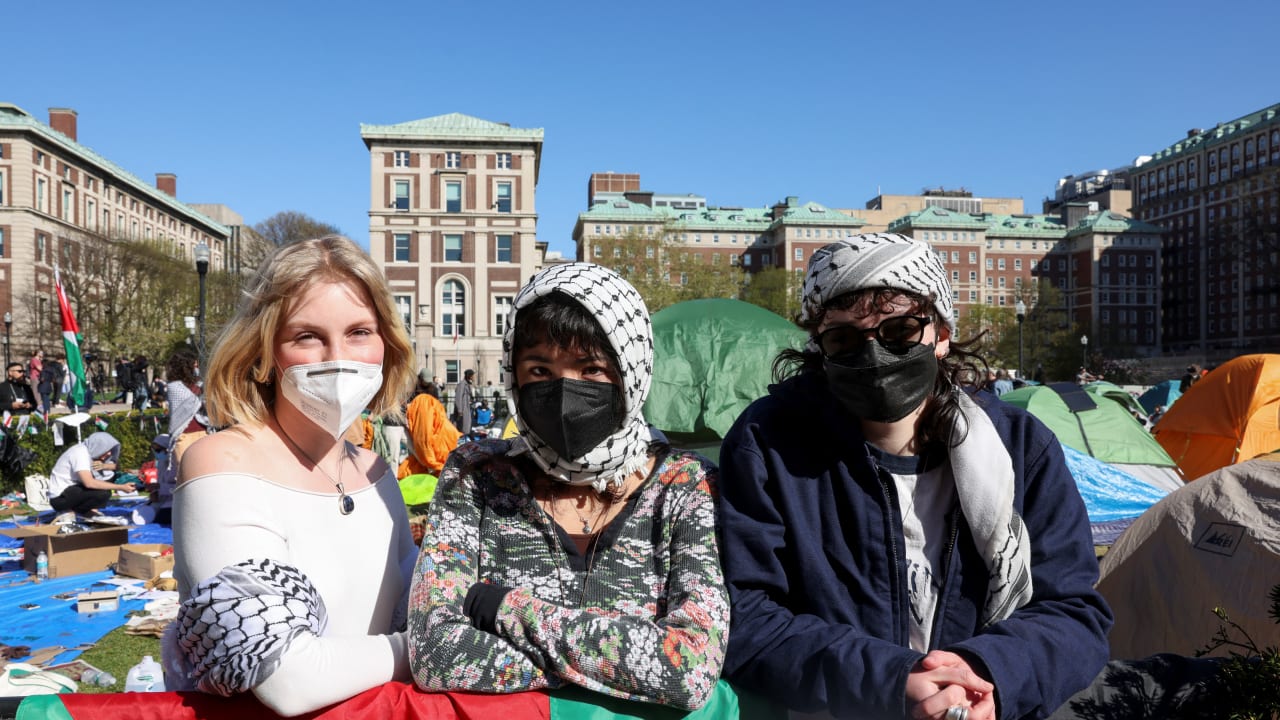
I witnessed something that brought this point home to me. During the Gaza encampments at UCLA, I walked through out of curiosity. There were hundreds of tents and what struck me was how similar they all were. Unless you believe there happened to be a giant sale on that particular tent, it was obvious that this was not a spontaneous event. It was organized and well-funded. That observation does not necessarily tell us who supplied the tents or who financed the encampment, but it raises a broader question that deserves scrutiny: who is organizing, funding, and supporting these movements on American campuses, and what ideology are they advancing? Is it simply an expression of free speech, or is it an attempt to manipulate the way people think, finding cover behind our Constitution to gain entrance and then tear our democracy apart from the inside?
Many critics argue that extensive foreign financial involvement in higher education has helped create a campus climate in which hostility toward the Jewish state has grown. Others disagree and argue that changing public opinion reflects independent scholarship and free debate. Whatever one’s conclusion, the question deserves honest examination.
The greatest victories are often won before a single shot is fired - when a society’s understanding of truth, morality, and loyalty quietly shifts until the change feels natural. Once that happens, bombs become almost unnecessary because the battlefield has already moved into the minds of the next generation.
This is not a war about conquering territory - it’s about conquering the future. If we ignore it, we are essentially surrendering.
The author is an entrepreneur, former Executive Director of the Clinton Foundation, retired airline pilot, and a current member of the Congressional Medal of Honor leadership board of directors.
This op-ed is published in partnership with a coalition of organizations that fight antisemitism across the world. Read the previous article by Alex Carson and Joseph Cohen.