The Haifa Children’s Theater Festival has a host of events the whole family can enjoy.
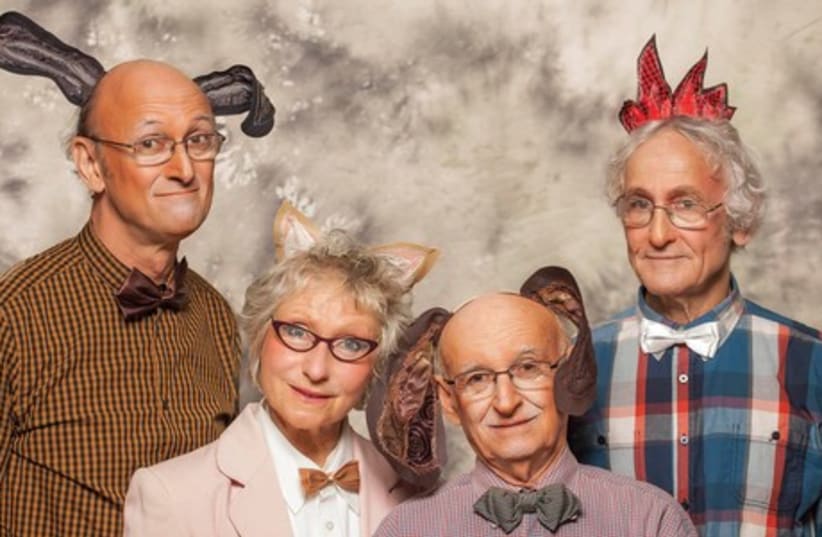
By BARRY DAVIS‘AN END, A START, A CAT’(photo credit: GERAR ALON)
There is a marketing ethos that posits that if something is free, it can’t be worth much.That is definitely not the case with regard to the street theater offerings at this year’s Haifa Children’s Theater Festival.Yinon Zafrir and Avi Gibson Barel, from the envelope-pushing Orto- Da theater company, have set up a mouth-watering and eye-opening program of outdoor entertainment for the festival goers. All told, there are 14 extramural slots in the threeday program (April 16 to 18), with seven each from here and from various countries around the world.The latter include troupes from France, England, Spain, Italy and Holland, and Zafrir and Barel have clearly pulled out all the stops to ensure that the audiences get much more than their money’s worth.“The Europeans, naturally, have a much longer street theater tradition than we do,” notes Barel.“That was part of our thinking in putting together the artistic program. As artistic directors of the outdoor entertainment of the Haifa festival – for the second year - it is our responsibility to bring the best shows we can.”The job, both of the artistic directors and of the performers, is not made any easier by the al fresco setting. When audience members settle into their plush seats in a comfortable auditorium, the expectation is that they will get a good cultural and/or entertaining return for their financial outlay. But audiences of outdoor events are generally less obliged to hang on if they become disinterested, or worse, with the show in progress.“If you’re watching something at an indoor venue, you may not feel comfortable getting up and leaving in the middle,” Barel points out. “But if you’re watching street theater, you’re free to move on to the next show or even go home whenever you want. That means that everyone involved in the show has to be at the top of their game all the time.”Barel is confident that the festival patrons will not be too inclined to leave in the middle of any of the street theater items that he and Zafrir have booked.“All the companies come from different cultures and bring different arts and skills to what they do,” states Barel. “We are talking about some of the best acts in the world in the field.Some bring new approaches, others are more traditional. There are parades, shows that include circus elements, while others are more lyrical.”The companies in the local lineup are no slouches, either, although Barel feels that the Israeli street theater scene still has some way to go to catch up with its foreign counterparts.“At Orto-Da, we travel around with our show Stones, and we perform at some wonderful festivals that are considered to be important events,” he says.“Unfortunately, there aren’t too many opportunities to perform street theater in Israel. There is Haifa, Bat Yam and Acre, of course, and a little bit in Jerusalem, but that’s about it.”That said, Orto-Da has performed Stones indoors at Tzavta in Tel Aviv more than 500 times.Barel is keen to point out that audience freedom of movement notwithstanding, the shows are worth their salt.“We are not talking about an amusing interlude to keep the members of the audience entertained outside an auditorium before they go in to see a show.These are professional productions with shows lasting up to an hour or so,” he stresses.One of the more intriguing imports comes from France in the form of Le reve d’Erica (Erica’s Dream), courtesy of the Bivouac Cie group from Bordeaux.“It’s a bit like Alice in Wonderland,” explains Barel.“Erica dreams about having a pair of red shoes, and she encounters all sorts of fantastic characters on the way to making her dream come true.”This is a full-blown 30-minute production.“There is live music and operatic singing,” Barel continues, “a Chinese pole, acrobatics and all sorts of weird and wonderful things. It’s a large-scale production with eight performers on the stage.”The French have gone all out to ensure that their Israeli audiences enjoy the venture.“We saw the show in France, but they are bringing over a special production for Israel,” says Barel.The other French contingent in the street theater lineup tends more towards the madcap side of the art form. A Flower in the Rifle by the Qualité Street company tells the story of an army officer who has a decidedly free-flowing approach to life, and he and his hapless assistant find themselves having to prepare for their first public singing performance. It’s not just a matter of getting their vocal chords straight, but they are concerned that they won’t know how to conduct themselves on stage and what the audience will expect of them.“This is a very high form of modern clowning, a sort of nonsense form of clowning,” notes Barel. “The actors also used a special kind of music box that actually records the music as the show progresses, and then plays it back.”A Flower in the Rifle has been described as “a burlesque show that groovily rebounces to the rhythm of characters torn in a mad way between behavioral codes and ingenuousness.”“There are so many different elements to this show – interplay between a controlling character and a subservient one,” adds Barel. “It is a very energetic show with a lot of innocence about it – sort in the [farce] style of [French comedian] Louis de Funès.”Devotees of the iconic 1970s British comedy TV series Fawlty Towers should dig the Hotel Crab show by the Trukitrek company of Spain. There are quite a few parallels between the two. The action of the wordless awardwinning Spanish street theater show is based at a small seaside hotel, and there are plenty of laughs along the way. The 50-minute production incorporates a mixture of circus skills and silent theater.Meanwhile, fans of outsized creatures will have fun at the Les Oiseaux de lux show by the Neighbourhood Watch Stilt International troupe from England. The show is described as “an invasion of giant wingless birds and their riders.” It is a visually powerful parade-style show that should thrill onlookers of all ages.Our street theater groups will also do their best to strut their stuff over the three days of the Haifa festival. The Dream Theater group will present The Journey to the Magical Sound show, which relates the charming story of a young boy who wants to visit the faraway Snow Kingdom and does several good turns along the way. And the Shlomi Center for Alternative Theater will unveil its interactive Laboratory production, which incorporates ingenious interplay between light and movement and music and feeds off the natural curiosity of its junior audience.Children and the young at heart should also enjoy Everything Can Happen by Jerome Arous, which features a simple newsstand vendor who, in his off-duty hours, dives into a fantasy world populated by comic characters.“We’d like people in Israel to appreciate and enjoy street theater,” says Barel. Judging by the Haifa Children’s Theater Festival street theater lineup, there is every chance that it will happen next week up north.For more information: (04) 860- 0500 and www.haifakids.com
if(catID != 151){
var cont = `Take Israel home with the new Jerusalem Post Store