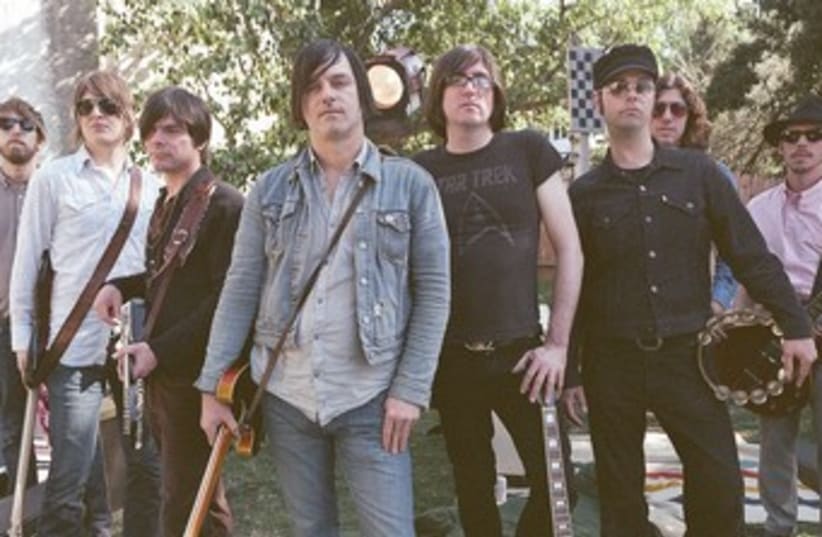
Having outgrown youthful wildness, Anton Newcombe is leading his band of psychedelic rockers into a new era.
By DAVID BRINNThe Brian Jonestown Massacre.(photo credit: Courtesy/PR)
If you ask Anton Newcombe if he’s a less scary figure these days, his response is “Is that a trick question?” That’s because Newcombe, the guiding light behind the ominously-titled alternative rock heroes The Brian Jonestown Massacre doesn’t necessarily think he was ever scary or threatening – even when he was leading his psychedelic revivalists on occasionally chaotic and unpredictable performance art excursions throughout the 1990s and beyond.Rising to underground popularity thanks to a series of albums since 1990 that simultaneously aped and honored everyone from The Rolling Stones, Bob Dylan, The Velvet Underground, Love and even Donovan, the band, named for the Stones’ visionary guitarist and the infamous 1978 mass suicide in Jonestown, Guyana, really rose to cult status thanks to the 2004 documentary Dig! A contrasting portrait of two bands – BJM and The Dandy Warhols – the film by Ondi Timoner, which is still regularly screened on Israeli cable channels, won the Documentary Grand Jury Prize at the Sundance Film Festival, primarily for its riveting focus on the volatile interaction between a drug-addled Newcombe and the Warhol’s frontman Courtney Taylor- Taylor.With an astounding number of personnel changes, the band evolved into Newcombe’s personal vehicle. And recent years have found the now clean-living 45-yearold California native relocating to Berlin and releasing quirky BJM albums and EPs like 2008’s Just Like Kicking Jesus in which he increasingly warmed to using pastiches of different well-known song elements to create new music. Newcombe also started his own Ustream channel called Dead TV where he cooks and chats with his audience via a Skype connection.However, recent events have propelled BJM back into the spotlight.Founding guitarist/bassist and songwriter Matt Hollywood returned to the fold last year, and there was an upswing in the band’s profile thanks to one of their songs, “Straight Up and Down” from their 1996 album Take It From the Man being chosen as the theme to the popular HBO show Boardwalk Empire.With the revamped BMJ’s recent release of its 12th album, the band has returned to the indie limelight and has launched a high-profile world tour which will see them arrive in Tel Aviv on July 11 for a show at the Barby Club.Catching up with Newcombe in an email interview as he was rehearsing the revamped lineup, including Hollywood, bassist Will Carruthers (formerly of Spaceman 3 and Spiritualized), guitarists Jon Saemunder Audarson and Henrik Baldvin Bjornsson and drummer Constantine Karlis, the articulate front-man defended the appropriation of existing art to create new art.“Pastiche is part and parcel of popular art, from Bob Dylan and The Beatles to samples and remix culture,” said Newcombe.“To me, it’s all about what I as an artist have to add to the lexicon. In my heart, I know have made a solid contribution. The music business tends to play up record sales, dollars and volumes of units, but there is a whole other level of success, and that is to being able to inspire others to study the arts, start groups, magazines, record labels. I’m interested in the organic model of life and building eco-systems.”Newcombe has given BJM albums titles like Their Satanic Majesties’ Second Request, and Bringing it All Back Home, Again in homage to the Stones and Dylan, and has sampled everyone from Joy Division to Anita Ward (“Ring My Bell”), said that he doesn’t intend to stop wearing his influences on his sleeves.“It’s my hope in the future to work on soundtracks for film, not just have my music placed in a film but to do something like [Italian composer] Ennio Morricone and truly make a great film even better,” he said. “If and when I get the chance to do that, I think it would be a great time to ‘honor’ people I respect by bringing them into the project.”DESPITE A seeming obsession with the macabre and a professed interest in cults, Newcombe explained that the band’s name and persona were installed more as buffer zones than pledges of allegiance to the bizarre.“I don’t really know where my interest in cults comes from, perhaps it started with quasi-esoteric television like Leonard Nimoy’s In Search of... series,” he said. “I enjoy non-fiction, don’t care for war movies or slasher films and video games. But I am interested in belief systems, and relating to my own group name, it’s interesting how cult leaders are like rock stars in many ways. However, my goal was to be neither.”“Let me clear up something – 99 percent of my art deals with love on a spiritual level. I chose to wrap the project in a certain abrasive icononography as a means of selfpreservation, as I am acutely aware the business has a way of turning beautiful songs into advertisements for feminine hygiene products and the like. I chose to try and make it all too hot to handle and somewhat dangerous, like some exotic fruit with spines... but very tasty.”That spiciness flowed over to the band’s live shows, which back in the day occasionally found both the performers and the audience in shouting matches or worse. However, Newcombe held no doubt that the band was always giving its best, even amid the turbulence.“For the most part, we showed up and played well. I wish in retrospect that members of the group would have perhaps understood how unique some of those concerts were, besides the fact of just being able to travel and making a living from what you do, your art,” he said.”You have to remember that when we started, there were zero bands like us in America, and very few on Earth. Some people react in negative ways to things they don’t understand. We represented a certain amount of freedom, and some, hearing tales of riots, would come to try and provoke a reaction and we would have to stand up for ourselves or leave. It’s much better now, this is old news.”The new news is the resurgent BJM and a happy Newcombe enthused about the new album Aufheben and riding high on playing and writing with Hollywood again.“It’s quite hard to write and record with me because I tend to come up with complete ideas all once, symphonic even if rough, while Matt tends to be thoughtful and refines his words and parts,” he said. “The strong point is that we truly learned to teach each other how to play music, so there is a connection, like ‘twins’ on a certain level, where we know where an idea is headed from the genesis. That can be powerful when communication is working.”According to Newcombe, communication played a big role in the concept for Aufheben – meaning both “to lift up” and “to abolish” in German. A student of eschatology (the theology concerned with the end of days), Newcombe envisioned a concept for people who showed anxiety over the projected 2012 end of the world.“The cover art is based on the Carl Sagan graphic included as a part of the Voyager space program – two probes that were sent to the outer reaches of the solar system and beyond, each containing information describing who we are, our location in our solar system and audio examples of hundreds of greetings in every language, as well as music like Bach, in order to reach out to... I don’t know... intelligent life elsewhere,” he said.“I thought it would have been funny if a scientist or someone added one word on this plaque: ‘aufheben.’ It’s a word with... to destroy and to preserve. If you think about German culture and relate it to the history of the last century, society had to destroy it to save and rebuild, as a way to preserve.Without getting too heavy, the implication is a suggestion to these unknown aliens or whatever... that the Earth be destroyed in order to be saved. It’s tongue-in-cheek – it’s obvious that we love the beautiful parts of life, and could do with less of the filth, fear and hatred.”Newcombe said that his move to Berlin has exposed him to a side of German culture and society that he finds more appealing than the US, both from the viewpoint of being a celebrity and as an ordinary resident.“Berlin leave me alone, and I love that about this place. Germans are very civil for the most part, as a culture they just don't get in your face ever,” he said.“Berlin has made a very solid effort to support the arts, so much so that it attracts great people here, and it’s a very safe place for women and children. To be honest, it seems to me that a certain new type of fascism is creeping into the Western world, not just right-wing extremists, but from top to bottom. Most of us want and demand to be safe, and that is understood and accepted.However, it occurred to me that because of its history, this would be the last place that either the police or the people could ever look and act like fascists... and that, to me, is worth more than gold. The people will not stand for any of it and that is a beautiful thing.”One offshoot of living in a city like Berlin, where 150,000 Israelis reside, is that Newcombe has become familiar with Israeli culture and friendly with many Israelis.“I follow the Israeli arts scene because, you know, to me it’s just the ‘arts scene,’ he said. “I think it’s great to be a part of any forward-thinking culture, and very important for the Jewish community to define itself in Berlin and Germany.It speaks volumes about the business of life, and moving forward, and it’s a very powerful lesson to humanity. It really defines the human spirit, and when standing side by side with the history, it’s inspiring to me.”And that inspiration is passed down through his music to the rest of us. That doesn’t seem scary at all.
if(catID != 151){
var cont = `Take Israel home with the new Jerusalem Post Store