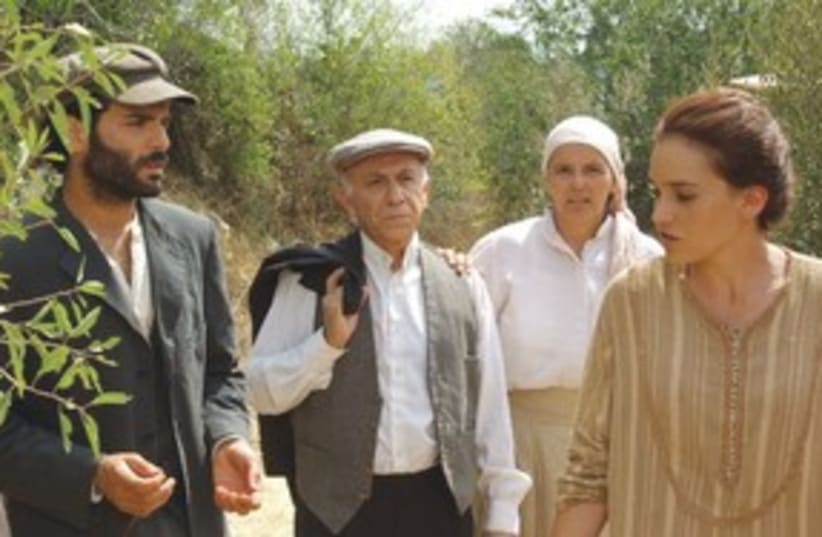
Director Dan Wolman takes a fresh look at the First Aliya in his new film ‘Gei Oni.’
By HANNAH BROWNstrength to strength(photo credit: Courtesy)
While many Israeli filmmakers have examined recent history in their films, director Dan Wolman looks back to a much earlier time in Gei Oni (Valley of Strength), his latest film.Based on a novel by Shulamit Lapid, the film looks at a young woman who comes to Palestine from Russia during the First Aliya. But while the period may not be contemporary, the story certainly is, as Wolman makes what could have been a typical story of a plucky new immigrant overcoming obstacles into a psychological drama about how a woman learns to overcome trauma and a stigma to build a new life for herself.“She marries, but she can’t touch or be touched,” says Wolman over coffee at the Tel Aviv Cinematheque, one of several theaters and cinematheques throughout Israel where Gei Oni is showing. “She starts out crippled because of her trauma, she feels foreign. But then she learns how to feel at home with her body and at home in her new country.”Wolman, 69, is one of Israel’s veteran directors. But while he made a name for himself in the 1970s, unlike many Israeli filmmakers of that period, he continued to develop as a filmmaker and has done some of his best work in the past decade. His movies show an unusual variety in style and subject matter. When he was a young man, he burst onto the Israeli cinema scene in 1970 with The Dreamer, a story about a young man who works in an old people’s home and is torn between his work there and a young woman he meets. In recent years, Wolman has made films that examine the lives of foreign workers in Israel and their Israeli employers in Foreign Sister (2000), and AIDS sufferers and their families in Tied Hands (2006).Gei Oni focuses on Fania, a young mother who arrives in Jaffa after surviving pogroms in Russia. This shy 17-year-old finds herself responsible for the remnants of her family who accompany her: her baby, her frail uncle and her mentally challenged brother. She meets a man from Gei Oni, the settlement that eventually became Rosh Pina, and agrees to marry him after knowing each other for only three days. She has little choice – she has no money and can’t find work. But the film shows how she finds herself by coming to terms with a secret that holds her back and by learning to love the land where she lives and her new husband.Wolman is mindful of the fact that the film may strike some as a patriotic love poem to Israel, and that doesn’t bother him.“The love of Israel is not Right or Left,” he says. “I am connected to this place. The fact that I made a movie about the suffering of a Jewish woman from the First Aliya doesn’t mean I don’t care about the suffering of Palestinian women and children today.”He sees his movie as documenting a specific moment in the history of that period, when there was a shift among the early immigrants: “The film documents the conflict between those who wanted to make their own living by farming and those who were comfortable living on charity from abroad.”At an emotional screening, he showed the film to residents of modern-day Rosh Pina.“People cried and clapped. There were a lot of questions. They asked. ‘How did you make a movie so original about that period?’” he recalls.One element that gives the film its contemporary feel are the actors, particularly the two leads. Tamar Alkan as Fania is a revelation. Appearing in nearly every scene, she manages to convey strength and vulnerability in equal measures, a challenge for any actress.But finding this newcomer wasn’t easy.“At first I was looking for a nursing mother who spoke Russian and played piano,” says Wolman, only half joking . But after seeing 200 actresses, he heard about Alkan from her acting teacher and met her in a café, where she read him a key scene. “I was in tears,” he says.Zion Ashkenazi, another young actor, plays the role of her husband, and they are supported by the more established actors Levana Finkelstein, Ya’acov Bodo and Ezra Dagan.In addition to its Israeli release, the film has been traveling the world. It has been shown in America, of course, at such places at the American Film Institute, the Washington Jewish Film Festival and the Palm Beach Film Festival. But Wolman has also chosen to bring the movie to audiences in Asia, including festivals in Cambodia (Phnom Penh), India (Goa) and China (Chengdu).“I want people to see it all over the world,” says Wolman. “It’s a movie that can touch audiences, whether they are in Israel or Cambodia.”
if(catID != 151){
var cont = `Take Israel home with the new Jerusalem Post Store