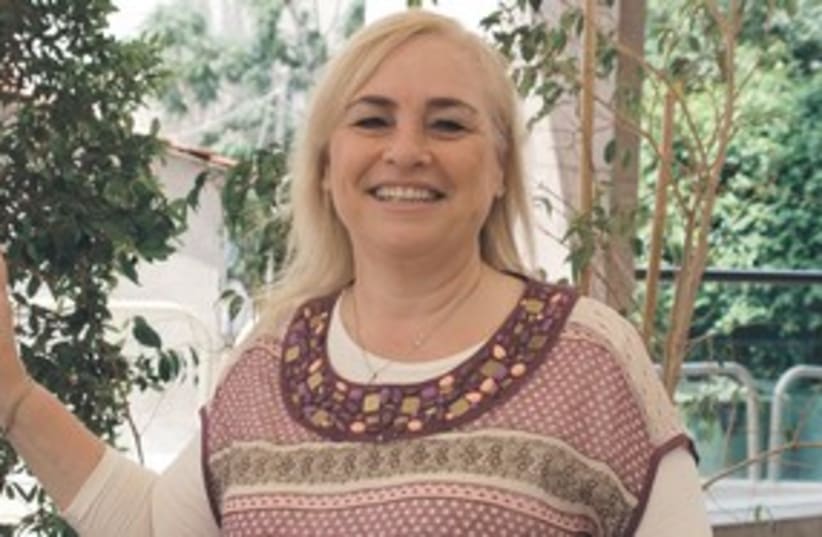
Having never taken a cooking lesson in her life, Sara Spigler is the favorite caterer for much of the Anglo community of Ra’anana.
By GLORIA DEUTSCHSpigler 311(photo credit: Gloria Deutsch)
Sara Spigler is the favorite caterer for much of the huge Anglo community of Ra’anana. Whether it’s for a Shabbat Hatan, brit, birthday party or just a family get-together, she’s the one they think of.Yet she’s never taken a cooking lesson in her life. She made aliya at 17 and worked for years as a dental hygienist.“Sometimes I think I’d like to stop working at least for a while, but people say to me, ‘What on earth will we do if you stop?’ so I can’t.”Spigler, now 55, was born here but left with her parents as a small child.“But I’ve always been a passionate Zionist and came here on a summer trip with my father when I was 16. I met a much older guy who followed me back to New Jersey, and we were married there. It was straight after high school and I was 17 when we came back to Israel to live.”SETTLING IN “I really thought I would be an English teacher,” she says. “Anyway I was accepted to study at Bar-Ilan University and to support my studies I worked as a dental assistant.”The marriage didn’t last, but during that time she went to study dental hygiene and she worked for the man whom she was later, in 1983, to marry, dentist Abe Sigler.DAILY LIFE From early on in her first marriage, Sara knew she would be unable to have children. She had had two ectopic pregnancies and she decided to adopt. Thirty years ago, she and her first husband adopted their son Yoni. Soon after they divorced and she later she married Abe.“Then, about 28 years ago, the doctors at Sheba Hospital in Tel Hashomer told me they were beginning to treat infertility with IVF [invitro fertilization]. They said they hadn’t tried it on humans yet, only rats, and would I be prepared to have a go. I said yes.”After eight difficult years and 10 tries, Sara gave birth to her twin boys, Amichai and Matan.Her sister had made aliya and took over the dental work as she could not work while pregnant.“The brit, at a hotel in Herzliya, was a very emotional occasion,” she recalls. “Everyone felt they were present at a miracle.”BECOMING A CATERER Thirteen years ago their first grandchild was born, and Spigler decided to make a brita, a celebration of the birth in their local synagogue. In those days it was allowed for the family to cater, but today it has to be under official supervision.“I made a Shabbat meal with the food served in porcelain dishes on linen tablecloths and everyone was surprised as the standard until then had been all disposable dishes. People started to tell me I should sell my food, which hadn’t occurred to me until then. Then someone asked me if I could prepare the food for a small second wedding, which I did. And from there it just kind of snowballed. For a year I was cooking out of my own kitchen.“I decided to start a formal catering business and went to the Ra’anana rabbinate to get kashrut certification. They said it wouldn’t be a problem, but I could not cook in my own kitchen. So we moved the car out of the garage and I made a wonderful kitchen in there built to the specifications of the rabbinate. It worked for six or seven years, though I’m not sure how thrilled the neighbors were about it.”LANGUAGE At home the family spoke English and Hebrew, but she was more fluent in English.“I so much wanted to become Israeli again that I would only speak, read and write in Hebrew,” she says. “In those days Ra’anana was a small town with very few Anglos, so it was easier.”OBSTACLES Although she never wanted to expand into a huge catering company, she decided to move out of her garage and find a kitchen she could work from outside her home. She thought she had found the ideal place, moved into it and then discovered the owner had lied and she had no business being there. She was even taken to court by the municipality. Then she tried various other options – sharing with a big Jerusalem catering company, sharing with a restaurant, which meant she could only start cooking at two in the afternoon, and several other unsatisfactory arrangements.But she is philosophical about the problems, feeling that perhaps God was showing her a way out because the various alternatives didn’t really work.BEST THING ABOUT ISRAEL “I adore Israel. Being in a Jewish country when for example it’s Rosh Hashana and the supermarkets are full of apples and honey and where the pomegranates suddenly appear everywhere.I try not to pay attention to the horrible things.Living in Ra’anana is a little like living in a bubble, and so many olim are happy to be here.”ADVICE TO NEW IMMIGRANTS “Try to take things as they come. I know it can be very hard sometimes, especially with the bureaucracy, but remember that this is not the only country where you have to run from office to office to get things done. It happens everywhere.”
if(catID != 151){
var cont = `Take Israel home with the new Jerusalem Post Store