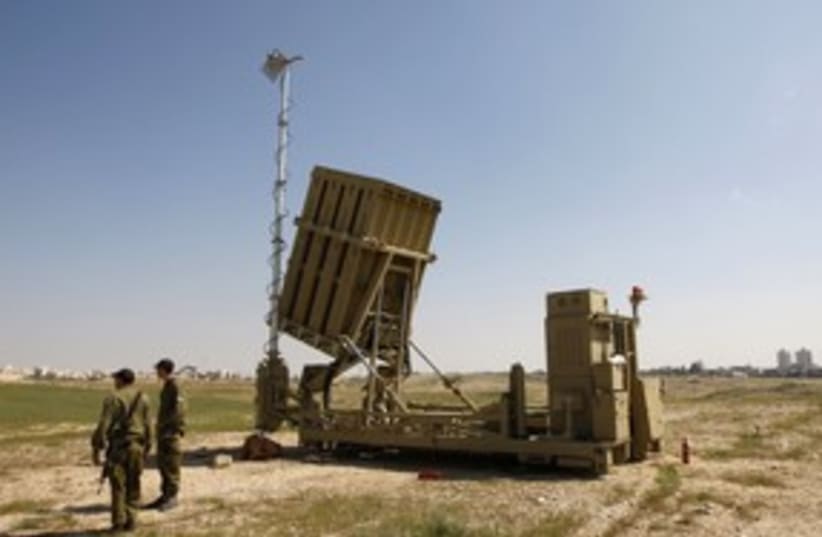
Many people from within and outside the defense establishment had questioned the Iron Dome's capabilities. They were wrong.
By YAAKOV KATZIron Dome 311(photo credit: REUTERS)
On Sunday, schoolchildren go on their annual Pessah vacation, and the real countdown begins – to end the current round of violence between Israel and Hamas before the start of the holiday.The IDF had prepared for this current round and accurately predicted that it would take place after it bombed the car in southern Gaza last Friday night, killing three senior Hamas operatives who were planning attacks against Israelis in Sinai. The answer came on Thursday with the anti-tank missile that hit the school bus near Kibbutz Sa’ad.RELATED:IDF vows to keep up air strikes as 120 rockets hit SouthHamas: We'll broaden attacks if IDF strikes continueAnalysis: Those fiendish Jews and their life-saving innovationsThe IDF has been warning for several months of the growing rift within Hamas between the political echelon, led by Ismail Haniyeh, and the military wing, led by Ahmed Jabari.Haniyeh and the rest of the Hamas government are mostly interested in solidifying their regime, and are currently more concerned about the possibility that the unrest in the Arab world will spread to Gaza than they are with Israel. For this reason, Hamas has cracked down hard in recent weeks on any signs of demonstrations and, like Libyan leader Muammar Gaddafi, has not hesitated to use brutal force to quell the riots.Jabari has other interests.First, he apparently felt the need to avenge the Israeli strike against his fellow Hamas operatives. It didn’t help that one of the men killed in last week’s strike was a personal friend of his.Secondly, he has prevented his fighters from using their weaponry against Israel since Operation Cast Lead two years ago, allowing Islamic Jihad to steal most of the show and gain prominence as an up-and-coming organization and power player in the Gaza Strip. His subordinates have felt real frustration.After all, they smuggled powerful and high-quality weaponry into Gaza, but were not allowed to use it.There are two main differences between this current escalation and the one that led to Operation Cast Lead two years ago.First, Israel is not agreeing so quickly to a cease-fire, and has made clear that it will not accept one in which Hamas fires rockets and Israel refrains from firing back.“It will either have to be a full cease-fire, or nothing,” a senior defense official explained Saturday night.The second difference is the successful operation of the Iron Dome counter-rocket system.Many people from within and outside the defense establishment had questioned its capabilities.They were wrong. Based on the 10 interceptions since Thursday, Iron Dome works.While it does not intercept every rocket fired into Israel, that is because it is designed to intercept only those set to strike populated areas. If the system detects a rocket falling in an open field, it will not fire an interceptor. At the same time, there are still only two batteries – deployed outside Beersheba and Ashkelon, respectively – hardly enough to provide an adequate defense for southern Israel.Nevertheless, this does provide Israeli leaders with unprecedented diplomatic maneuverability.While rockets are hitting within Israel, the damage and number of casualties is lower than it would have been in the past, due to Iron Dome. This means the government does not feel as much domestic pressure to launch a larger offensive against Hamas, and can consider its options more slowly and more carefully.It also means that the government feels it can continue to strike at terrorists it detects in Gaza, even at the risk of more rocket attacks.The clock will be ticking, though, with Seder night approaching. What will likely happen is that Israel and Hamas will try to find a way to end this cycle before it escalates any further, so Israelis can celebrate Pessah and Jabari and his men can go back to the drawing board and plan for tomorrow.
if(catID != 151){
var cont = `Take Israel home with the new Jerusalem Post Store