IDF conditionally ceases air strikes on Hamas targets
Palestinian official says Hamas, Israel agree to truce shortly before Kassam rocket explodes near Ashkelon; no injuries or damage reported.
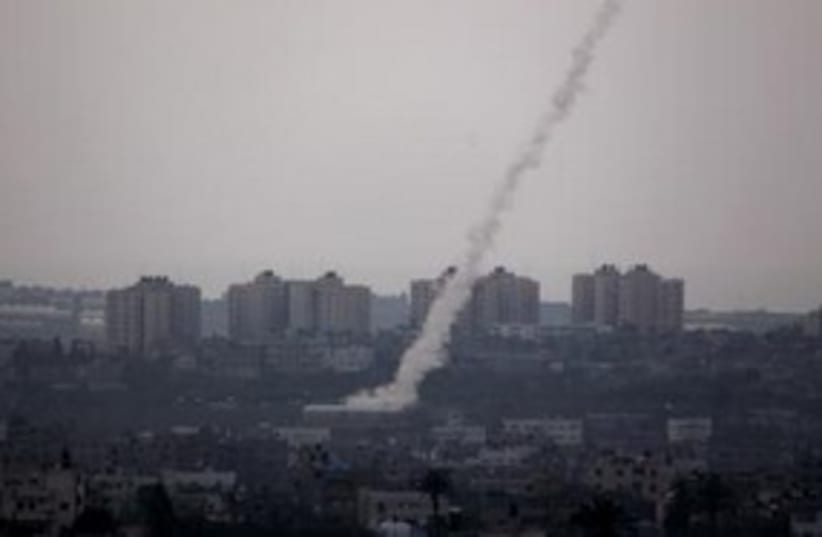
By YAAKOV KATZ, JPOST.COM STAFFKassam rocket being fired from Gaza Strip 311 (R)(photo credit: REUTERS/Darren Whiteside)
The IDF stopped its air strikes against Hamas targets in the Gaza Strip on Sunday after Palestinian terror groups cut back on rocket attacks against Israel, in what appeared to be the beginning of a shaky cease-fire. The decision was made shortly before a Kassam rocket exploded near Ashkelon. No injuries were reported and no damage was caused.On Sunday, 13 rockets were fired into Israel, and a senior official in the Defense Ministry, who requested anonymity, told reporters that Israel decided to hold its fire as long as Hamas and the other Palestinian terror groups ceased launching attacks on civilians.RELATED:Iron Dome works in combat, intercepts Katyusha rocketIDF to move Iron Dome to Gush Dan region in weeks“It all depends on the other side,” the Defense Ministry official said. “If a barrage of missiles falls in a town and there are casualties, that will change the situation – but if a rocket lands in an open field we will look at that differently.”At the same time, a Palestinian official close to UN-and Egyptian-mediated negotiations told Reuters on Sunday that Israel and terrorist groups in Gaza had agreed to a truce, as cross-border violence abated."Palestinian factions have agreed to halt rocket fire and Israel agreed to cease attacks on the Gaza Strip," the Palestinian official said.A senior IDF officer said Sunday that the IDF has a list of 19 names of Hamas and Islamic Jihad terrorists who have been killed in air strikes and ground attacks since Israel stepped up military operations following Thursday’s anti-tank missile attack against a school bus near Nahal Oz.Another 47 terrorists have been wounded, and there are two known deaths of civilians.“We believe that Hamas has understood the message,” the senior defense official, who requested anonymity, said.“We are ready to escalate our operations, however, if the attacks continue.”Meanwhile, the star of the latest round of violence between Israel and Hamas continued to be the Iron Dome counter-rocket defense system, which has intercepted eight rockets since Thursday.On Sunday, the Defense Ministry’s MAFAT Research and Development Directorate released video footage from the Iron Dome, showing how the Tamir interceptor shot down a number of Katyusha rockets over the weekend.Israel plans to increase the number of operational batteries to six in the coming years, with the arrival of $205 million the Obama administration has pledged it will provide Israel to purchase additional rocket defense systems. The money is supposed to be included in the US’s upcoming annual budget.The Defense Ministry recently completed negotiations with Iron Dome manufacturer Rafael about the upcoming deal.Defense Minister Ehud Barak said the system’s success “has deeply impacted Israel’s ability to act operationally and to maneuver diplomatically against challenges, not just routinely, but also during much broader events.”Once the money is received, it will still take at least 18 months before the first of the four batteries is delivered to the Air Force and up to two-and-a-half years before the last of the four is operational.Reuters contributed to this report.
if(catID != 151){
var cont = `Take Israel home with the new Jerusalem Post Store