PA gives no indication of calling for West Bank calm
Following death of Palestinian prisoner in Israeli jail, 4,500 Palestinians send back food in protest; Palestinians throw stones at security forces in Hebron area; PM reportedly orders transfer of tax revenues to PA.
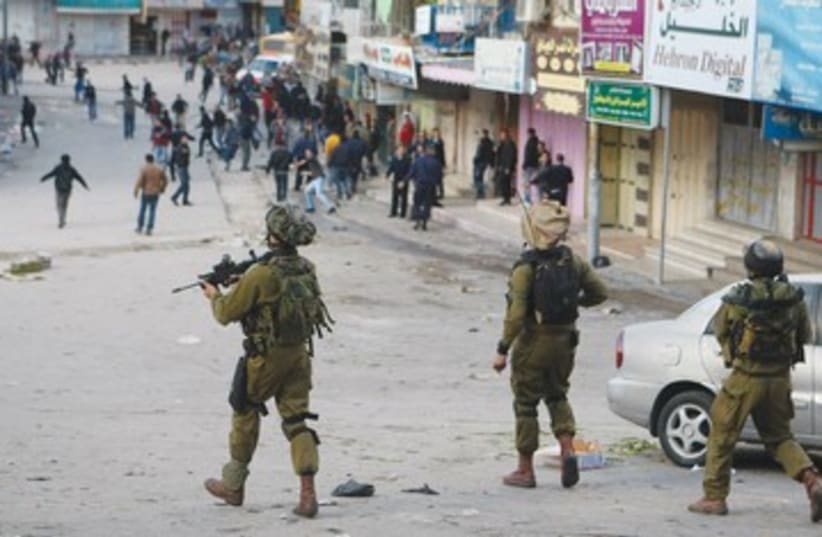
By BEN HARTMAN, KHALED ABU TOAMEH, TOVAH LAZAROFFIDF Soldiers disperse Palestinian rioters in Hebron 390(photo credit: Reuters)
Prime Minister Binyamin Netanyahu sent a message to the Palestinian Authority to calm tensions in the West Bank on Sunday as Palestinians rioted and threw stones at security forces near Hebron.However, a senior aide to Palestinian Authority President Mahmoud Abbas gave no indication the Authority, which exercises limited self-rule in the West Bank, would issue any call for calm, and blamed Israel for the spike in unrest.Yasser Abed Rabbo, a senior Abbas aide, said Israel's treatment of prisoners and anti-Palestinian violence by Jewish settlers were "the cause of the deterioration".Senior officials in Jerusalem said that Netanyahu's request to calm tensions was made to the PA leadership through his peace talks liaison Yitzhak Molcho.According to Channel 10, Netanyahu also instructed Israeli authorities to transfer the PA its tax revenues for January, "so that they won't have an excuse not to enforce calm on the ground."Security forces were on high alert in the West Bank and east Jerusalem on Sunday morning amid concerns that the death of Palestinian prisoner Arafat Jaradat in Megiddo Prison on Saturday would set off violent Palestinian demonstrations.The Palestinian Authority on Saturday strongly condemned Jaradat's death from an apparent heart attack and called for a UN investigation into the case.There were demonstrations in Ramallah and Hebron following his death and 4,500 Palestinians in Israeli prisons sent back there food Sunday morning in protest.Israel Prison Service spokesman Sivan Veitzman said the protest includes nearly all of the security prisoners in Israel's jails but that the IPS does not view the action as a hunger strike and that they expect that the protest will only last one day, at most three.She added that while the protest has not included violence on the part of any of the security prisoners, prison personnel are currently on a higher state of alert than usual.In Jaradat's village of Kfar Sa'ir near Hebron, dozens of Palestinians threw stones at IDF soldiers on Sunday morning. Riots were reported in additional areas of the West Bank, mostly in the Hebron area.An IDF soldier was injured from stones thrown by Palestinians close to Beit Hadassah in Hebron.The IDF employed riot dispersal methods in attempts to contain the rioters.Jaradat's death came amid heightened tensions as a group of security prisoners in Israeli jails engage in an ongoing hunger strike. Even before Jaradat’s death, Palestinians rioted and attacked security personnel in several places in the West Bank and in east Jerusalem on Friday.Police are investigating the death and an autopsy was set for Sunday.PA Minister for Prisoners Affairs Issa Qaraqi held Israel fully responsible for the death of Jaradat and charged that he had been tortured.Qaraqi and PLO Executive Committee member Hanan Ashrawi called on the UN to open an investigation into the death of Jaradat.“This is not an isolated case,” Ashrawi said, referring to the death of the inmate.“This is the case of the rights of all the prisoners – rights that are being violated by the occupation. This requires quick action to open Israeli prisons to the world.”Ashrawi said the Palestinians were determined to demand that the UN Security Council force Israel to honor the rights of Palestinian prisoners. Amos Gilad, a senior Israeli Defense Ministry official, questioned whether the protests were just a tactical move by the Palestinians to draw international attention before Obama's visit to Israel, the West Bank and Jordan. But he added, in an Israel Radio interview: "Things can get out of control."Contributing to the tense atmosphere in the West Bank were clashes between settlers and Palestinians on Saturday.The IDF is investigating the possibility that Israeli civilians shot two Palestinians from Kusra, near Nablus, during clashes with settlers and the IDF on Saturday.Aron Katsof, a spokesman for the Esh Kodesh outpost, said that Palestinians attacked his small community around noon by throwing stones and that he and others from the outpost and nearby settlements went out to defend their homes. He denied that anyone had shot at the Palestinians.Rabbis for Human Rights said the Palestinians were shot in Kusra. The organization’s field worker Zacharia Sadeh charged that violence broke out after settlers had attacked two homes in the village.Melanie Lidman, Ariel Ben Solomon, Jpost.com staff and Reuters contributed to this report.
if(catID != 151){
var cont = `Take Israel home with the new Jerusalem Post Store