Is the seizure of Gaza-bound Iranian arms at sea a bad omen for Israel?
The intercepted weapons shipment from Iran to Gaza could signal a renewal of ties between Tehran and Hamas. If so, Iran is likely to demand that Hamas pay a price for its patronage - the resumption of rocket fire on Israel.
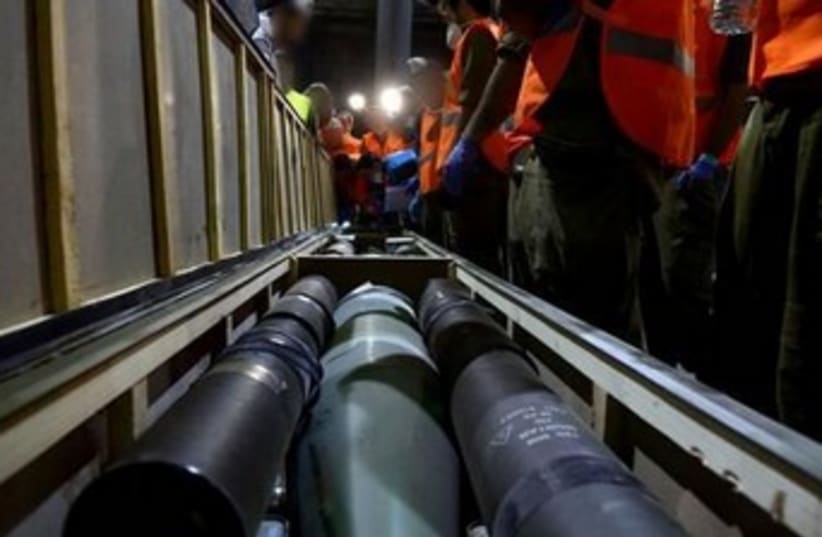
By YOSSI MELMANWeapons recovered by the IDF from the Klos C.(photo credit: COURTESY IDF SPOKESMAN'S OFFICE)
The looming question which continues to evade Israeli intelligence regarding the Klos-C remains, for who were the Iranian weapons intended? Intel indicates that the ship was destined to unload its cargo in Sudan, where the Iranian Revolutionary Guards Quds Force would have transferred the weapons onwards, over-land.The arms could have been intended for Global Jihad factions, operating in the Sinai Peninsula. The Quds Force has had contact with these and other al-Qaida-linked factions for over a decade, using them when necessary to promote Iranian interests.Yet, more than likely, the rockets, mortars and munitions were intended for Gaza- perhaps for the Palestinian terror organization Islamic Jihad, which Tehran has sponsored for years. Still the possibility cannot be ruled out that the missiles were intended for Hamas.In either case, even after all the praise for a successful military operation and the precise intelligence which enabled the successful seizure of the ship on Tuesday, the revelation of such a weapons shipment is a bad omen for Israel.It indicates a renewal of ties between Gaza and Tehran. Indeed, it appears that the three-year gap between the Shiite regime and the Sunni organization in Hamas, which began with the civil war in Syria has been solved.Until the war in Syria erupted, the senior Hamas leadership sat in Damascus, while Iran supplied weapons (sent in ships to Sudan and then trucked through Egypt and Sinai to Gaza tunnels) and provided military assistance to the organization.With the outbreak of the war, Hamas condemned the attacks by the regime, led by the Alawite Assad family (an offshoot of the Shi'ite Muslim faction), who ruled over the largely Sunni Syrian population. In response, the Syrian regime cut support for Hamas, ordered it out of the bunkers and safe-houses it had been using, and banned the organization from the city.Tehran, for it's part, aligned itself with the Assad regime and ceased its financial and military aid to Hamas. For a short period, Hamas found a sponsor in Mohamed Morsi's Egypt under the Muslim Brotherhood. However, with the military takeover in Cairo following massive protests and violence against the Muslim Brotherhood, Hamas was once again isolated.In recent months, Hamas leaders have been working to renew their old alliance with Iran and sent emissaries to achieve this. Does the capture of the Klos-C and its cargo of Iranian weapons indicate Hamas's success in healing ties with Iran?If this is the case, then the thawing of relations will come at a price which Hamas is apparently willing to pay. Secret talks and communications in clandestine circles indicate that Iran demands that Hamas resume the firing of rockets at Israel.This resumption of hostilities will not occur immediately, and Israeli capabilities to strike back and thwart attacks weighs heavily on Hamas. Hamas knows that in the next war, Israel will not be satisfied with heavy sanctions as it settled for in the previous two conflicts, in 2009 and 2012. This time Israel will seek to topple the regime. Nevertheless, as the saying goes, when the gun appears in the opening scene, the shot will be heard in the final scene.The time to revel in the success of Israel's operation is short-lived. According to several reports, the IDF has been operating in the Red Sea and the Indian Ocean for more than a decade, with vessels (ships and submarines) and aircraft. The navy took control of several ships which carried or were suspected of transporting weapons. The most famous being the Karine-A which Israel captured smuggling weapons in 2002.In recent years, reports have indicated military strikes along Sudan's coast and on ships and convoys transporting weapons which originated in Iran. These attacks have been attributed to Israel by the Sudanese government and foreign media, along with an attack on a Sudanese warehouse housing missiles.As it is, we can and should admire the precise intelligence obtained by Israel (with the assistance of the US whose intelligence capabilities in the Red Sea, Indian Ocean and Persian Golf out-pace those of Israel). The fact that Prime Minister Binyamin Netanyahu bothered to call and to thank not only the chief of staff, but also the Mossad's Chief Tamir Pardo, more than suggests the part which that organization played in obtaining information on the Klos-C. Indeed Israel's intelligence certainly used an array of assets such as HUMINT (agents on the ground), SIGINT (communications and signals monitoring) as well as the air-force (with aircraft and satellites).It should also be taken into account, that missiles such as those exposed in the recent operation, M-302 with a range of up to 200km and the capability to carry a warhead of more than 100 kg, are already in Gaza. The working assumption of the army and intelligence is that such shipments must have an acceptable rate of success in order to continue, where ships have managed to slip through the net and reached their destinations. After all, Intel cannot know what it does not know.For Israel, such missiles- in the hands of Hamas or Islamic Jihad in Gaza- are a "game-changer." Such missiles would allow terrorist organizations to launch the next missile campaign against, not only central Israel, Tel Aviv, Jerusalem, and Dimona, but also northern Israel. The truth is, however, that such missiles have already been in the hands of Hezbollah, in Lebanon, for over a decade and were launched from Lebanon toward Haifa and Afula in the Second Lebanon War.Military Intelligence Chief Maj. General Aviv Kochavi, said a few weeks ago that there are about 170 thousand missiles and rockets aimed at Israel from all directions. Lebanon and Syria in the North, Iran in the East, and Gaza and Sinai in the South. The seizure of several dozen missiles, impressive as it is, as well as Israel's missile defense systems-"Iron Dome" and "Arrow" as well as the future system "Magic Wand"-do not change the facts: every military base, every airport, every strategic site, and all civilian communities, whether small or large, in Israel are within range.(Translation by Lev Selmon)
if(catID != 151){
var cont = `Take Israel home with the new Jerusalem Post Store