Officials say the test demonstrates Israel's ability to defend itself in a future war.
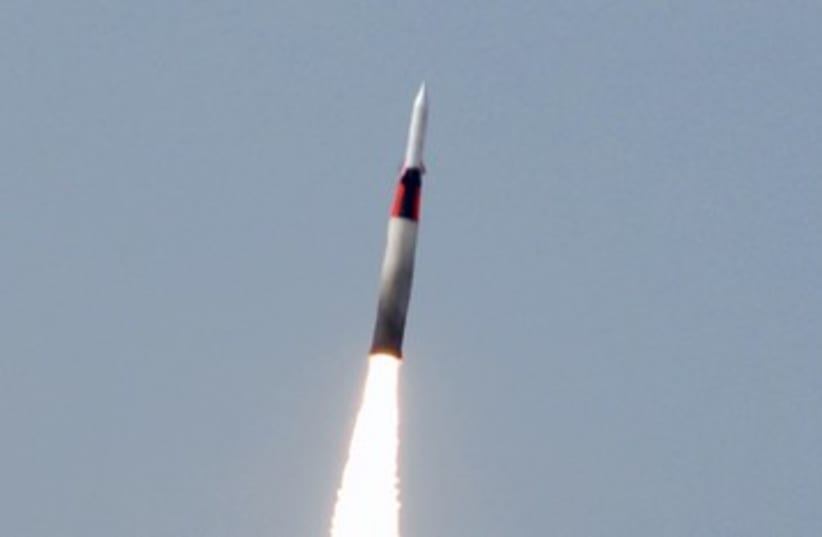
By YAAKOV KATZArrow missile defense system launch 390(photo credit: Ho New / Reuters)
In the face of Iran’s continued pursuit of a nuclear weapon, Israel tested the Arrow missile defense system on Friday in what officials said was a successful demonstration of the country’s ability to defend itself in a future war.At 11 a.m. Friday, an F-15 Israel Air Force (IAF) fighter jet launched a Blue Sparrow missile developed by Raphael to impersonate long-range Iranian ballistic missiles.The Arrow’s radar and detection system, developed by Israel Aerospace Industries (IAI) detected the incoming “enemy” missile and tracked it together with the United States X-Band radar deployed in the Negev desert.The Arrow interceptor was not launched during the test, in line with the parameters of the drill, which was carried out to test the system’s overall capabilities in detecting and tracking incoming enemy targets.“This was a complicated test due to the way the missile operated and the objective of getting all the systems to work together,” explained Yair Ramati, head of Israel’s Homa Missile Defense Agency.The Defense Ministry said the test was not connected to current events and was part of the Arrow system’s annual training regimen, but that it was a significant milestone, as it completes the development of Block 4 stage of the interceptor, which will be delivered to the IAF in the coming weeks.The Arrow serves as Israel’s upper-tier missile defense system. Additional layers include the Iron Dome for short-range rockets and the soon-to-be-deployed David’s Sling, which is being developed to defend against medium-range rockets.Defense Minister Ehud Barak praised the successful test.“This is an important technological achievement and an important step in Israel’s progress in the field of defense,” Barak said. “The successful test demonstrates once again the high technical capabilities of engineers, technicians and employees of Israeli defense companies which participated in the test.”Israel and the United States are scheduled to hold the Austere Challenge missile- defense exercise later this year, likely in late October.Senior American military officers from the European Command arrived in Israel recently to finalize plans to hold the exercise, which has been billed as the largest joint missile-defense exercise in the countries’ history.The drill was initially scheduled for April and was supposed to see the deployment of thousands of US troops and various sophisticated American military equipment in Israel.
if(catID != 151){
var cont = `Take Israel home with the new Jerusalem Post Store