Attacks target Israeli embassies in Georgia, India
4 injured in in New Delhi car bombing, including diplomat's wife; Georgia police defuse bomb after anniversary of Mughniyeh.
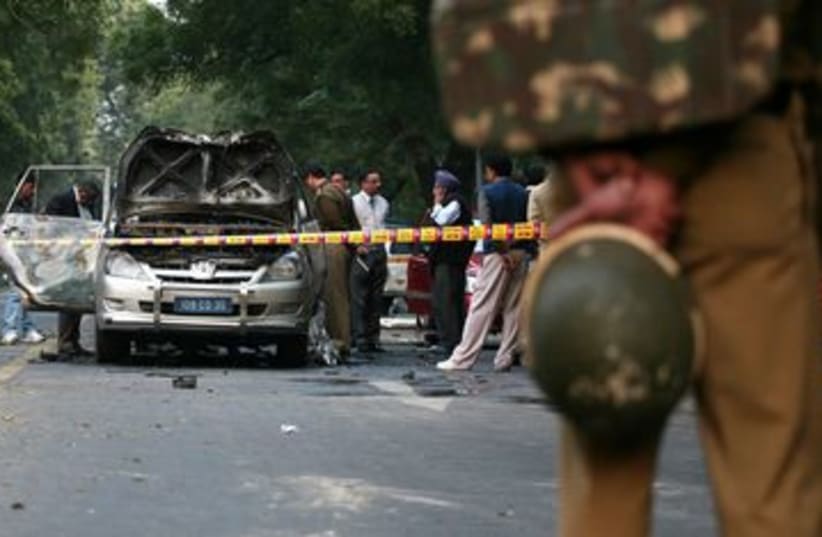
By YAAKOV KATZIndian police inspect bombed car in New Delhi 390 (R)(photo credit: REUTERS/Parivartan Sharma)
A day after the fourth anniversary of the assassination of Hezbollah’s military commander, two seemingly coordinated attacks were launched on Monday against Israeli embassies overseas.In the first attack, the wife of the Israeli embassy's chief security officer was injured when a bomb exploded in her car in New Delhi, India. The woman succeeded in driving to the Israeli embassy where she was evacuated to a nearby hospital. She was reported to be in moderate condition. Three others were also injured in the attack, according to Reuters.The woman was named as Tali Yoshua Koren, wife of the Defense Ministry representative to India.Koren, who also works at the embassy, left Monday afternoon with a driver to pick up her children from school. On her way to the school, the blast occurred. She sustained moderate injuries, mostly to her legs, was evacuated to a nearby hospital and is currently in surgery, suffering mostly from shrapnel injuries.Two Israeli doctors, coincidentally in New Delhi at the time, in coordination with the Foreign Ministry, arrived at the hospital and took charge of her medical care. Defense officials said discussions were taking place about the possibility of evacuating Koren back to Israel.The current assessment within the Israeli defense establishment was that the bomb was attached to the car by an assassin on a motorbike. It was unclear if the assassin knew that Koren was in the car or thought that her husband, the Defense Ministry representative, was in the car instead.In the second attack, an embassy staffer in Tbilisi, Georgia discovered a bomb underneath his car as he was driving to the embassy Monday morning. The staffer – a local Georgian national – heard something during the drive, pulled over to the side of the road, noticed the bomb and called local authorities. The bomb was dismantled before exploding.Israeli security authorities raised the level of alert worldwide following the attacks. Security officials said that it was possible that the attacks were connected to the fourth anniversary of the assassination of Hezbollah military chief Imad Mughniyeh who was killed in Damascus on February 12, 2008.Diplomats worldwide have been ordered to check in and citizens currently overseas have been asked to do the same, reporting where they are and what their status is.Security at embassies is being boosted by local police and military forces and Israel was considering the possibility of sending reinforcements from Israel. The Shin Bet (Israel Security Agency) was holding security assessments at its headquarters in Israel.The attacks were believed to be coordinated. Iran and Hezbollah have tried a number of times in recent years to avenge Mughniyeh’s assassination.Israel raised its level of alert in early January surrounding delegations overseas out of concern that Iran and Hezbollah are trying to launch an attack ahead of the fourth anniversary of the assassination Mughniyeh. Attacks were recently thwarted in Azerbaijan and in Thailand.Other attempts have included a plan to shoot down an Israeli airliner over Turkey with shoulder-to-air missiles and a plan to attack Israeli tourists in the Sinai.Responding to news of the attack, Foreign Minister Avigdor Liberman said Israel knows exactly how to identify those responsible for the attacks.Last month, IDF Chief of Staff Lt.-Gen. Benny Gantz warned Hezbollah on Tuesday not to test Israel's resolve by perpetrating a terror attack against an Israeli target overseas."We are witnessing efforts by Hezbollah and other hostile elements to perpetrate a brutal terror attack far from Israel," Gantz said at the time."I recommend to everyone not to test our resolve."JPost.com staff, Gil Hoffman and Reuters contributed to this report.
if(catID != 151){
var cont = `Take Israel home with the new Jerusalem Post Store