The Jerusalem Post
Jpost search icon google-icon iphone
  Set as Homepage
Fri, May 24, 2013   15 Sivan, 5773
newspapers magazines
 
    • Breaking News
    • Diplomacy & Politics
    • Defense
    • National
    • Mideast
    • Syria
    • Iran
    • World
    • Business
    • Sports
    • Health & Science
    • Environment
  • Video
  • Opinion
    • Columnists
    • Editorials
    • Op-Eds
    • Letters
  • Jewish World
  • Lifestyle
    • Arts & Culture
    • Food & Wine
    • Travel
  • Features
    • Insights & Features
    • Week in review
    • On the Web
    • Shalva Superheroes
    • Obama in Israel
  • Blogs
    • In the news
    • Judaism
    • From the Middle East
    • Lifestyle
    • Aliya
    • Science and Technology
  • JPost Apps
    • iPhone app
    • iPad app
    • Android app
    • Twitter
    • Facebook
    • RSS feeds
    • JPost Toolbar
    • JPost Newsletter
    • JPost Alert
  • Premium Zone
    • The Jerusalem Report
    • The Experts
    • 20 Questions
    • e-paper
    • Ivrit
    • Christian Edition
    • Dash
    • Magazine
    • Metro
    • In Jerusalem
  • French
    • Politique & Social
    • Affaires Palestiniennes
    • Diplomatie & Monde
    • Art & Culture
    • Israel
  • Green Israel
JPost Learn Hebrew  
Advertise with us  
Nefesh Guided Aliyah  
Eldan  
AFMDA  
Africa Israel Group  
Isram Group  
Kupat Ha  
JPost Twitter  
JPost Facebook  
Classifieds  


Breaking News
 
 
  • JPost.com
  • Defense
 

Analysis: Far from over

By YONAH JEREMY BOB
12/13/2012 22:49
Tweet

Issues surrounding the IDF’s targeting of media centers in Pillar of Defense remain on the legal agenda of the International Federation of Journalists.

Office of Hamas’s al-Aksa television channel
Office of Hamas’s al-Aksa television channel Photo: Majdi Fathi/Reuters

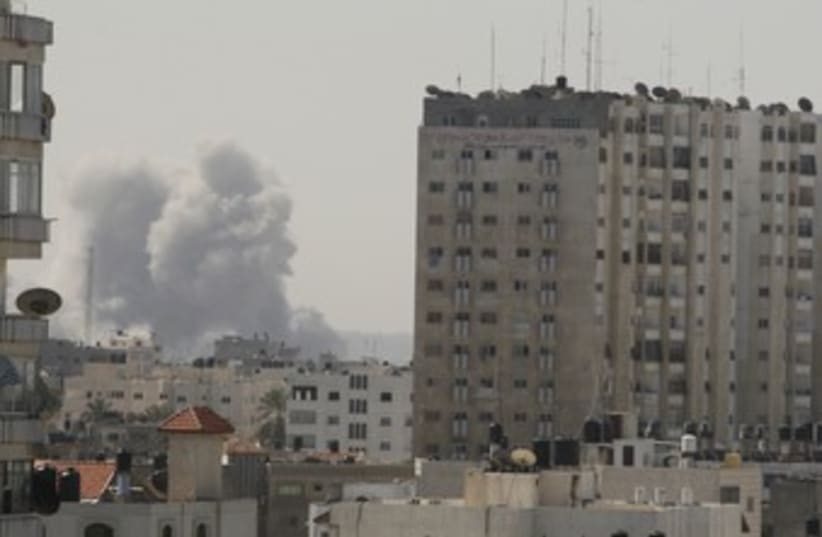
More has started to emerge about whether the IDF’s targeting media antennas and buildings in the last Gaza war was legal. So although it will still take some time for the picture to fill out, the debate is on regarding at least six incidents.

The International Federation of Journalists (IFJ) is encouraging a UN investigation and accusing Israel of deliberately targeting journalists, while Israel claims it was targeting terrorists or military targets.

  • In fog of war, when are the media human shields?

IFJ Human Rights representative Ernest Sagaga said that even if terrorists were using an antenna on a building or if there were terrorists in the building, the IDF still could not attack media facilities if there were innocent journalists inside.

The IDF has claimed that Hamas was using an antenna the army attacked on top of a media building on November 18, and that four Islamic Jihad terrorists were in a building it attacked on November 19.

Sagaga based his claim on language from Protocol I to the Fourth Geneva Convention and UN Resolution 1738, which say that civilians remain protected as long as they themselves (as opposed to third parties) do not take any action adversely affecting their civilian status.

At the same time, he said the IFJ “would unreservedly condemn any attempts” by third parties “to endanger the safety of journalists by turning their place of work into a military target,” while indicating that the IFJ had no evidence that terrorists were inside media facilities during the disputed incidents.

A question for the IFJ would be: Is it really capable of knowing all the time whether terrorists have clandestinely infiltrated its facilities? This is an especially tough question if, as the IDF claims, some Gaza journalists play journalist and terrorist alternately – a claim the IFJ has vehemently denied.

Regarding the IDF claim that terrorists were using the building’s civilian status to hide themselves or their use of the building’s antennas behind journalists as “human shields,” Sagaga said the “claim raises more questions than it offers answers to, such as what role the army considered these ‘terrorists’ were playing inside the buildings.”

He may have been alluding to the argument of some legal scholars that if there was no evidence that the terrorists were engaged in combat and were merely meeting, even targeting them in a civilian media facility might have violated the proportionality principle.

The argument goes that even a military target may not be targeted if the risk to civilians at that moment outweighs the military advantage.

He said that “everyone will agree that a missile, however surgical and precise, will not just hit the antenna and bounce back in the air. It will most likely take out chunks of the buildings and cause serious risk of harm to those inside.”

As such, he said, “the IDF defense would command more credibility if, at the very least, they had warned those inside those buildings to evacuate before launching their attacks.”

The IDF said it always issues warnings, but the IFJ said there had been no warning of this particular attack.

Assuming that terrorists were in the targeted building on November 19, the IDF can respond that International Committee of the Red Cross commentary to Article 28 of the Fourth Geneva Convention makes it clear that if an adversary uses human shields, one can attack the adversary anyway, provided that the proportionality rule is followed.

The commentary clarifies that this applies equally to “resistance movements” and “small sites” as well as formal militaries in wide areas.

Foreign Ministry Spokesman Yigal Palmor said that the overall pervasive Hamas tactic of using “human shields” was key in deciphering the real facts in these controversial incidents.

He noted that “Hamas hides behind civilians” regularly, “fires rockets into civilian areas” and “publicly takes pride in carrying out military operations using civilian facilities.”

Palmor was asked about the IDF claim that Hamas used the media facilities as “human shields,” considering there had not been reports that Hamas physically moved individual journalists into the line of fire.

He responded that Hamas’s “use of civilian media facilities is tantamount” to using the facilities the way it uses individual civilians as human shields.

The question is even more complex when it comes to the November 18 antenna attack.

The same UN Resolution 1738 that the IFJ cited for protecting journalists and their equipment contains an exception if the equipment becomes a military objective.

Hebrew University Law School president and international law expert Yuval Shany said that the legality of the attack would depend on what the antenna was used for militarily.

Simply passing on general hate propaganda might be problematic and in some cases reason for arrest and prosecution, but for the army to attack the antenna, it would need to have been used for military communications purposes. Otherwise it would not provide a “concrete military advantage” as required under the law of armed conflict.

Even if it were being used for military broadcasts, a simpler and possibly more proportional solution could have been to jam the transmission, which could have prevented what the IFJ claimed was damage to several floors below the antenna.

On the other hand, the IDF can point out that while it strives to use the least dangerous munitions or tactics possible when attacking targets near civilians, the law of armed conflict does not demand use of one tactic over another, and relies more on general principles.

What will happen next is unpredictable.

The IFJ is seeking a UN and independent investigation.

There is certainly precedent for these investigations, including the 2009 Goldstone Report after Operation Cast Lead and Israel’s own Turkel Commission. But with no ground invasion, there are fewer reported incidents of civilian casualties and buildings being hit, and there may be less public pressure for an inquiry.

If there are further demands on the IDF and Israel to investigate the media incidents, Shany said, who investigates should depend on who approved the strikes. If a midlevel military lawyer approved them, then a different IDF lawyer who was not involved in the approval could perform the investigation.

Shany is not one of those opposed to the IDF investigating itself in all circumstances.

But he suggested that if the attacks were approved at a higher level, there should be an independent inquiry, since if lower-level officers then had to perform the investigation, he doubted they would be willing to criticize their superiors’ decisions.

The media incidents are likely far from being a Goldstone II, but it is also likely that the story surrounding them is far from over

  • Send
  • Large
  • Small
  • Print
  • Share
This article is by :
Yonah Jeremy Bob

Follow @jeremybob1
Recent stories:
  • Couple charged with killing woman, melti...
  • Rule of Law: Israel’s legal headache
  • German minister: There is a chance for p...
  • Shapira to investigate PM over foreign t...
Most Viewed in
1
IAF chief warns 'surprise war' is potential threat
2
Experts deny Israel may directly intervene in Syria
3
Remote-control machine gun repairs just got quicker
4
Is Israel in touch with Syria villagers?
JPost Community
Tweet
Operation Pillar of Defense IDf Media Journalist Legal International Federation of Journalists
Share this article
Tweet
Share
Send
Your comment must be approved by a moderator before being published on JPost.com. Disqus users can post comments automatically.

Comments must adhere to our Talkback policy. If you believe that a comment has breached the Talkback policy, please press the flag icon to bring it to the attention of our moderation team.
JPost Services
conferenceConference
newsletterNewsletter
iphoneMobile Apps
kotelcamKotel Cam
kolboJPost Alert
premiumPremium
JPost TV News  
Mobile Apps  
Bank Hapoalim  
Meir Panim  
Yad Ezra  
Rambam Hospital  
TourLuxe  
Zev Goldstein PLLC  
Penrose Gallery  
JPost Premium Zone  
JPost kotel Camera  
         
 
Israel Focus
JPost TV News
Coming soon to a screen near you!  
Nefesh B'Nefesh Guided Aliyah
Already living in Israel? Enjoy the Benefits of Aliyah!  
Give "Freedom" this Passover
to needy Israeli families. Donate now  
War Threatens
Protect the People of Northern Israel  
China Suppliers
 
Intelligence Squared
The international debate forum, announces it is coming to Israel  
Bank Hapoalim
Israeli's number one bank  
Jerusalem Post Lite
Lite Edition of the Jerusalem Post for English improvement  
Learn Hebrew with us
Get 10 minutes free personal coaching in Hebrew through phone or Skype  
JPost newspapers
Sign up for the JPost newspapers and receive one month free subscription  
Kosher English Magazine
English language weekly magazine - especially for religious people  
JReport Kindle Edition
Now you can get the Jerusalem Report directly to your Kindle  
JPost Premium Edition
The very best articles are available only in our Premium edition  
Lifestyle Magazine
 
 
Real Estate
Don't Look For a House!
In Israel, our website will do it for you!  
 
Travel
Eldan Rent a Car
20% off all Car Rental Reservations in Israel  
Hertz Car Rental
Special Online Discounts!  
The King David Jerusalem Hotel
One of the world's truly iconic hotels, and a Jerusalem landmark  


Sites Of Interest:

Jerusalem Hotels
KKL-JNF
Poalim Online
BreitBart.com
Our Friends
Jerusalem Attractions
Jerusalem Tours
itraveljerusalem.com

JPost sites:

Learn Hebrew
The Jerusalem Report
Our Magazines
JPost Edition Francaise
Green Israel
Christian World
Jerusalem Post Lite

Services:

JPost Mobile Apps
JPost Premium
JPost Newsletter
JPost Toolbar
JPost News Ticker
JPost RSS feeds
JPost Archives
JPost Alert
JPost Kotel Cam

JPost Conferences:

NYC Conference
Diplomatic Conference

Information:

About Us
Feedback
Staff E-mails
Copyright
Sitemap
News Partners
Advertise with Us
Statistics
Ad Specs
Terms Of Service
Jpost.com, the online edition of the Jerusalem Post Newspaper - the most read and best-selling English-language newspaper in Israel. For analysis and opinion from Israel, the Jewish World and the Middle East. Jpost.com offers expert and in-depth reporting from Israel, the Jewish World and the Middle East, including diplomacy and defense, the Palestinian-Israeli conflict, the Arab Spring, the Mideast peace process, politics in Israel, life in Jerusalem, Israel's international affairs, Iran and its nuclear program, Syria and the Syrian civil war, Lebanon, the Palestinian Authority, the West Bank and Gaza Strip, Israel's world of business and finance, and Jewish life in Israel and the Diaspora.
 
About Us | Advertise with Us | Subscribe | Premium | Newsletter | RSS | Contact Us
 
All rights reserved © The Jerusalem Post 1995 - 2012