More to lose in crisis with Turkey than meets the eye
Analysis: For Israel, Turkey was a partner in the war on terror and a confidant when it came to sensitive intelligence information.
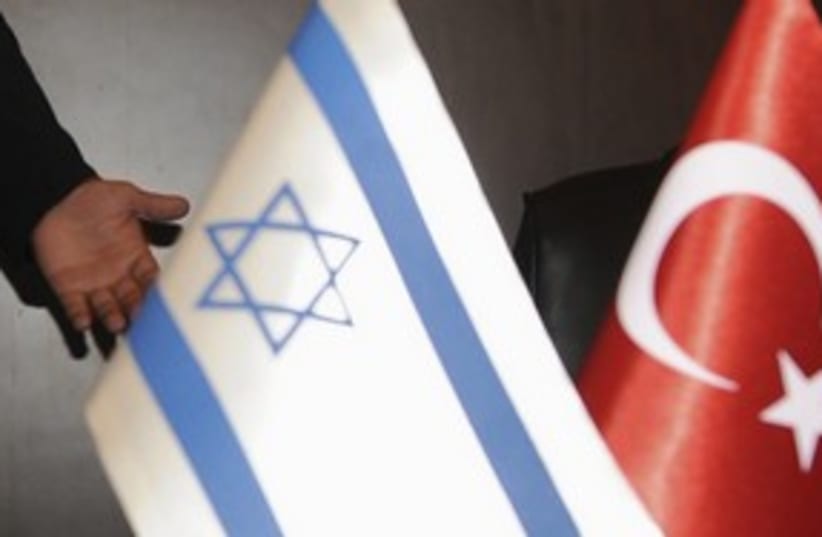
By YAAKOV KATZIsraeli and Turkish flags 311 (R)(photo credit: REUTERS)
It is easy to judge Israeli-Turkish relations by what we all can see – military exercises have come to an end and defense exports to what was once one of Israel’s best customers are almost completely frozen.There is also, of course, the diplomatic fallout from the current crisis which makes Israel even more isolated in an already extremely volatile Middle East.RELATED:Security cabinet meets to ‘contain crisis’ with Turkey'Erdogan visit to Gaza would hurt Turkey-US ties'There are, however, greater ramifications that Israel does not yet know how and if they will play out.For Israel, Turkey was more than just a country with airspace and waters in which to train. It was a partner in the war on terror and a confidant when it came to sensitive intelligence information regarding attacks against Israel or terrorist plans throughout the region.One example was in 2009 when the media reported about the thwarting of terrorist plans to shoot down an Israeli airliner over Turkey with shoulder-to-air missiles.The scheme was apparently an effort by Hezbollah to avenge the 2008 assassination of its military commander Imad Mughniyeh in Damascus, which the Lebanese guerrilla group attributed to the Mossad.Other examples include the recent grounding of Iranian transport aircraft in Turkey earlier this year that were allegedly carrying weaponry destined for Hezbollah, and the seizure of some 300 Iranian rockets aboard a freight train on its way to Syria via Turkey in 2007.There was also the alleged Israeli strike four years ago this month against the nuclear reactor President Bashar Assad was building in northeast Syria.
After the bombing and as they lit their boosters to evade Syrian air defense missiles, the Israel Air Force fighter jets dropped their supplemental fuel tanks over Turkish territory. While the Turks, who were accused of allowing Israel to use its airspace, made a fuss and asked Israel for clarifications, the event was quickly shelved in the interest of both countries.In short, Israel could be losing not only a diplomatic and military ally but also a partner in the war on terror.This could mean that Israel will not have someone to pass on information to in the event that it knows of plans to perpetrate attacks in Turkey or elsewhere in the region, and that the Turks might no longer have as strong an interest in intercepting weapons shipments that may pass through their country on their way to Iran’s various terror proxies.Israel has already voiced concern over the appointment last year of Hakan Fidan as Ankara’s intelligence czar. Fidan, who heads Turkey’s National Intelligence Agency, is believed to have strong ties with Iran and there has been concern, since his appointment last summer, that information Israel passes on to Turkey makes its way elsewhere as well.What happens next in the ongoing Israel-Turkey saga is unclear.Both countries have national pride at stake that will likely continue to play a role in the inability to reach a compromise that would end the crisis. Turkey has threatened to deploy its navy in the eastern Mediterranean to accompany future aid ships to Gaza. Senior defense officials said Sunday that while they did not believe the threat would materialize, it was a direct challenge to Israeli sovereignty and could not be easily ignored.On the other hand, though, the involvement of the United States in Turkey and the country’s continued membership in NATO likely means that the crisis will not develop into something larger, like a military confrontation.The same day that Ankara said it was reducing ties, it also announced that it had agreed to deploy an advanced American radar in its territory as part of the US’s European missile defense shield. With Israel and Turkey failing to reach a compromise, it might be up to the Americans to play a more active role in getting their two strongest allies in the region back together.
if(catID != 151){
var cont = `Take Israel home with the new Jerusalem Post Store