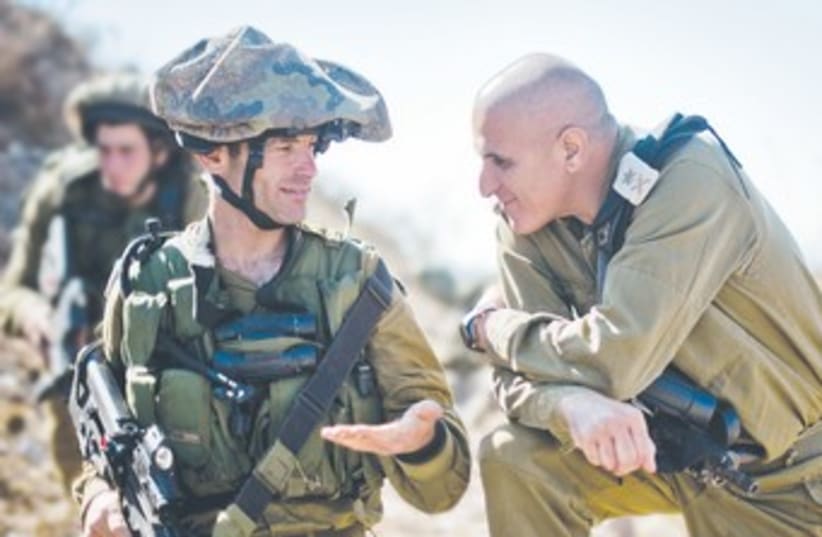
Maj.-Gen. Sami Turgeman tells ‘Post’ of preparations army has made for next ground offensive.
By YAAKOV LAPPINMAJ.-GEN. SAMI TURGEMAN speaks with a soldier 370(photo credit: IDF Spokesman’s Office)
Maj.-Gen. Sami Turgeman, outgoing head of the IDF’s Ground Forces, sat at his desk at General Staff Headquarters in Tel Aviv last week, and spoke of the satisfaction he felt at what he had achieved over the past three-and-half years.When Turgeman took over the Ground Forces in 2009, the army was still reeling from its performance during the 2006 Second Lebanon War, a conflict that served as a painful reminder that it had grown too accustomed to counter-terrorism and security missions in the West Bank, and had neglected preparations for ground operations against Hezbollah.Turgeman oversaw a process aimed at getting the Ground Forces back in shape for an effective and speedy maneuver in southern Lebanon in case of renewed hostilities, based on the premise that only a ground offensive would decisively defeat the Shi’ite terrorist organization, which is armed with over 60,000 rockets. The same preparations will serve the army in case it is ordered to retake the Gaza Strip, if Hamas and Islamic Jihad renew rocket attacks on Israel.Since 2006, Turgeman noted, the army has doubled its battle training time for ground forces, for both regular and reserve brigades. The IDF is also equipped with a greater number of Mark 4 tanks, and Namer (“Leopard”) heavy armored personnel carriers, which will ferry infantry soldiers into enemy territory.“From 2000 to 2006, the army dealt with combating terrorism in Judea and Samaria,” Turgeman said. After the shortcomings of the 2006 conflict with Hezbollah, “we learned lessons,” he added.“Seven years have passed since. We’ve seen ground forces in operation during Operation Cast Lead [in Gaza, January 2009], and we’ve seen them mobilized in Operation Pillar of Defense [in November 2012]. I can say that we have units ready for their missions,” he said.To ensure maximal readiness, Turgeman has instructed all commanders to assume that war will break out on their watch. He told them to ensure that all of their activities are “preparations for war.”“Hence,” he told The Jerusalem Post, “they are getting ready, training, and carrying out very difficult exercises. In the rain and in the cold, so that all of the units are ready.”An example of this stepped-up training could be found on the Golan Heights last week, where tanks from the 401st Armored Brigade held a war drill just days after soldiers from the Nahal infantry brigade were suddenly mobilized to the Golan to simulate the outbreak of a conflict.“This is the standard. There are many surprises [in the training].They [the IDF soldiers] shouldn’t think they will know what will be,” Turgeman said.“We expect difficult combat. The enemy is doing all that it can to build capabilities that will increase its advantages. It is investing in defense,” he added.The ultimate aim, Turgeman pointed out, is to deal a difficult blow to the terror organization, one which will take it many years to recover from.With Hezbollah and Hamas both in possession of large numbers of rockets threatening the Israeli home front, any conflict must be won quickly and decisively, and a ground offensive is the best way to achieve this, Turgeman holds.“We have increased intelligence and surveillance capabilities. We have more deadly fire power, including new shells and rockets.Our mobility has increased, and we have more new tanks and Namer [APC]s,” he stated. “We are ready.”This week, Turgeman will become the head of the IDF Southern Command.
if(catID != 151){
var cont = `Take Israel home with the new Jerusalem Post Store