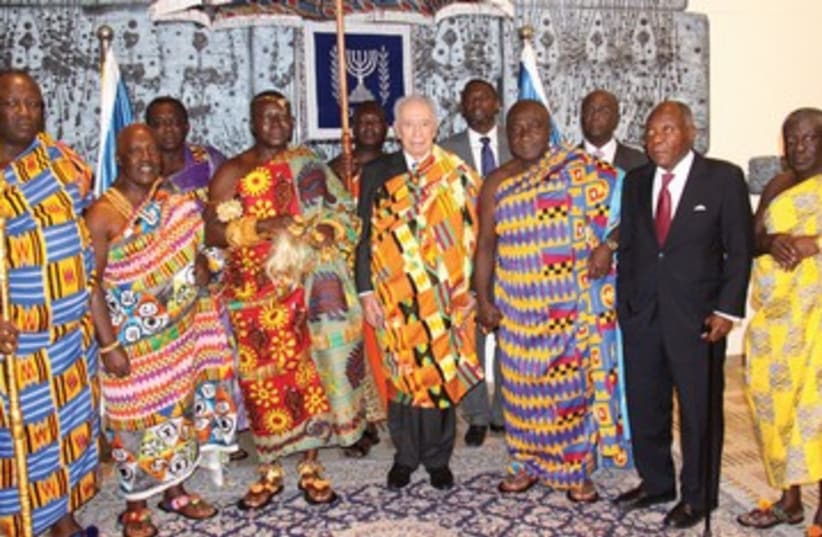
Ghanaian monarch thanks Save a Child’s Heart project for healing youngsters from his country.
By GREER FAY CASHMAN, JUDY SIEGEL-ITZKOVICHPeres with Ghanaian monarch African garb 390(photo credit: Yosef Avi Yair Engel/GPO)
In the week he has been touring Israel from the Golan Heights to the Sinai, visiting high technology plants, water desalination projects and hospitals, His Majesty King Otumfuo Osei Tutu II of the Asante people of Ghana has usually opted to wear either a suit and tie or sports clothes. But when he called on President Shimon Peres at his Jerusalem residence on Sunday morning, he and most of his entourage came in the full regal splendor of his kingdom, wearing colorful toga-like robes and many gold chains.The King himself was bedecked with armbands, bracelets and heavy rings of gold, and wore gold sandals.He also sported a circle of colored beads with a gold talisman on his head. His spokesman carried a gold scepter, and stood as the monarch spoke, shouting the word “Yong” each time the king finished a sentence.According to a member of his nine-person delegation, this is the traditional manner of notifying the people that the king is speaking.King Osei Tutu presented Peres with a robe no less splendid than his own and Peres cheerfully put it on and posed for photographs. Aside from the regular press photographers, the president’s staff was entranced with the change in his appearance and photographed him with their cell phone cameras.In addition to the gift, King Osei Tutu brought greetings from President John Atta Mills, who is looking forward to coming to Israel and issued a reminder that the invitation for Peres to visit the Republic of Ghana is still open. This prompted Peres to reminisce about having visited the country at David Ben-Gurion’s behest soon after Ghana gained independence 55 years ago.Peres had been very impressed by Ghana’s first president Kwame Nkruma, who had lived in America for ten years. Prior to leaving Ghana, Nkruma had a problem with his teeth, which he attended to in America. Thus when he came home to his village, Peres recounted, his mother did not recognize him and said he was not her son, who was still in America. But Nkruma had proof: he had been born with an additional finger – and this was all his mother needed to know that her son had returned.Ghana was the first African country to enter into diplomatic relations with Israel, and Israel was helpful to Ghana in developing the country’s agriculture.Together with India, Israel also assisted in the establishment and training of Ghana’s air force. Ghana severed diplomatic ties with Israel in 1973 in the wake of the Yom Kippur War, and renewed them less than a decade ago, although it took Israel somewhat longer to reopen its embassy there.Israel’s Ambassador to Ghana, Sharon Bar-Li, presented her credentials to Mills in September of last year and told Peres that the first visa to Israel that she issued was for King Osei Tutu.Among the members of the king’s entourage was Kobina Annan, a former Ghanaian ambassador to Morocco who is also the brother of former UN secretary-general Kofi Annan, with whom Peres is very well acquainted and to whom he sent his warmest regards.What is happening in Syria, said Peres, is not a failure on Kofi Annan’s part. “No one can stop the guns.”Congratulating the king on on his country’s accomplishments, Peres said, “What you have done in Africa is unique.Ghana is considered to be the most advanced country in Africa, not only because of the work of the people but also the wisdom of the leaders.”Peres lauded Ghana as having the best economy in Africa and being an emerging hope.“For us the success of Ghana is a correction of history,” he said, noting that Africa had suffered for a long time under foreign rule – only now beginning to emerge from its difficult past and enjoy equal rights, independence and respect.King Osei Tutu, whose higher education was obtained in London, is an accountant by training and an economist by experience. He has worked as a senior consultant for the Mutual of Omaha Insurance Company of Toronto, as finance officer at the British firm Oxo in London and as personnel administrator at the Manpower Services Commission attached to the Brent Council in London. His kingdom of eight million subjects used to be independent but is now a region in Ghana. In power for the past 13 years, the king is regarded as the strongest traditional ruler in Africa. He was a guest of the Foreign Ministry and his country’s embassy, and came at the invitation of businessman Eytan Stibbe, one of several Israeli businessmen with interests in Ghana.The king thanked Wolfson Medical Center’s Save a Children’s Heart (SACH) project for repairing the hearts of dozens of youngsters from his country.Visiting the Holon hospital at the end of last week, he had learned how the voluntary organization functions and visited children from Ghana, Angola, Zanzibar, Tanzania, Zimbabwe and Uganda who are being treated surgically for life-threatening congenital heart defects. He said he was very impressed and thanked the approximately 70 people in the medical team for their work.Israel is currently building a hospital in Ghana, and the king was hopeful that Ghanaian doctors would be able to come to Israel for additional specialized training. Ghana is also seeking cooperation in technological training and hopes to attract more Israeli investors.The king, who is primarily interested in economic, health and peace issues, told Peres that he supports the Ghanaian government of the day in these areas, but stays away from politics.
if(catID != 151){
var cont = `Take Israel home with the new Jerusalem Post Store