Netanyahu's speech at the UN General Assembly will explain uncertainty of new Middle East, how that translates to Israeli national security.
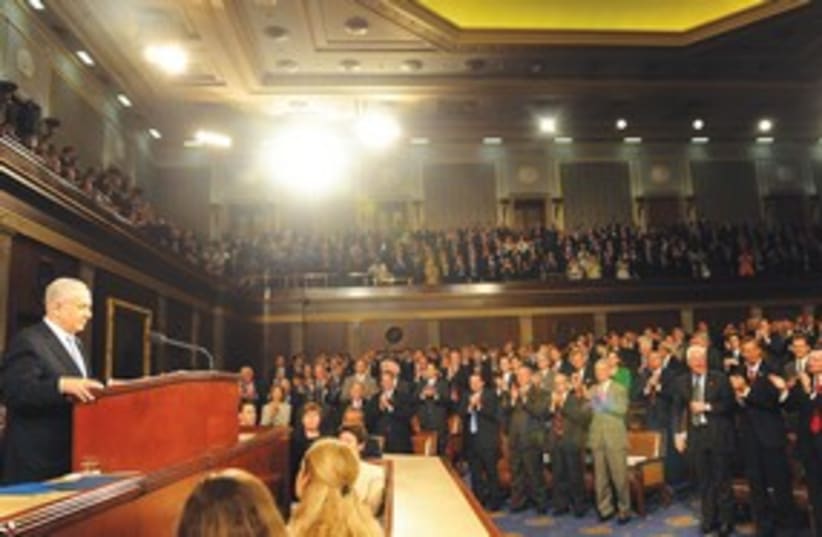
By HERB KEINONNetanyahu addresses Congress 311(photo credit: Avi Ohayun/GPO)
Prime Minister Binyamin Netanyahu's critics, and they are legion – both here and abroad – charge he has no strategy, neither a long term strategy vis-à-vis the Palestinians, nor a short term one regarding how to withstand Friday's predicted UN "earthquake" that will trigger a diplomatic "tsunami."But they're wrong. He does have a strategy, it's just not of the I'm-going-to-pull-a-peace-initiative-out-of-the-hat variety that will knock everyone's socks off and revolutionize the Middle East. His strategy is much less spectacular, more plodding, even dull. It's not the razzle-dazzle of ice hockey; but rather the boredom of curling.RELATED:Davutoglu: We don’t need US help for Israel crisisUS President Barack Obama: Gaddafi regime 'over'Netanyahu's strategy is to explain. Explain, explain, explain. He is a man of words. He loves to read, and to speak – some less charitable would say he loves to lecture. And he believes in the power of words, of oratory, of rhetoric.So when the prime minister left Israel for the UN late Tuesday night he did not carry in his computer a Power Point presentation with a list of Israeli initiatives that he intends to unfurl at the UN or in meetings with US President Barack Obama, or –perhaps – with Palestinian Authority President Mahmoud Abbas.
Rather he is carrying a speech to explain to the world what he feels much of it fails to see: that the Middle East has changed; changed radically, and changed fundamentally. At Sunday's cabinet meeting Netanyahu explained why he decided, after weeks of deliberation, to go to the UN himself and combat the Palestinian Authority's statehood recognition move. "My UN trip will have a double goal," he said "The first goal is to ensure that this move to bypass negotiations does not succeed and is stopped in the Security Council." The second goal, he said, is to present the truth about "our desire for peace" and Israel's historic rights to the country that go back "only 4,000 years." And then he cut to the chase: "I will also speak about our intention to achieve peace with our neighbors while ensuring our security. If this was clear and necessary in the past, then today it is even more important. Especially now, when the Middle East is undergoing a great upheaval, from Tunisia to Yemen, from Libya to Egypt, Syria and throughout the region; when we don't know what tomorrow will bring, or how things will turn out."Netanyahu's strategy is to explain to the world that the pre-February 11 Middle East, the one that existed before Hosni Mubarak was brought down in Egypt, is as different from the post February Middle East as the Ottoman Middle East was different from the one that emerged after the re-shaping of the region following World War I. He will explain that since everything has changed, and is continuing to change, past assumptions about what is and what is not possible must be re-examined. He will explain that while the Arab revolution has shown what the Arabs are against – corruption, bad government, dysfunctional regimes – it hasn't revealed yet what they are for, nor what will emerge. He will explain the need for caution, for not rushing head-long into anything, because who knows what tomorrow will bring. In his speech to the US State Department on May 19, Obama said of the Israeli-Palestinians issue that the world was looking at a conflict that has "grinded on for decades, and sees a stalemate. Indeed, there are those who argue that with all the change and uncertainty in the region, it is simply not possible to move forward.I disagree. At a time when the people of the Middle East and North Africa are casting off the burdens of the past, the drive for a lasting peace that ends the conflict and resolves all claims is more urgent than ever."Among those arguing at the time that it was impossible to move swiftly forward was Netanyahu. And that was then, four months ago, when for so many the Arab Spring still held out such great promise.In the interim, the revolution has lost much of its early bloom, and – as Netanyahu cautioned in the early days – it is apparent that its guiding lights are not necessarily the descendants of John Locke and Jean-Jacques Rousseau.Netanyahu will argue to anyone who will listen that what he said then -- about the need to see where the dust settles, who will gain control , what new alliances emerge -- is truer now that the nasty side of the revolution is starting to emerge.Last September, during those few days when Netanyahu and Abbas did speak for a few hours, the Prime Minister told Abbas that Israel would need a military presence along the Jordan River for a long period of time. When Abbas asked Netanyahu why, the prime minister replied that one never knows what could happen, and that a presence on the Jordan River – to protect against any untoward developments from the east – was a necessity. And that was before the fall of Hosni Mubarak, the chaos in Syria, the uncertainty in Jordan, and the rift with Turkey.How much truer is it now, he will argue, how much more caution is needed now, than in the past, because who really knows what will develop. If Fatah can lose control of Gaza to Hamas in a matter of weeks, if the Egyptians leadership can now talk about re-visiting and perhaps trashing a 30-year peace treaty, then previous assumptions and strategies and ways of doing business need to be re-thought. Netanyahu will not advocate thinking out of the box, he will advocate destroying the box completely because it is no longer relevant, and that what is needed is to build a new box altogether.Netanyahu's strategy is to explain this to the world, over and over and over again, be it from the plenum of his home turf in the Knesset, to the rostrum in the friendly US Congress, or at the podium of the unfriendly UN. That's his strategy for the short term at the UN – to explain why recognition of a Palestinian state would only serve to destabilize an already reeling region – and for the long term, why Israel should not be expected, or pressed, to take any giant steps at a time when the Middle East's tectonic plates are shifting.Israel must step ever so lightly, he will say, or risk falling through the emerging cracks and into the abyss. That's his strategy, and that will be his message.Whether it's enough, however, is a different question entirely.
if(catID != 151){
var cont = `Take Israel home with the new Jerusalem Post Store