IDF must stay in Jordan Valley, PM tells US lawmakers
Netanyahu tells 7 visiting US congressman that any peace agreement with the Palestinians must include a long-term Israeli presence along the Jordan River.
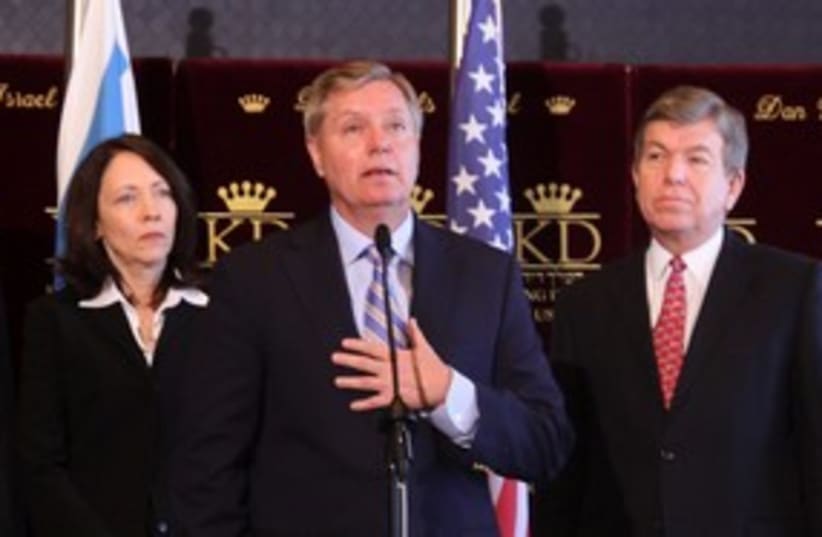
By HERB KEINON, JOSHUA HAMERMAN, TOVAH LAZAROFFUS Senator Lindsay Graham in Jerusalem 311(photo credit: Marc Israel Sellem)
Any peace agreement with the Palestinians must include a long-term Israeli presence along the Jordan River, Prime Minister Binyamin Netanyahu told a visiting delegation of seven US congressman on Wednesday.That presence would protect Israel from the importation of terrorists from Jordan into a Palestinians state, he said, reiterating something he has been talking about for months.RELATED:PM to meet US rep. threatening to block funds from PA'Annexation for declaration' idea advancing in KnessetHe added a new element at Wednesday’s meeting, saying the IDF would have to deploy an anti-missile defense system along the western border of a Palestinian state, to protect Israel from the type of homemade rockets that have been fired for years from Gaza at communities in the South.Newsweek published a story in December claiming that Netanyahu had told the Palestinians that in addition to a presence in the Jordan Valley, Israel would want IDF troops stationed along territory on the “Palestinian side” of the West Bank security barrier, to protect the country’s “narrow waistline.”It was not made clear in his meeting with the congressmen where exactly he intended to place the antimissile batteries. The prime minister thanked the delegation for the recent approval of another $205 million for the Iron Dome anti-missile system.During the meeting, Netanyahu also discussed apparent Palestinian plans to ask the UN General Assembly in September for recognition of statehood, saying that a strong American position against the move was necessary, and that Washington should make it clear to the Palestinian Authority that it would only achieve statehood through negotiations.If that position was presented strongly by the US, and received international support from “fair minded countries,” then it could take the sting out of any negative UN resolution, Netanyahu said.The expectation in Jerusalem is that if the US, which has come out unequivocally against the move so far, stays on this course, then countries in Europe and other parts of the world will follow suit.Asked by the US lawmakers what messages they should bring the Palestinians, with whom they were to meet later in their visit, Netanyahu enumerated three: Meet and negotiate with Israel; don’t go for unity with Hamas; and that they would lose US support if they went “in the wrong direction.”Regarding Egypt, Netanyahu said he was troubled by some of the voices coming out of Cairo calling for cancellation of the Israeli- Egyptian peace treaty. He told the delegation it was incumbent upon the international community to express a clear expectation that any Egyptian government honor the treaty.Speaking with reporters after the meeting, Sen. Lindsey Graham (R-South Carolina), who sits on the Senate’s Armed Services and Budget committees, sent a warning to Egypt regarding its treaty with Israel.Although he praised the Egyptian people who took to the streets out of a desire for democracy and a better life, he said that they would send the wrong message by then breaking a long-standing peace treaty with a neighboring state.“It would be a huge mistake for the Egyptian people to go down that road in my view, and when it came to future American assistance, it could be a fatal mistake,” Graham said.Earlier this week a poll by Pew Research Center’s Global Attitudes Project showed that 54 percent of Egyptians want to cancel the peace treaty with Israel.Only 36% percent said it should be maintained.Netanyahu urged the delegation to do everything in its power to provide assistance to the people of Egypt, Tunisia, Jordan and other countries in the region experiencing unrest, Graham said, adding, “I think he’s right.”Sen. Roy Blunt (R-Missouri) said Wednesday’s attack on a gas pipeline in Sinai leading to Israel and Jordan was “not a huge shock,” but that Egypt would “suffer if it loses the client base of Israel as a customer.”When asked about the US participation in the Multinational Force and Observers peacekeeping force in Sinai, Sen. Kelly Ayotte (R-New Hampshire) said that such observers could play a larger role in the region.“I think these international observers have played a vital role in the Sinai, and I would be asking, given the unrest and change happening in the entire region, if there is a bigger role for such an organization as observers to help with stabilization,” Ayotte said.Commenting on the Syrian crackdown on anti-regime protesters, Graham called for economic and diplomatic sanctions and said the US should recall its ambassador from Damascus.He added, however, that “I don’t believe military action is on the table at this point.”With regard to Libya, Graham said the US needed to give the rebels there more arms, training and logistical support, and should use Predator drone aircraft to bring the war to a close.“NATO lost a lot of capability to help the opposition forces in Libya, so I would urge the [Obama] administration to start using American aircraft. Predators being injected into the fight will pay dividends,” he said He added he believed that US financial assistance in the Middle East, including to Israel, was vital to American national security.Still, Graham said, it was always possible to find a way to make budget cuts.“We’re providing money to the UN Human Rights Council. To me, that’s a good place to reduce assistance.”The delegation members spoke of the US’s unwavering support for Israel. They rejected both Palestinian unilateral moves for statehood at the United Nations and the Palestinian attempt to set the border of that state squarely on the pre-1967 lines.“From my point of view, I can never imagine an agreement that goes back to the ’67 boundaries, because in my view those boundaries are indefensible,” Graham said.“The purpose of this trip is to try and reinforce from my point of view the unwavering support that the State of Israel has in Congress. Quite frankly, Congress has Israel’s back. It is very important for the people in Israel to know that their national security interests are legitimate.”Graham also heaped praise on PA Prime Minister Salam Fayyad’s state-building measures, but said that the only path to statehood was through negotiations.“To our allies out there who think that some kind of UN-sanctioned state is going to solve all the problems, you are doing more damage than good,” he said.In speaking with The Jerusalem Post after the meeting Rep. Kay Granger (RTexas) said that if the Palestinians refused to return to the negotiating table with Israel, withdrawing US funding would be a option, but that it was still too early to consider that.
if(catID != 151){
var cont = `Take Israel home with the new Jerusalem Post Store