Israel’s Turkish dilemma: To lead with head or heart?
Analysis: Open Knesset debate over officially recognizing Armenian genocide was gut responding to deteriorated Turkish-Israeli ties.
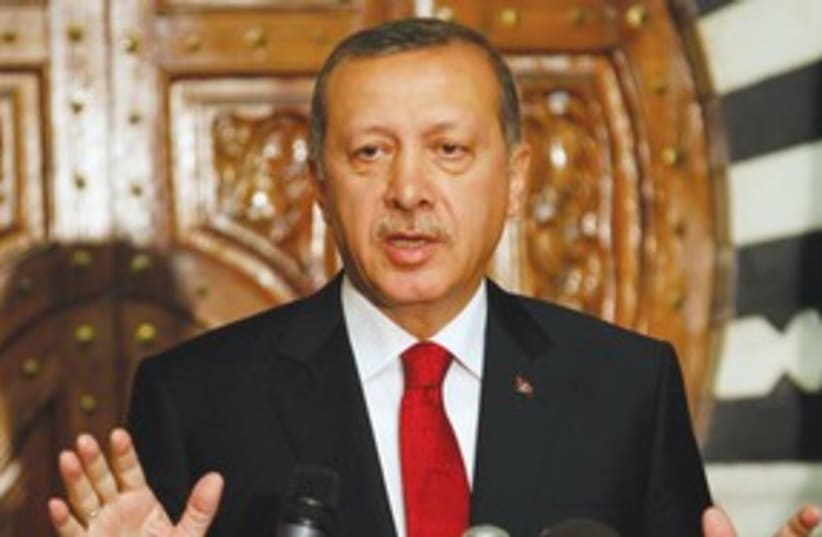
By HERB KEINONTurkish Prime Minister Recep Tayyip Erdogan_311(photo credit: Reuters)
After listening to Turkish Prime Minister Recep Tayyip Erdogan use Israel as a rhetorical whipping boy for years; after seeing Turkish militants with metal bars attack Israeli commandos enforcing a legal naval blockade of Gaza; after hearing the Turks threaten to deploy warships to accompany another flotilla to Gaza; after watching Ankara unceremoniously show Israel’s ambassador the door; after taking note of Erdogan saying Israel has killed “hundreds of thousands” of Palestinians, the gut simply wants to say, “To hell with Turkey.”The mind, however, has a different take. It thinks back 10-15 years to the golden age of Turkish-Israel strategic ties and hopes to recapture some of that magic. It says the US is keen on Israel and Turkey repairing their broken relationship because that is something very much in Washington’s regional interest.RELATED:Opinion: Israel-Turkey relations and the silent revolution The mind says efforts should be made to stem the negative momentum with Turkey since it is a significant power in the region, whose influence is only growing with the uncertainty of the Arab revolutions throughout the Middle East.For all those reasons, the mind says there is no reason to gratuitously anger Ankara.The decision to hold an open debate in the Knesset Education Committee Monday to discuss whether Israel should officially recognize the Armenian genocide was the gut speaking. The position of the Foreign Ministry presented at the committee – that this is a sensitive political issue better left for another day – was the mind having its say.And while the inability of the Knesset committee to come to a decision indicates that there is not yet a clear winner in this battle between emotion and reason, both of which are legitimate, the Foreign Ministry’s position showed that despite all the affronts and insults Israel has suffered at the hands of Turkey in recent months, Jerusalem still wants to keep the door to Turkey ajar for another day.Some could argue, with justification, that recognizing as genocide the Turkish murder of 1.5 million Armenians in the waning days of the Ottoman Empire is a moral issue, and that the Jewish people, who have suffered genocide, should be the first to recognize and loudly condemn it when it happens to others.Besides, this argument could run, what are the Turks going to do in response? Back in 2007, when ADL National Director Abe Foxman merely reversed his organization’s policy and said that what the Turks did to the Armenians was “tantamount to genocide,” Israel was mightily concerned that this could seriously harm Israeli-Turkish ties. But is it really worried today that such a move would harm Israeli-Turkish relations? Isn’t the relationship already at rock-bottom? What more is Turkey going to do? It is illustrative to see how Erdogan reacted when France’s lower house of parliament voted last week to criminalize the denial of the Armenian genocide.Erdogan proceeded to recall Turkey’s ambassador to France and cancel bilateral political, economic and military activities with France.He also said French requests for military overflights of Turkey would be dealt with on a case-for-case basis, and warned of future steps.In effect, he was just taking pages out of a playbook he already used against Israel.He took those same steps when Jerusalem refused in August to apologize – as he demanded – for the Mavi Marmara incident of May 2010 when nine Turks were killed trying to break the Gaza naval blockade.The Turks kicked out Israel’s ambassador, stopped military overflights and canceled some military contracts.Erdogan, as well as Turkish President Abdullah Gul and Foreign Minister Ahmet Davutoglu, bashed Israel from every rooftop, including throughout the Arab world. If that wasn’t enough, Erdogan also threatened a “Plan B.”So what’s left? Sure, Erdogan could precipitate a military conflict by carrying out his threat to send warships to Gaza, but is that really what Turkey – which has gone from a stated policy of “no problems” with its neighbors, to major problems with Israel, Syria, Cyprus, Armenia and France – wants to do?
It isn’t the fear of an immediate Turkish reaction that motivated the Foreign Ministry’s cautious approach to the Armenian genocide issue, but rather the desire not to burn the bridges with Ankara entirely. It’s one thing for the Defense Ministry to scuttle the sale of advanced intelligence systems to the Turkish Air Force, as was done last week, because of fear that the technology could find its way into Iranian hands, and quite another to take action on the Armenian genocide issue.The scuttling of the arms pact is a concrete Israeli vote of no confidence and no trust in Erdogan and his government. The Foreign Ministry’s message to walk gently on the genocide issue is an expression of Israel’s hope that “this too shall pass,” that Erdogan won’t be around for ever, and that somewhere down the line it will be possible to repair – though perhaps not fix entirely – the relationship with Ankara. And in that case, the Foreign Ministry is reckoning, it won’t help to have the Armenian genocide issue standing in the way.
if(catID != 151){
var cont = `Take Israel home with the new Jerusalem Post Store