Right-wing politicians press PM to approve report calling for the legalization of unauthorized Jewish West Bank construction.
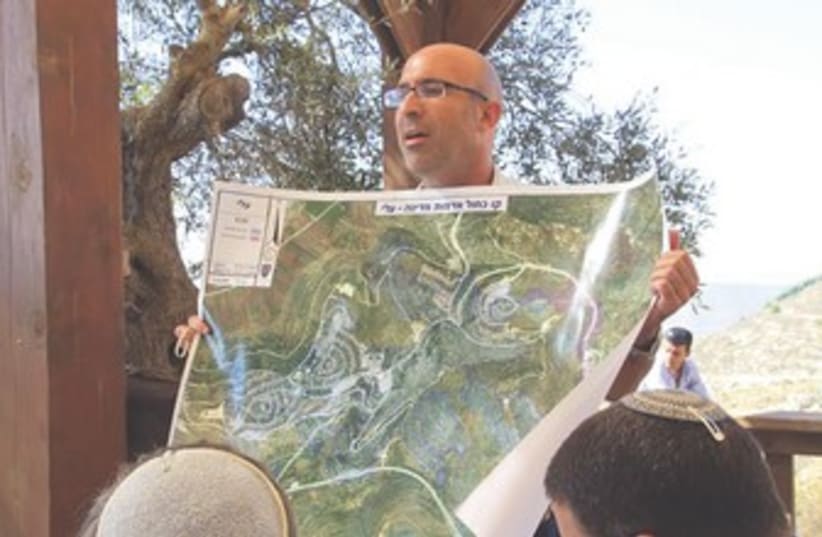
By TOVAH LAZAROFFKoby Elraz shows map of his settlement 370(photo credit: Tovah Lazaroff)
Right-wing politicians on Sunday called on Prime Minister Binyamin Netanyahu to approve the Levy Report, which called for unauthorized Jewish West Bank building to be legalized when possible.“It is an important report that will allow me and other ministers to implement [projects] that are difficult to do now,” Transportation Minister Israel Katz (Likud) said.He was among a group of 11 politicians, mostly from the Likud, from the Knesset Land for Israel Lobby who visited the Amona outpost (near the Ofra settlement), which is danger of demolition. They also visited the Eli settlement to hear first hand the problems Jewish communities in Judea in Samaria face, because construction is unauthorized.Peace Now and Yesh Din – Volunteers for Human Rights have for years waged many legal battles in an effort to force the state to remove illegal Jewish West Bank construction, particularly building on private Palestinian property.But settlers have argued that only politics has prevented the authorized of buildings, which could otherwise be legalized. They have also said that some of the land has been misclassified as Palestinian property. In instances where the land does belong to Palestinians, they said, compensation should be given.In July, the government-sponsored Levy Report on outposts was submitted to Netanyahu and the Ministerial Settlements Committee.The report was penned by three legal experts: former Supreme Court justice Edmund Levy, former Foreign Ministry legal adviser Alan Baker and former Tel Aviv District Court deputy president Tehiya Shapira.It argued that the government must solve the issue of unauthorized Jewish West Bank construction, by legalizing the building when possible, and creating a legal system to deal with land disputes.Netanyahu said the settlements committee would soon discuss the report, but it has yet to do so.During the trip, coalition chairman Ze’ev Elkin (Likud) and MK Arieh Eldad (National Union) both said that three months after the report’s publication, there was no reason to continue with past policies with regard to outposts.They condemned those policies, which they called draconian.Amona Rabbi Yair Frank asked the politicians not to “rest or sleep” until his community was authorized.In Eli, council head Koby Elraz explained to the politicians the difficult situation his community is in because it lacked proper authorizations.Eight petitions have been filed to the High Court of Justice against the settlement, he said. Even though it was established in the early 1980s, it does not have a zoning plan, he said.Only at the end of July, did the Civil Administration of Judea and Samaria determine the status of the land and set its boundaries, Elraz said. But it was years before a zoning plan could be approved, he said.The only way to protect the settlements from losing the court petitions, he said, was to approve the Levy Report.Otherwise, the settlement remains vulnerable, because it lacks a zoning plan, he said.
Related TagsYesh DinAmona
if(catID != 151){
var cont = `Take Israel home with the new Jerusalem Post Store